
The Writing of News A Handbook with Chapters on Newspaper Correspondence and Copy Reading
Charles G. (Charles Griffith) Ross
THE CLASSIC COLLECTION · 1894
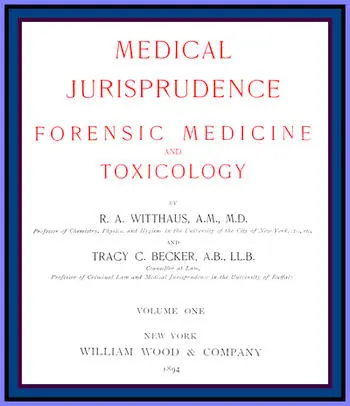
"Medical Jurisprudence, Forensic Medicine and Toxicology. Vol. 1" by R. A. Witthaus et al. is a scientific publication written in the late 19th century. This comprehensive work serves as a fundamental reference for the intersection of medicine and law, particularly focusing on how medical knowledge applies in legal contexts. The book explores various aspects of medical jurisprudence, forensic medicine, and toxicology, aimed at practitioners in both legal and medical fields, as well as scholars interested in legal medicine’s historical and practical significance. The opening of the volume sets the stage by delineating the key topics—medical jurisprudence, forensic medicine, and toxicology. It discusses the historical development of these fields, illustrating the evolution of the legal relationships between medical practitioners and the law. The introduction emphasizes the necessity for legal definitions regarding medical practice, the rights and duties of physicians, and the importance of providing expert testimony in legal cases. This section serves not only as an academic foundation but also as a practical guide for understanding the statutory landscape governing medical practice and its implications for both physicians and patients.
Introduction adapted from the source catalogue; source summaries may be automatically generated.
Free to read · English · 310,507 words · No account needed
MAKE TIME FOR A GOOD BOOK
On by default. Untick to stop anonymous reading totals. Each page counts after 10 seconds in view. How this works.
Anonymous counting is on unless you have switched it off.
Public officers and their assistants, and their deputies of every county, city, town, or other municipality, or of every prison, chain gang, penitentiary, county morgue, public hospital, having control of dead body to be buried at public expense (not dying of infectious disease) shall deliver same to medical college for dissection, etc., unless claimed by friends or relatives or such friends or relatives request same to be buried, or unless deceased was a stranger or traveller (Laws, 1887, vol. 2, p. 77).
Removal of body from grave, etc., unlawfully for dissection or sale is felony, or receiving or purchasing it knowing it to have been so taken, or trafficking in dead bodies, or having them conveyed without the State for sale, etc., is a felony (Laws, 1882, vol. 2, p. 87).
Coroner to hold inquest, etc., and may exhume it for that purpose (R.
L., sec. 8,377).
Coroner to bury body decently when not claimed by relatives, etc., and if necessary, at expense of county (R. L., sec. 2,081).
Removal of body unlawfully or aiding in such removal is punishable as a felony—one to ten years (S. & C. Am. Stat., vol. 1, p. 794).
Coroner to hold inquest, etc. (S. & C. Am. Stat., vol. 1, p. 606).
And to deliver body to friends or bury decently if no friends claim it, if necessary at county expense (S. & C. Am. Stat., vol. 1, p. 606).
Body of executed criminals may be delivered to any physician or surgeon for dissection unless friends object (S. & C. Am. Stat., vol. 1, p. 869; Crim. Code, sec. 503).
In cities and counties where population exceeds one hundred thousand, superintendents of penitentiaries, wardens of poor-houses, coroner, city undertaker, having body required to be buried at public expense, may deliver remains to medical college or any physician or surgeon for dissection, unless claimed by relatives (S. & C. Am. Stat., vol. 3, p. 867).
Removal of dead body or part of same unlawfully is a felony (R. L.,
sec. 2,165).
Concealment of body or part thereof, which has been unlawfully used for dissection, is a felony (R. L., sec. 2,167).
Receiving or buying a body knowing it to have been unlawfully disinterred is a felony (R. L., sec. 2,168).
Dead body of one dying in a State, city, or county prison or jail, or county asylum or infirmary or public hospital, or dead body of an executed criminal, or dead body of a vagrant, or one killed while committing a felony or escaping from prison or officers, may be delivered to the faculty of a medical college in State for dissection, etc., unless deceased requested to be buried or body is claimed by next of kin (R. L., sec. 4,258 et seq.).
Your reading position is saved on this browser. Take it to another device with a library code. Reading pages adapt to text, rather than matching a printed edition.
BEHIND THE BOOK
This eBook is for the use of anyone anywhere in the United States and most other parts of the world at no cost and with almost no restrictions whatsoever. You may copy it, give it away or re-use it under the terms of the Project Gutenberg License included with this eBook or online at www.gutenberg.org. If you are not located in the United States, you will have to check the laws of the country where you are located before using this eBook. Read the source licence.
The original source file, including credits and licence, is retained by this library. Request an original-format copy at no charge. Please include the book title and Project Gutenberg identifier #49027.
KEEP YOUR CURIOSITY GOING
Charles G. (Charles Griffith) Ross
Hannah Webster Foster

Emily Lawless
Edwin Hamlin Carr

Charles De Lano Hine
Andrew Ure