
The Writing of News A Handbook with Chapters on Newspaper Correspondence and Copy Reading
Charles G. (Charles Griffith) Ross
THE CLASSIC COLLECTION · 1894
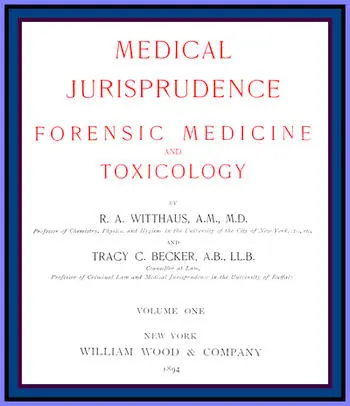
"Medical Jurisprudence, Forensic Medicine and Toxicology. Vol. 1" by R. A. Witthaus et al. is a scientific publication written in the late 19th century. This comprehensive work serves as a fundamental reference for the intersection of medicine and law, particularly focusing on how medical knowledge applies in legal contexts. The book explores various aspects of medical jurisprudence, forensic medicine, and toxicology, aimed at practitioners in both legal and medical fields, as well as scholars interested in legal medicine’s historical and practical significance. The opening of the volume sets the stage by delineating the key topics—medical jurisprudence, forensic medicine, and toxicology. It discusses the historical development of these fields, illustrating the evolution of the legal relationships between medical practitioners and the law. The introduction emphasizes the necessity for legal definitions regarding medical practice, the rights and duties of physicians, and the importance of providing expert testimony in legal cases. This section serves not only as an academic foundation but also as a practical guide for understanding the statutory landscape governing medical practice and its implications for both physicians and patients.
Introduction adapted from the source catalogue; source summaries may be automatically generated.
Free to read · English · 310,507 words · No account needed
MAKE TIME FOR A GOOD BOOK
On by default. Untick to stop anonymous reading totals. Each page counts after 10 seconds in view. How this works.
Anonymous counting is on unless you have switched it off.
=No Particular Schools Recognized by the Courts.=—The general trend of the decisions in all the States, whenever any questions in reference to schools of medicine have been before our courts, is to avoid recognizing any particular system or school. The theory of the New York courts upon this subject is well expressed by the liberal-minded and learned Judge Daly in the New York Court of Common Pleas, in the case of Corsi v. Maretzek, 4 E. D. Smith, 1-5. In that case it was claimed that a certificate of incapacity because of sickness, given by a “homœopathic” physician to an opera-singer, was not binding. It was argued that the employment of a “homœopathic” physician under the contract did not fulfil a provision thereof which required the event of the singer’s sickness to be certified to by “a doctor,” to be appointed by the director.
The Court said: “The system pursued by the practitioner is immaterial. The law has nothing to do with particular systems. Their relative merit may become the subject of inquiry, when the skill or ability of a practitioner in any given case is to be passed upon as a matter of fact. But the law does not, and cannot, supply any positive rules for the interpretation of medical science. It is not one of those certain or exact sciences in which truths become established and fixed, but is essentially progressive in its nature, enlarging with the growth of human experience, and subject to those changes and revolutions incident to any branch of human inquiry, the laws of which are not fully ascertained. The labors of the anatomist, the physiologist, and the chemist have contributed an immense storehouse of facts; but the manner in which this knowledge is to be applied in the treatment and cure of diseases has been, and will probably continue to be, open to diversity of opinion. No one system of practice has been uniformly followed, but physicians from the days of Hippocrates have been divided into opposing sects and schools. The sects of the dogmatists and the empirics divided the ancient world for centuries, until the rise of the methodics, who, in their turn, gave way to innumerable sects. Theories of practice, believed to be infallible in one age, have been utterly rejected in another. For thirteen centuries Europe yielded to the authority of Galen. He was implicitly followed—his practice strictly pursued. Everything that seemed to conflict with his precepts was rejected; and yet, in the revolutions of medical opinion, the works of this undoubtedly great man were publicly burned by Paracelsus and his disciples; and for centuries following, the medical world was divided between the Galenists and the chemists, until a complete ascendency over both was obtained by the sect of the Vitalists. This state of things has been occasioned by the circumstance that medical practitioners have often been more given to the formation of theories upon the nature of disease and the mode of its treatment, than to that careful observation and patient accumulation of facts, by which, in other sciences, the phenomena of nature have been unravelled. I am far from undervaluing the great benefits conferred upon mankind by the study of medicine, and have no wish to minister to any vulgar prejudice against a useful and learned profession, but it is not to be overlooked that, as an art, it has been characterized, in a greater degree, by fluctuations of opinion as to its principles and the mode of its practice, than, perhaps, any other pursuit. That it has been distinguished by the constant promulgation and explosion of theories, that it has alternated between the advancement of new doctrines and the revival of old ones, and that its professors in every age have been noted for the tenacity with which they have clung to opinions, and the unanimity with which they have resisted the introduction of valuable discoveries. They still continue to disagree in respect to the treatment of diseases as old as the human race; and at the present day, when great advances have been made in all departments of knowledge, a radical and fundamental difference divides the allopathist from the followers of Hahnemann, to say nothing of those who believe in the sovereign instrumentality of water.
Your reading position is saved on this browser. Take it to another device with a library code. Reading pages adapt to text, rather than matching a printed edition.
BEHIND THE BOOK
This eBook is for the use of anyone anywhere in the United States and most other parts of the world at no cost and with almost no restrictions whatsoever. You may copy it, give it away or re-use it under the terms of the Project Gutenberg License included with this eBook or online at www.gutenberg.org. If you are not located in the United States, you will have to check the laws of the country where you are located before using this eBook. Read the source licence.
The original source file, including credits and licence, is retained by this library. Request an original-format copy at no charge. Please include the book title and Project Gutenberg identifier #49027.
KEEP YOUR CURIOSITY GOING
Charles G. (Charles Griffith) Ross
Hannah Webster Foster

Emily Lawless
Edwin Hamlin Carr

Charles De Lano Hine
Andrew Ure