
The Writing of News A Handbook with Chapters on Newspaper Correspondence and Copy Reading
Charles G. (Charles Griffith) Ross
THE CLASSIC COLLECTION · 1894
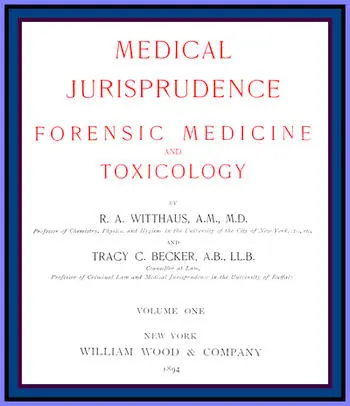
"Medical Jurisprudence, Forensic Medicine and Toxicology. Vol. 1" by R. A. Witthaus et al. is a scientific publication written in the late 19th century. This comprehensive work serves as a fundamental reference for the intersection of medicine and law, particularly focusing on how medical knowledge applies in legal contexts. The book explores various aspects of medical jurisprudence, forensic medicine, and toxicology, aimed at practitioners in both legal and medical fields, as well as scholars interested in legal medicine’s historical and practical significance. The opening of the volume sets the stage by delineating the key topics—medical jurisprudence, forensic medicine, and toxicology. It discusses the historical development of these fields, illustrating the evolution of the legal relationships between medical practitioners and the law. The introduction emphasizes the necessity for legal definitions regarding medical practice, the rights and duties of physicians, and the importance of providing expert testimony in legal cases. This section serves not only as an academic foundation but also as a practical guide for understanding the statutory landscape governing medical practice and its implications for both physicians and patients.
Introduction adapted from the source catalogue; source summaries may be automatically generated.
Free to read · English · 310,507 words · No account needed
MAKE TIME FOR A GOOD BOOK
On by default. Untick to stop anonymous reading totals. Each page counts after 10 seconds in view. How this works.
Anonymous counting is on unless you have switched it off.
BOARD OF EXAMINERS.—The board of medical examiners is composed of seven practising physicians of known ability and integrity, graduates of some medical school, college, or university duly established under and by virtue of the laws of the country in which it is situated, four allopathic members, three homœopathic members, and one eclectic member (Compiled Laws 1884, s. 2,553).
QUALIFICATION.—Applications for certificates and examinations are made to the board through their secretary (ib., s. 2,555).
The board must examine diplomas as to their genuineness; the verification consists in an affidavit of the holder and applicant that he is the lawful possessor of the diploma and the person therein named; the affidavit may be taken before any person authorized to administer oaths, and shall be attested under his hand and official seal if he have a seal. Graduates may present their diplomas and affidavits by letter or by proxy (ib., s. 2,556).
Examinations of persons not graduates or licentiates must be made by the board, and certificates by a majority of the board authorize the possessor to practise medicine and surgery (ib., s. 2,557).
The certificate must be recorded in the county clerk’s office in every county in which the holder practises or attempts to practise medicine or surgery (ib., s. 2,558).
When a certificate is filed, the clerk must record it and attach his certificate thereto, showing the date of filing and recording and the number of the book and the page of the record (ib., s. 2,559).
Examinations of persons not graduates must be made by the board and may be wholly or partly in writing, in anatomy, physiology, chemistry, pathology, surgery, obstetrics, and the practice of medicine (exclusive of materia medica and therapeutics) (ib., s. 2,561).
The board may refuse or revoke a certificate to an individual guilty of unprofessional or dishonorable conduct (ib., s. 2,562).
DEFINITION, EXCEPTIONS.—Practising medicine is defined as professing publicly to be a physician and prescribing for the sick or appending to a name the letters “M.D.” The act does not prohibit students from prescribing under the supervision of a preceptor, nor prevent women from practising midwifery, nor prohibit gratuitous services in cases of emergency, nor apply to commissioned surgeons or acting surgeons of the United States army or navy (ib., s. 2,563).
PENALTY.—Practising medicine or surgery without complying with the act is punishable with a fine of from $50 to $500 for each offence; and filing a diploma or a certificate of another, or a forged affidavit of identification, is a felony punishable the same as forgery.
EXCEPTION.—The provisions of the act do not apply to those who have been practising medicine ten years in the Territory (ib., s. 2,564, Act passed 1882).
Your reading position is saved on this browser. Take it to another device with a library code. Reading pages adapt to text, rather than matching a printed edition.
BEHIND THE BOOK
This eBook is for the use of anyone anywhere in the United States and most other parts of the world at no cost and with almost no restrictions whatsoever. You may copy it, give it away or re-use it under the terms of the Project Gutenberg License included with this eBook or online at www.gutenberg.org. If you are not located in the United States, you will have to check the laws of the country where you are located before using this eBook. Read the source licence.
The original source file, including credits and licence, is retained by this library. Request an original-format copy at no charge. Please include the book title and Project Gutenberg identifier #49027.
KEEP YOUR CURIOSITY GOING
Charles G. (Charles Griffith) Ross
Hannah Webster Foster

Emily Lawless
Edwin Hamlin Carr

Charles De Lano Hine
Andrew Ure