
The Writing of News A Handbook with Chapters on Newspaper Correspondence and Copy Reading
Charles G. (Charles Griffith) Ross
THE CLASSIC COLLECTION · 1894
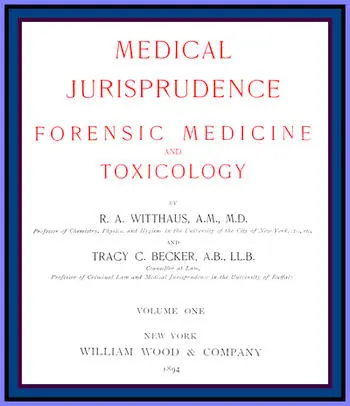
"Medical Jurisprudence, Forensic Medicine and Toxicology. Vol. 1" by R. A. Witthaus et al. is a scientific publication written in the late 19th century. This comprehensive work serves as a fundamental reference for the intersection of medicine and law, particularly focusing on how medical knowledge applies in legal contexts. The book explores various aspects of medical jurisprudence, forensic medicine, and toxicology, aimed at practitioners in both legal and medical fields, as well as scholars interested in legal medicine’s historical and practical significance. The opening of the volume sets the stage by delineating the key topics—medical jurisprudence, forensic medicine, and toxicology. It discusses the historical development of these fields, illustrating the evolution of the legal relationships between medical practitioners and the law. The introduction emphasizes the necessity for legal definitions regarding medical practice, the rights and duties of physicians, and the importance of providing expert testimony in legal cases. This section serves not only as an academic foundation but also as a practical guide for understanding the statutory landscape governing medical practice and its implications for both physicians and patients.
Introduction adapted from the source catalogue; source summaries may be automatically generated.
Free to read · English · 310,507 words · No account needed
MAKE TIME FOR A GOOD BOOK
On by default. Untick to stop anonymous reading totals. Each page counts after 10 seconds in view. How this works.
Anonymous counting is on unless you have switched it off.
DEFINITION.—To “practise medicine” means to suggest, recommend, prescribe, or direct, for the use of any person, any drug, medicine, appliance, apparatus, or other agency, whether material or not material, for the cure, relief, or palliation of any ailment or disease of mind or body, or for the cure or relief of any wound, fracture, or other bodily injury, or any deformity, after having received or with the intent of receiving therefor, either directly or indirectly, any bonus, gift, or compensation (ib., s. 1,409 [b]).
REGISTRATION.—Every person now lawfully engaged in practice must register on or before December 1st, 1881; every person hereafter duly qualified shall, before commencing to practise, register in the office of the clerk of the superior court of the county wherein he resides and is practising, or intends to practise, his name, residence, and place of birth, together with his authority; he shall subscribe or verify, by oath or affirmation, before a person duly qualified to administer oaths under the laws of this State, an affidavit containing such facts, and whether such authority is by diploma or license, and the date of the same, and by whom granted, which shall be exhibited to the county clerk, before the applicant is allowed to register, and which, if wilfully false, is punishable as false swearing (ib., s. 1,409 [c]).
REMOVAL.—A registered physician changing his residence from county to county must register in the clerk’s office of the county to which he removes and wherein he intends to reside and to practise medicine (ib., s. 1,409 [d]).
PENALTY.—The violation of this law or practising, or offering to practise, without lawful authority, or under cover of a diploma or license illegally obtained, is a misdemeanor, punishable by a fine of from $100 to $500, or imprisonment from thirty to ninety days, or both (ib., s. 1,409 [e]).
EXCEPTIONS.—Commissioned medical officers of the United States army or navy, or United States marine hospital service, and women practising only midwifery, are not affected (ib., s. 1,409 [f]).
MEDICAL BOARDS.—All medical boards are abolished, and only the qualifications of practitioners of medicine set forth above are required (ib., s. 1,409 [g]).
FEES.—To county clerk, fifty cents for each registration (ib., s.
1,409 [c]).
TAX.—On practitioners of physic, $5 per annum (ib., s. 809).
QUALIFICATION.—No person can lawfully practise medicine or surgery who has not received a medical education, and a diploma from a regularly chartered medical school, having a bona fide existence when the diploma was granted (Rev. Stats., 1887, s. 1,298).
Your reading position is saved on this browser. Take it to another device with a library code. Reading pages adapt to text, rather than matching a printed edition.
BEHIND THE BOOK
This eBook is for the use of anyone anywhere in the United States and most other parts of the world at no cost and with almost no restrictions whatsoever. You may copy it, give it away or re-use it under the terms of the Project Gutenberg License included with this eBook or online at www.gutenberg.org. If you are not located in the United States, you will have to check the laws of the country where you are located before using this eBook. Read the source licence.
The original source file, including credits and licence, is retained by this library. Request an original-format copy at no charge. Please include the book title and Project Gutenberg identifier #49027.
KEEP YOUR CURIOSITY GOING
Charles G. (Charles Griffith) Ross
Hannah Webster Foster

Emily Lawless
Edwin Hamlin Carr

Charles De Lano Hine
Andrew Ure