
The Writing of News A Handbook with Chapters on Newspaper Correspondence and Copy Reading
Charles G. (Charles Griffith) Ross
THE CLASSIC COLLECTION · 1894
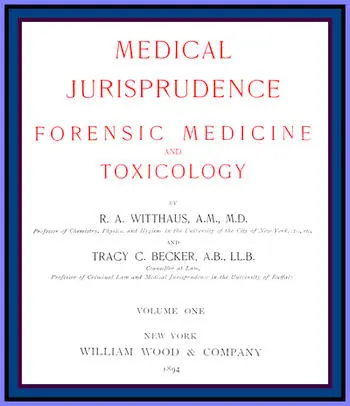
"Medical Jurisprudence, Forensic Medicine and Toxicology. Vol. 1" by R. A. Witthaus et al. is a scientific publication written in the late 19th century. This comprehensive work serves as a fundamental reference for the intersection of medicine and law, particularly focusing on how medical knowledge applies in legal contexts. The book explores various aspects of medical jurisprudence, forensic medicine, and toxicology, aimed at practitioners in both legal and medical fields, as well as scholars interested in legal medicine’s historical and practical significance. The opening of the volume sets the stage by delineating the key topics—medical jurisprudence, forensic medicine, and toxicology. It discusses the historical development of these fields, illustrating the evolution of the legal relationships between medical practitioners and the law. The introduction emphasizes the necessity for legal definitions regarding medical practice, the rights and duties of physicians, and the importance of providing expert testimony in legal cases. This section serves not only as an academic foundation but also as a practical guide for understanding the statutory landscape governing medical practice and its implications for both physicians and patients.
Introduction adapted from the source catalogue; source summaries may be automatically generated.
Free to read · English · 310,507 words · No account needed
MAKE TIME FOR A GOOD BOOK
On by default. Untick to stop anonymous reading totals. Each page counts after 10 seconds in view. How this works.
Anonymous counting is on unless you have switched it off.
BOARD OF EXAMINERS.—The State board of medical examiners is composed of nine practising physicians of known ability and integrity, graduates of medical schools of undoubted respectability, six of the regular school, two of the homœopathic, and one of the eclectic school or system, appointed by the governor (Mills’ “Annotated Statutes” 1891, s. 3,547).
QUALIFICATION.—Every person practising medicine must possess the required qualifications. If a graduate in medicine, he must present his diploma to the State board of medical examiners for verification, or furnish other evidence conclusive of his being a graduate of a legally chartered medical school in good standing. The board issues its certificate, and such diploma or evidence and certificate are conclusive. If not a graduate of a legally chartered medical school in good standing, the person must present himself before the board for examination. All persons who have made the practice of medicine and surgery their profession or business continuously for ten years, and can furnish satisfactory evidence thereof to the State medical examiners, shall receive a license to continue (ib., s. 3,550).
Examinations of persons not graduates are made by the State board, wholly or partly in writing, in anatomy, physiology, chemistry, pathology, surgery, obstetrics, and practice of medicine (exclusive of materia medica and therapeutics) (ib., s. 3,553).
The holder of a certificate should have it recorded in the office of the clerk of the county in which he resides, and the record indorsed thereon, and on removing to another county to practise should procure an indorsement to that effect on the certificate from the county clerk, and record this certificate in the county to which he removes (ib., s. 3,554).
The board may refuse certificates to persons convicted of conduct of criminal nature; and may revoke certificates for like cause (ib., s. 3,356).
DEFINITION.—Professing publicly to be a physician and prescribe for the sick, or attaching to name “M.D.,” or “surgeon” or “doctor” in a medical sense, is regarded as practising medicine. Gratuitous services in case of emergency are not prohibited (ib., s. 3,557).
PENALTY.—The penalty for violation of the act is a fine of from $50 to $300, or imprisonment in the county jail from ten days to thirty days, or fine and imprisonment for each offence; filing or attempting to file the diploma or certificate of another, or false or forged evidence, is a felony punishable the same as forgery (ib., s. 3,558).
SYSTEM OF MEDICINE.—Certificates are issued without prejudice, partiality, or discrimination as to schools or systems of practice or medicine, including the electropathic school (ib., s. 3,561).
FEES.—To treasurer of board by graduates and practitioners of ten
years’ standing, $5. By candidates for examination, $10 (ib., s.
3,552).
To county clerk, for recording certificate, $1 (ib., s. 3,554).
Your reading position is saved on this browser. Take it to another device with a library code. Reading pages adapt to text, rather than matching a printed edition.
BEHIND THE BOOK
This eBook is for the use of anyone anywhere in the United States and most other parts of the world at no cost and with almost no restrictions whatsoever. You may copy it, give it away or re-use it under the terms of the Project Gutenberg License included with this eBook or online at www.gutenberg.org. If you are not located in the United States, you will have to check the laws of the country where you are located before using this eBook. Read the source licence.
The original source file, including credits and licence, is retained by this library. Request an original-format copy at no charge. Please include the book title and Project Gutenberg identifier #49027.
KEEP YOUR CURIOSITY GOING
Charles G. (Charles Griffith) Ross
Hannah Webster Foster

Emily Lawless
Edwin Hamlin Carr

Charles De Lano Hine
Andrew Ure