
The Writing of News A Handbook with Chapters on Newspaper Correspondence and Copy Reading
Charles G. (Charles Griffith) Ross
THE CLASSIC COLLECTION · 1812
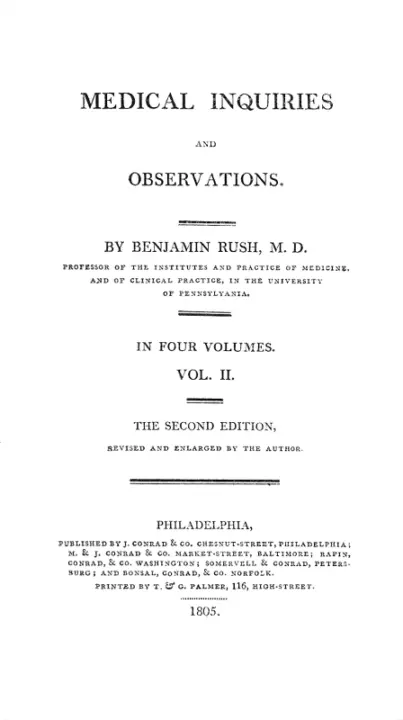
"Medical Inquiries and Observations, Vol. 2" by Benjamin Rush is a scientific publication written in the early 19th century. The work presents a comprehensive examination of various medical topics, featuring discussions on the influences of physical causes on mental faculties, the nature of diseases such as pulmonary consumption and dropsy, and observations on historical medical cases. It showcases the author's insights into the interconnectedness of physical health and moral behavior, emphasizing the influence of environmental and dietary factors on well-being. The opening of this volume introduces an inquiry into the "influence of physical causes upon the moral faculty." Rush begins by differentiating between the moral faculty and conscience, establishing a framework for understanding morality as linked to physical conditions. He explores how physical ailments can affect moral sensibilities, delving into examples from human behavior and observations on how different factors such as climate, diet, and bodily conditions can shape moral character. This premise sets the stage for further discussions on specific diseases and their effects on both mental and physical health, indicating a holistic approach to medicine that considers both the body and the mind in treatment and diagnosis.
Introduction adapted from the source catalogue; source summaries may be automatically generated.
Free to read · English · 90,114 words · No account needed
MAKE TIME FOR A GOOD BOOK
On by default. Untick to stop anonymous reading totals. Each page counts after 10 seconds in view. How this works.
Anonymous counting is on unless you have switched it off.
Chilly fits occurring in the forenoon, are more favourable than when they occur in the evening. They indicate the disease to partake a little of the nature of an intermittent, and are a call for the use of the remedies proper in that disease.
Rheumatic pains, attended with an abatement of the cough, or pains in the breast, are always favourable; so are
Eruptions, or an abscess on the external parts of the body, if they occur before the last stage of the disease.
A spitting of blood, in the early, or forming stage of the disease, is favourable, but after the lungs become much obstructed, or ulcerated, it is most commonly fatal.
A pleurisy, occurring in the low state of the disease, generally kills, but I have seen a case in which it suddenly removed the cough and hectic fever, and thus became the means of prolonging the patient's life for several years.
The discharge of calculi from the lungs by coughing and spitting, and of a thin watery liquid, with a small portion of pus swimming on its surface, are commonly signs of an incurable consumption.
No prediction unfavourable to life can be drawn from pus being discharged from the lungs. We see many recoveries after it has taken place, and many deaths where that symptom has been absent. Large quantities of pus are discharged in consumptions attended with abscesses, and yet few die of them, where they have not been preceded by long continued debility of the whole system. No pus is expectorated from tubercles, and how generally fatal is the disease, after they are formed in the lungs! It is only after they ulcerate that they discharge pus, and it is only after ulcers are thus formed, that the consumption probably becomes uniformly fatal. I suspect these ulcers are sometimes of a cancerous nature.
A sudden cessation of the cough, without a supervening diarrh[oe]a, indicates death to be at hand.
A constant vomiting in a consumption, is generally a bad sign.
Feet obstinately cold, also a swelling of the feet during the day, and of the face in the night, commonly indicate a speedy and fatal issue of the disease.
Lice, and the falling off of the hair, often precede death.
A hoarseness, in the beginning of the disease, is always alarming, but it is more so in its last stage.
A change of the eyes from a blue, or dark, to a light colour, similar to that which takes place in very old people, is a sign of speedy dissolution.
I have never seen a recovery after an apthous sore throat took place.
Your reading position is saved on this browser. Take it to another device with a library code. Reading pages adapt to text, rather than matching a printed edition.
BEHIND THE BOOK
This eBook is for the use of anyone anywhere in the United States and most other parts of the world at no cost and with almost no restrictions whatsoever. You may copy it, give it away or re-use it under the terms of the Project Gutenberg License included with this eBook or online at www.gutenberg.org. If you are not located in the United States, you will have to check the laws of the country where you are located before using this eBook. Read the source licence.
The original source file, including credits and licence, is retained by this library. Request an original-format copy at no charge. Please include the book title and Project Gutenberg identifier #58860.
KEEP YOUR CURIOSITY GOING
Charles G. (Charles Griffith) Ross
Hannah Webster Foster

Emily Lawless
Edwin Hamlin Carr

Charles De Lano Hine
Andrew Ure