
The Writing of News A Handbook with Chapters on Newspaper Correspondence and Copy Reading
Charles G. (Charles Griffith) Ross
THE CLASSIC COLLECTION · 1812
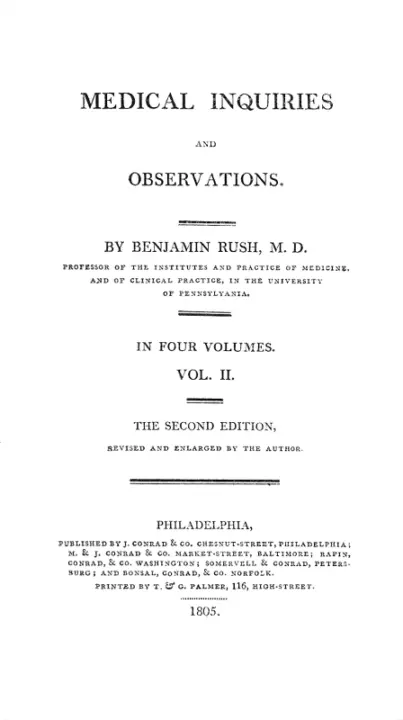
"Medical Inquiries and Observations, Vol. 2" by Benjamin Rush is a scientific publication written in the early 19th century. The work presents a comprehensive examination of various medical topics, featuring discussions on the influences of physical causes on mental faculties, the nature of diseases such as pulmonary consumption and dropsy, and observations on historical medical cases. It showcases the author's insights into the interconnectedness of physical health and moral behavior, emphasizing the influence of environmental and dietary factors on well-being. The opening of this volume introduces an inquiry into the "influence of physical causes upon the moral faculty." Rush begins by differentiating between the moral faculty and conscience, establishing a framework for understanding morality as linked to physical conditions. He explores how physical ailments can affect moral sensibilities, delving into examples from human behavior and observations on how different factors such as climate, diet, and bodily conditions can shape moral character. This premise sets the stage for further discussions on specific diseases and their effects on both mental and physical health, indicating a holistic approach to medicine that considers both the body and the mind in treatment and diagnosis.
Introduction adapted from the source catalogue; source summaries may be automatically generated.
Free to read · English · 90,114 words · No account needed
MAKE TIME FOR A GOOD BOOK
On by default. Untick to stop anonymous reading totals. Each page counts after 10 seconds in view. How this works.
Anonymous counting is on unless you have switched it off.
This I infer, 1st, From the remote and exciting causes which produce it. The remote causes are pneumony, catarrh, hæmoptysis, rheumatism, gout, asthma, scrophula, chronic diseases of the stomach, liver, and kidneys, nervous and intermitting fevers, measles, repelled humours from the surface of the body, the venereal disease, obstructed menses, sudden growth about the age of puberty, grief, and all other debilitating passions of the mind; hypochondriasis, improper lactation, excessive evacuation of all kinds, more especially by stool[18], cold and damp air, a cough, external violence acting upon the body[19]; and finally, every thing that tends, directly or indirectly, to diminish the strength of the system.
[18] Sir George Baker relates, in the second volume of the Medical Transactions, that Dr. Blanchard had informed him, that he had seen the consumption brought on ten persons out of ninety, by excessive purging used to prepare the body for the small-pox. I have seen a case of consumption in a youth of 17, from the spitting produced by the intemperate use of segars.
[19] Dr. Lind says, that out of 360 patients whom he attended between July 1st, 1758, and July 1st, 1760, in consumptions, the disease was brought on one fourth of them by falls, bruises, and strains, received a year or two before the disease made its appearance.
The most frequent exciting cause of consumption is the alternate application of heat and cold to the whole external surface of the body; but all the remote causes which have been enumerated, operate as exciting causes of consumption, when they act on previous debility. Original injuries of the lungs seldom excite this disease, except they first induce a debility of the whole system, by a troublesome and obstinate cough.
2. From the debilitating occupations and habits of persons who are most liable to this disease. These are studious men, and mechanics who lead sedentary lives in confined places; also women, and all persons of irritable habits, whether of body or mind.
3. From the period in which persons are most liable to be affected by this disease. This is generally between the 18th and 36th year of life, a period in which the system is liable, in a peculiar manner, to most diseases which induce it, and in which there is a greater expenditure of strength, than in any other stage of life, by the excessive exercises of the body and mind, in the pursuits of business or pleasure.
I have conformed to authors, in fixing the period of consumptions between the 18th and 36th year of life; but it is well known that it sometimes appears in children, and frequently in persons beyond the 40th, or even 60th year of life.
Your reading position is saved on this browser. Take it to another device with a library code. Reading pages adapt to text, rather than matching a printed edition.
BEHIND THE BOOK
This eBook is for the use of anyone anywhere in the United States and most other parts of the world at no cost and with almost no restrictions whatsoever. You may copy it, give it away or re-use it under the terms of the Project Gutenberg License included with this eBook or online at www.gutenberg.org. If you are not located in the United States, you will have to check the laws of the country where you are located before using this eBook. Read the source licence.
The original source file, including credits and licence, is retained by this library. Request an original-format copy at no charge. Please include the book title and Project Gutenberg identifier #58860.
KEEP YOUR CURIOSITY GOING
Charles G. (Charles Griffith) Ross
Hannah Webster Foster

Emily Lawless
Edwin Hamlin Carr

Charles De Lano Hine
Andrew Ure