
The Writing of News A Handbook with Chapters on Newspaper Correspondence and Copy Reading
Charles G. (Charles Griffith) Ross
THE CLASSIC COLLECTION · 1812
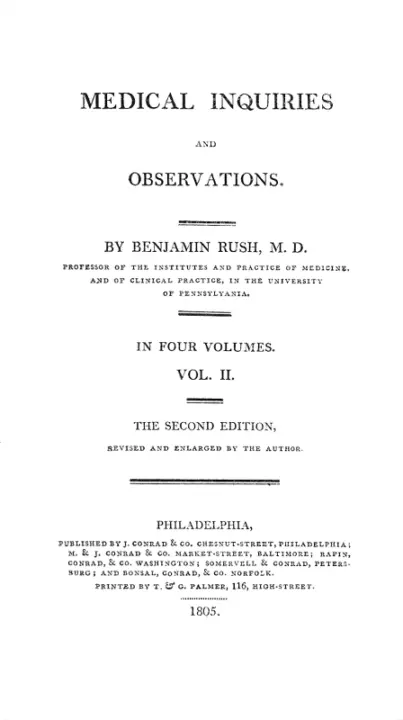
"Medical Inquiries and Observations, Vol. 2" by Benjamin Rush is a scientific publication written in the early 19th century. The work presents a comprehensive examination of various medical topics, featuring discussions on the influences of physical causes on mental faculties, the nature of diseases such as pulmonary consumption and dropsy, and observations on historical medical cases. It showcases the author's insights into the interconnectedness of physical health and moral behavior, emphasizing the influence of environmental and dietary factors on well-being. The opening of this volume introduces an inquiry into the "influence of physical causes upon the moral faculty." Rush begins by differentiating between the moral faculty and conscience, establishing a framework for understanding morality as linked to physical conditions. He explores how physical ailments can affect moral sensibilities, delving into examples from human behavior and observations on how different factors such as climate, diet, and bodily conditions can shape moral character. This premise sets the stage for further discussions on specific diseases and their effects on both mental and physical health, indicating a holistic approach to medicine that considers both the body and the mind in treatment and diagnosis.
Introduction adapted from the source catalogue; source summaries may be automatically generated.
Free to read · English · 90,114 words · No account needed
MAKE TIME FOR A GOOD BOOK
On by default. Untick to stop anonymous reading totals. Each page counts after 10 seconds in view. How this works.
Anonymous counting is on unless you have switched it off.
In order to illustrate the effects of physical causes upon the moral faculty, it will be necessary first to show their effects upon the memory, the imagination, and the judgment; and at the same time to point out the analogy between their operation upon the intellectual faculties of the mind, and the moral faculty.
1. Do we observe a connection between the intellectual faculties, and the degrees of consistency and firmness of the brain in infancy and childhood? The same connection has been observed between the strength, as well as the progress of the moral faculty in children.
2. Do we observe a certain size of the brain, and a peculiar cast of features, such as the prominent eye, and the aquiline nose, to be connected with extraordinary portions of genius? We observe a similar connection between the figure and temperament of the body, and certain moral qualities. Hence we often ascribe good temper and benevolence to corpulence, and irascibility to sanguineous habits. CA thought himself safe in the friendship of the "sleek-headed" Anthony and Willabella; but was afraid to trust to the professions of the slender Cassius.
3. Do we observe certain degrees of the intellectual faculties to be hereditary in certain families? The same observation has been frequently extended to moral qualities. Hence we often find certain virtues and vices as peculiar to families, through all their degrees of consanguinity, and duration, as a peculiarity of voice, complexion, or shape.
4. Do we observe instances of a total want of memory, imagination, and judgment, either from an original defect in the stamina of the brain, or from the influence of physical causes? The same unnatural defect is sometimes observed, and probably from the same causes, of a moral faculty. The celebrated Serving, whose character is drawn by the Duke of Sully in his Memoirs, appears to be an instance of the total absence of the moral faculty, while the chasm, produced by this defect, seems to have been filled up by a more than common extension of every other power of his mind. I beg leave to repeat the history of this prodigy of vice and knowledge. "Let the reader represent to himself a man of a genius so lively, and of an understanding so extensive, as rendered him scarce ignorant of any thing that could be known; of so vast and ready a comprehension, that he immediately made himself master of whatever he attempted; and of so prodigious a memory, that he never forgot what he once learned. He possessed all parts of philosophy, and the mathematics, particularly fortification and drawing. Even in theology he was so well skilled, that he was an excellent preacher, whenever he had a mind to exert that talent, and an able disputant, for and against the reformed religion indifferently. He not only understood Greek, Hebrew, and all the languages which we call learned, but also all the different jargons, or modern dialects. He accented and pronounced them so naturally, and so perfectly imitated the gestures and manners both of the several nations of Europe, and the particular provinces of France, that he might have been taken for a native of all, or any of these countries: and this quality he applied to counterfeit all sorts of persons, wherein he succeeded wonderfully. He was, moreover, the best comedian, and the greatest droll that perhaps ever appeared. He had a genius for poetry, and had wrote many verses. He played upon almost all instruments, was a perfect master of music, and sang most agreeably and justly. He likewise could say mass, for he was of a disposition to do, as well as to know all things. His body was perfectly well suited to his mind. He was light, nimble, and dexterous, and fit for all exercises. He could ride well, and in dancing, wrestling, and leaping, he was admired. There are not any recreative games that he did not know, and he was skilled in almost all mechanic arts. But now for the reverse of the medal. Here it appeared, that he was treacherous, cruel, cowardly, deceitful, a liar, a cheat, a drunkard and a glutton, a sharper in play, immersed in every species of vice, a blasphemer, an atheist. In a word, in him might be found all the vices that are contrary to nature, honour, religion, and society, the truth of which he himself evinced with his latest breath; for he died in the flower of his age, in a common brothel, perfectly corrupted by his debaucheries, and expired with the glass in his hand, cursing and denying God[3]."
Your reading position is saved on this browser. Take it to another device with a library code. Reading pages adapt to text, rather than matching a printed edition.
BEHIND THE BOOK
This eBook is for the use of anyone anywhere in the United States and most other parts of the world at no cost and with almost no restrictions whatsoever. You may copy it, give it away or re-use it under the terms of the Project Gutenberg License included with this eBook or online at www.gutenberg.org. If you are not located in the United States, you will have to check the laws of the country where you are located before using this eBook. Read the source licence.
The original source file, including credits and licence, is retained by this library. Request an original-format copy at no charge. Please include the book title and Project Gutenberg identifier #58860.
KEEP YOUR CURIOSITY GOING
Charles G. (Charles Griffith) Ross
Hannah Webster Foster

Emily Lawless
Edwin Hamlin Carr

Charles De Lano Hine
Andrew Ure