
The Writing of News A Handbook with Chapters on Newspaper Correspondence and Copy Reading
Charles G. (Charles Griffith) Ross
THE CLASSIC COLLECTION · 1812
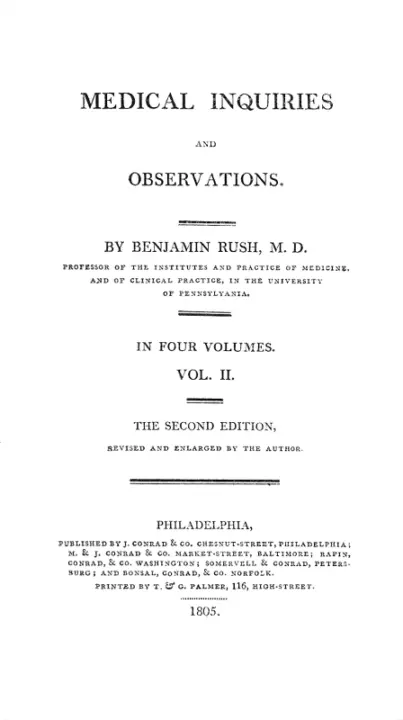
"Medical Inquiries and Observations, Vol. 2" by Benjamin Rush is a scientific publication written in the early 19th century. The work presents a comprehensive examination of various medical topics, featuring discussions on the influences of physical causes on mental faculties, the nature of diseases such as pulmonary consumption and dropsy, and observations on historical medical cases. It showcases the author's insights into the interconnectedness of physical health and moral behavior, emphasizing the influence of environmental and dietary factors on well-being. The opening of this volume introduces an inquiry into the "influence of physical causes upon the moral faculty." Rush begins by differentiating between the moral faculty and conscience, establishing a framework for understanding morality as linked to physical conditions. He explores how physical ailments can affect moral sensibilities, delving into examples from human behavior and observations on how different factors such as climate, diet, and bodily conditions can shape moral character. This premise sets the stage for further discussions on specific diseases and their effects on both mental and physical health, indicating a holistic approach to medicine that considers both the body and the mind in treatment and diagnosis.
Introduction adapted from the source catalogue; source summaries may be automatically generated.
Free to read · English · 90,114 words · No account needed
MAKE TIME FOR A GOOD BOOK
On by default. Untick to stop anonymous reading totals. Each page counts after 10 seconds in view. How this works.
Anonymous counting is on unless you have switched it off.
[13] A public dispensary.
Lastly, ATTRACTION, COMPOSITION, and DECOMPOSITION, belong to the passions as well as to matter. Vices of the same species attract each other with the most force: hence the bad consequences of crowding young men, whose propensities are generally the same, under one roof, in our modern plans of education. The effects of composition and decomposition upon vices, appear in the meanness of the school-boy being often cured by the prodigality of a military life, and by the precipitation of avarice, which is often produced by ambition and love.
If physical causes influence morals in the manner we have described, may they not also influence religious principles and opinions? I answer in the affirmative; and I have authority, from the records of physic, as well as from my own observations, to declare, that religious melancholy and madness, in all their variety of species, yield with more facility to medicine, than simply to polemical discourses, or to casuistical advice. But this subject is foreign to the business of the present inquiry.
From a review of our subject, we are led to contemplate with admiration, the curious structure of the human mind. How distinct are the number, and yet how united! How subordinate, and yet how co-equal are all its faculties! How wonderful is the action of the mind upon the body! of the body upon the mind! and of the Divine Spirit upon both! What a mystery is the mind of man to itself!---- O! Nature!---- or, to speak more properly, O! THOU GOD OF NATURE! in vain do we attempt to scan THY immensity, or to comprehend THY various modes of existence, when a single particle of light, issued from THYSELF, and kindled into intelligence in the bosom of man, thus dazzles and confounds our understandings!
The extent of the moral powers and habits in man is unknown. It is not improbable, but the human mind contains principles of virtue, which have never yet been excited into action. We behold with surprise the versatility of the human body in the exploits of tumblers and rope-dancers. Even the agility of a wild beast has been demonstrated in a girl of France, and an amphibious nature has been discovered in the human species, in a young man in Spain. We listen with astonishment to the accounts of the memories of Mithridates, Cyrus, and Servin. We feel a veneration bordering upon divine homage, in contemplating the stupenduous understandings of lord Verulam and sir Isaac Newton; and our eyes grow dim, in attempting to pursue Shakespeare and Milton in their immeasurable flights of imagination. And if the history of mankind does not furnish similar instances of the versatility and perfection of our species in virtue, it is because the moral faculty has been the subject of less culture and fewer experiments than the body, and the intellectual faculties of the mind. From what has been said, the reason of this is obvious. Hitherto the cultivation of the moral faculty has been the business of parents, schoolmasters, and divines[14]. But if the principles, we have laid down, be just, the improvement and extension of this principle should be equally the business of the legislator, the natural philosopher, and the physician; and a physical regimen should as necessarily accompany a moral precept, as directions with respect to the air, exercise, and diet, generally accompany prescriptions for the consumption, and the gout. To encourage us to undertake experiments for the improvement of morals, let us recollect the success of philosophy in lessening the number, and mitigating the violence of incurable diseases. The intermitting fever, which proved fatal to two of the monarchs of Britain, is now under absolute subjection to medicine. Continual fevers are much less fatal than formerly. The small-pox is disarmed of its mortality by inoculation, and even the tetanus and the cancer have lately received a check in their ravages upon mankind. But medicine has done more. It has penetrated the deep and gloomy abyss of death, and acquired fresh honours in his cold embraces. Witness the many hundred people who have lately been brought back to life by the successful efforts of the humane societies, which are now established in many parts of Europe, and in some parts of America. Should the same industry and ingenuity, which have produced these triumphs of medicine over diseases and death, be applied to the moral science, it is highly probable, that most of those baneful vices, which deform the human breast, and convulse the nations of the earth, might be banished from the world. I am not so sanguine as to suppose, that it is possible for man to acquire so much perfection from science, religion, liberty, and good government, as to cease to be mortal; but I am fully persuaded, that from the combined action of causes, which operate at once upon the reason, the moral faculty, the passions, the senses, the brain, the nerves, the blood, and the heart, it is possible to produce such a change in his moral character, as shall raise him to a resemblance of angels; nay, more, to the likeness of GOD himself. The state of Pennsylvania still deplores the loss of a man, in whom not only reason and revelation, but many of the physical causes that have been enumerated, concurred to produce such attainments in moral excellency, as have seldom appeared in a human being. This amiable citizen considered his fellow-creature, man, as God's extract, from his own works; and whether this image of himself was cut out from ebony or copper; whether he spoke his own, or a foreign language; or whether he worshipped his Maker with ceremonies, or without them, he still considered him as a brother, and equally the object of his benevolence. Poets and historians, who are to live hereafter, to you I commit his panegyric; and when you hear of a law for abolishing slavery in each of the American states, such as was passed in Pennsylvania, in the year 1780; when you hear of the kings and queens of Europe, publishing edicts for abolishing the trade in human souls; and, lastly, when you hear of schools and churches, with all the arts of civilized life, being established among the nations of Africa, then remember and record, that this revolution in favour of human happiness, was the effect of the labours, the publications, the private letters, and the prayers of ANTHONY BENEZET[15].
Your reading position is saved on this browser. Take it to another device with a library code. Reading pages adapt to text, rather than matching a printed edition.
BEHIND THE BOOK
This eBook is for the use of anyone anywhere in the United States and most other parts of the world at no cost and with almost no restrictions whatsoever. You may copy it, give it away or re-use it under the terms of the Project Gutenberg License included with this eBook or online at www.gutenberg.org. If you are not located in the United States, you will have to check the laws of the country where you are located before using this eBook. Read the source licence.
The original source file, including credits and licence, is retained by this library. Request an original-format copy at no charge. Please include the book title and Project Gutenberg identifier #58860.
KEEP YOUR CURIOSITY GOING
Charles G. (Charles Griffith) Ross
Hannah Webster Foster

Emily Lawless
Edwin Hamlin Carr

Charles De Lano Hine
Andrew Ure