
The Writing of News A Handbook with Chapters on Newspaper Correspondence and Copy Reading
Charles G. (Charles Griffith) Ross
THE CLASSIC COLLECTION · 1812
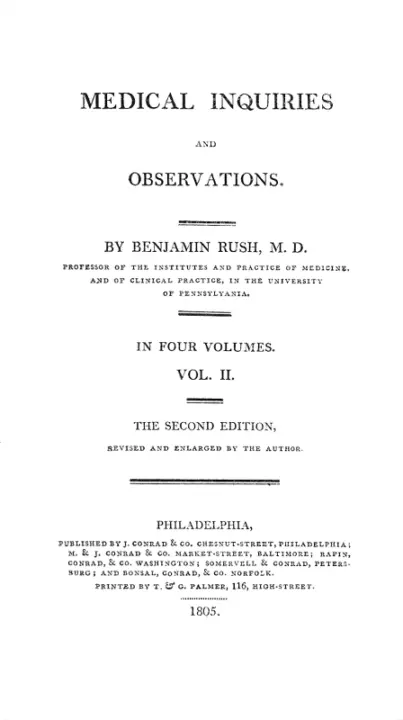
"Medical Inquiries and Observations, Vol. 2" by Benjamin Rush is a scientific publication written in the early 19th century. The work presents a comprehensive examination of various medical topics, featuring discussions on the influences of physical causes on mental faculties, the nature of diseases such as pulmonary consumption and dropsy, and observations on historical medical cases. It showcases the author's insights into the interconnectedness of physical health and moral behavior, emphasizing the influence of environmental and dietary factors on well-being. The opening of this volume introduces an inquiry into the "influence of physical causes upon the moral faculty." Rush begins by differentiating between the moral faculty and conscience, establishing a framework for understanding morality as linked to physical conditions. He explores how physical ailments can affect moral sensibilities, delving into examples from human behavior and observations on how different factors such as climate, diet, and bodily conditions can shape moral character. This premise sets the stage for further discussions on specific diseases and their effects on both mental and physical health, indicating a holistic approach to medicine that considers both the body and the mind in treatment and diagnosis.
Introduction adapted from the source catalogue; source summaries may be automatically generated.
Free to read · English · 90,114 words · No account needed
MAKE TIME FOR A GOOD BOOK
On by default. Untick to stop anonymous reading totals. Each page counts after 10 seconds in view. How this works.
Anonymous counting is on unless you have switched it off.
V. The exercises of the faculties of the mind have a wonderful influence in increasing the quantity of human life. They all act by reflection only, after having been previously excited into action by impressions made upon the body. This view of the re-action of the mind upon the body accords with the simplicity of other operations in the animal economy. It is thus the brain repays the heart for the blood it conveys to it, by re-acting upon its muscular fibres. The influence of the different faculties of the mind is felt in the pulse, in the stomach, and in the liver, and is seen in the face, and other external parts of the body. Those which act most unequivocally in promoting life are the understanding, the imagination, and the passions. Thinking belongs to the understanding, and is attended with an obvious influence upon the degree and duration of life. Intense study has often rendered the body insensible to the debilitating effects of cold and hunger. Men of great and active understandings, who blend with their studies temperance and exercise, are generally long lived. In support of this assertion, a hundred names might be added to those of Newton and Franklin. Its truth will be more fully established by attending to the state of human life in persons of an opposite intellectual character. The cretins, a race of idiots in Valais, in Switzerland, travellers tell us, are all short lived. Common language justifies the opinion of the stimulus of the understanding upon the brain: hence it is common to say of dull men, that they have scarcely ideas enough to keep themselves awake.
The imagination acts with great force upon the body, whether its numerous associations produce pleasure or pain. But the passions pour a constant stream upon the wheels of life. They have been subdivided into emotions and passions properly so called. The former have for their objects present, the latter, future good and evil. All the objects of the passions are accompanied with desire or aversion. To the former belong chiefly, hope, love, ambition, and avarice; to the latter, fear, hatred, malice, envy, and the like. Joy, anger, and terror, belong to the class of emotions. The passions and emotions have been further divided into stimulating and sedative. Our business at present is to consider their first effect only upon the body. In the original constitution of human nature, we were made to be stimulated by such passions and emotions only as have moral good for their objects. Man was designed to be always under the influence of hope, love, and joy. By the loss of his innocence, he has subjected himself to the dominion of passions and emotions of a malignant nature; but they possess, in common with such as are good, a stimulus which renders them subservient to the purpose of promoting animal life. It is true, they are like the stimulus of a dislocated bone in their operation upon the body, compared with the action of antagonist muscles stretched over bones, which gently move in their natural sockets. The effects of the good passions and emotions, in promoting health and longevity, have been taken notice of by many writers. They produce a flame, gentle and pleasant, like oil perfumed with frankincense in the lamp of life. There are instances likewise of persons who have derived strength and long life from the influence of the evil passions and emotions that have been mentioned. Dr. Darwin relates the history of a man, who used to overcome the fatigue induced by travelling, by thinking of a person whom he hated. The debility induced by disease is often removed by a sudden change in the temper. This is so common, that even nurses predict a recovery in persons as soon as they become peevish and ill-natured, after having been patient during the worst stage of their sickness. This peevishness acts as a gentle stimulus upon the system in its languid state, and thus turns the scale in favour of life and health. The famous Benjamin Lay, of this state, who lived to be eighty years of age, was of a very irascible temper. Old Elwes was a prodigy of avarice, and every court in Europe furnishes instances of men who have attained to extreme old age, who have lived constantly under the dominion of ambition. In the course of a long inquiry which I instituted some years ago into the state of the body and mind in old people, I did not find a single person above eighty, who had not possessed an active understanding, or active passions. Those different and opposite faculties of the mind, when in excess, happily supply the place of each other. Where they unite their forces, they extinguish the flame of life, before the oil which feeds it is consumed.
Your reading position is saved on this browser. Take it to another device with a library code. Reading pages adapt to text, rather than matching a printed edition.
BEHIND THE BOOK
This eBook is for the use of anyone anywhere in the United States and most other parts of the world at no cost and with almost no restrictions whatsoever. You may copy it, give it away or re-use it under the terms of the Project Gutenberg License included with this eBook or online at www.gutenberg.org. If you are not located in the United States, you will have to check the laws of the country where you are located before using this eBook. Read the source licence.
The original source file, including credits and licence, is retained by this library. Request an original-format copy at no charge. Please include the book title and Project Gutenberg identifier #58860.
KEEP YOUR CURIOSITY GOING
Charles G. (Charles Griffith) Ross
Hannah Webster Foster

Emily Lawless
Edwin Hamlin Carr

Charles De Lano Hine
Andrew Ure