
The Writing of News A Handbook with Chapters on Newspaper Correspondence and Copy Reading
Charles G. (Charles Griffith) Ross
THE CLASSIC COLLECTION · 1812
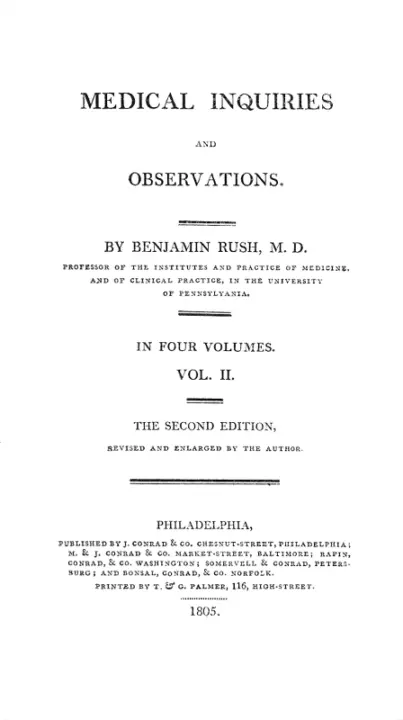
"Medical Inquiries and Observations, Vol. 2" by Benjamin Rush is a scientific publication written in the early 19th century. The work presents a comprehensive examination of various medical topics, featuring discussions on the influences of physical causes on mental faculties, the nature of diseases such as pulmonary consumption and dropsy, and observations on historical medical cases. It showcases the author's insights into the interconnectedness of physical health and moral behavior, emphasizing the influence of environmental and dietary factors on well-being. The opening of this volume introduces an inquiry into the "influence of physical causes upon the moral faculty." Rush begins by differentiating between the moral faculty and conscience, establishing a framework for understanding morality as linked to physical conditions. He explores how physical ailments can affect moral sensibilities, delving into examples from human behavior and observations on how different factors such as climate, diet, and bodily conditions can shape moral character. This premise sets the stage for further discussions on specific diseases and their effects on both mental and physical health, indicating a holistic approach to medicine that considers both the body and the mind in treatment and diagnosis.
Introduction adapted from the source catalogue; source summaries may be automatically generated.
Free to read · English · 90,114 words · No account needed
MAKE TIME FOR A GOOD BOOK
On by default. Untick to stop anonymous reading totals. Each page counts after 10 seconds in view. How this works.
Anonymous counting is on unless you have switched it off.
2. The influenza passes with the utmost rapidity through a country, and affects the greatest number of people, in a given time, of any disease in the world.
3. It appears from the histories of it which are upon record, that neither climate, nor the different states of society, have produced any material change in the disease. This will appear from comparing the account I have given, with the histories of it which have lately been given by Dr. Grey, Dr. Hamilton, Dr. A. Fothergill, Mr. Chisholm, and other modern physicians. It appears further, that even time itself has not been able materially to change the type of this disease. This is evident, from comparing modern accounts of it with those which have been handed down to us by ancient physicians.
I have hinted in a former essay at the diminutives of certain diseases. There is a state of influenza, which is less violent and more local, than that which has been described. It generally prevails in the winter season. It seems to originate from a morbid matter, generated in crowded and heated churches, and other assemblies of the people. I have seen a cold, or influenza, frequently universal in Philadelphia, which I have distinctly traced to this source. It would seem as if the same species of diseases resembled pictures, and that while some of them partook of the deep and vivid nature of mosaic work, others appeared like the feeble and transient impressions of water colours.
My business in this chair is to teach the institutes of medicine. They have been divided into physiology, pathology, and therapeutics. The objects of the first are, the laws of the human body in its healthy state. The second includes the history of the causes and seats of diseases. The subjects of the third are the remedies for those diseases. In entering upon the first part of our course, I am met by a remark delivered by Dr. Hunter in his introductory lectures to his course of anatomy. "In our branch (says the doctor) those teachers who study to captivate young minds with ingenious speculations, will not leave a reputation behind them that will outlive them half a century. When they cease from their labours, their labours will be buried along with them. There never was a man more followed and admired in physiology, than Dr. Boerhaave. I remember the veneration in which he was held. And now, in the space of forty years, his physiology is---- it shocks me to think in what a light it appears[89]." Painful as this premonition may be to the teachers of physiology, it should not deter them from speculating upon physiological subjects. Simple anatomy is a mass of dead matter. It is physiology which infuses life into it. A knowledge of the structure of the human body occupies only the memory. Physiology introduces it to the higher and more noble faculties of the mind. The component parts of the body may be compared to the materials of a house, lying without order in a yard. It is physiology, like a skilful architect, which connects them together, so as to form from them an elegant and useful building. The writers against physiology resemble, in one particular, the writers against luxury. They forget that the functions they know and describe belong to the science of physiology; just as the declaimers against luxury forget that all the conveniences which they enjoy beyond what are possessed in the most simple stage of society, belong to the luxuries of life. The anatomist who describes the circulation of the blood, acts the part of a physiologist, as much as he does, who attempts to explain the functions of the brain. In this respect Dr. Hunter did honour to our science; for few men ever explained that subject, and many others equally physiological, with more perspicuity and eloquence, than that illustrious anatomist. Upon all new and difficult subjects there must be pioneers. It has been my lot to be called to this office of hazard and drudgery; and if in discharging its duties I should meet the fate of my predecessors, in this branch of medicine, I shall not perish in vain. My errors, like the bodies of those who fall in forcing a breach, will serve to compose a bridge for those who shall come after me, in our present difficult enterprise. This consideration, aided by just views of the nature and extent of moral obligation, will overbalance the evils anticipated by Dr. Hunter, from the loss of posthumous fame. Had a prophetic voice whispered in the ear of Dr. Boerhaave in the evening of his life, that in the short period of forty years, the memory of his physiological works would perish from the earth, I am satisfied, from the knowledge we have of his elevated genius and piety, he would have treated the prediction with the same indifference that he would have done, had he been told, that in the same time, his name should be erased from a pane of glass, in a noisy and vulgar country tavern.
Your reading position is saved on this browser. Take it to another device with a library code. Reading pages adapt to text, rather than matching a printed edition.
BEHIND THE BOOK
This eBook is for the use of anyone anywhere in the United States and most other parts of the world at no cost and with almost no restrictions whatsoever. You may copy it, give it away or re-use it under the terms of the Project Gutenberg License included with this eBook or online at www.gutenberg.org. If you are not located in the United States, you will have to check the laws of the country where you are located before using this eBook. Read the source licence.
The original source file, including credits and licence, is retained by this library. Request an original-format copy at no charge. Please include the book title and Project Gutenberg identifier #58860.
KEEP YOUR CURIOSITY GOING
Charles G. (Charles Griffith) Ross
Hannah Webster Foster

Emily Lawless
Edwin Hamlin Carr

Charles De Lano Hine
Andrew Ure