
The Writing of News A Handbook with Chapters on Newspaper Correspondence and Copy Reading
Charles G. (Charles Griffith) Ross
THE CLASSIC COLLECTION · 1812
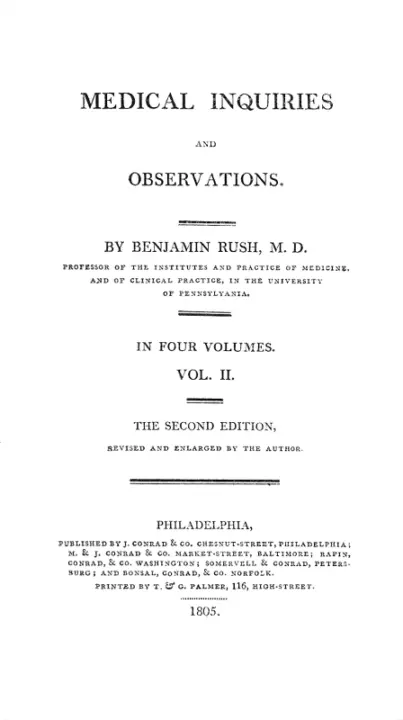
"Medical Inquiries and Observations, Vol. 2" by Benjamin Rush is a scientific publication written in the early 19th century. The work presents a comprehensive examination of various medical topics, featuring discussions on the influences of physical causes on mental faculties, the nature of diseases such as pulmonary consumption and dropsy, and observations on historical medical cases. It showcases the author's insights into the interconnectedness of physical health and moral behavior, emphasizing the influence of environmental and dietary factors on well-being. The opening of this volume introduces an inquiry into the "influence of physical causes upon the moral faculty." Rush begins by differentiating between the moral faculty and conscience, establishing a framework for understanding morality as linked to physical conditions. He explores how physical ailments can affect moral sensibilities, delving into examples from human behavior and observations on how different factors such as climate, diet, and bodily conditions can shape moral character. This premise sets the stage for further discussions on specific diseases and their effects on both mental and physical health, indicating a holistic approach to medicine that considers both the body and the mind in treatment and diagnosis.
Introduction adapted from the source catalogue; source summaries may be automatically generated.
Free to read · English · 90,114 words · No account needed
MAKE TIME FOR A GOOD BOOK
On by default. Untick to stop anonymous reading totals. Each page counts after 10 seconds in view. How this works.
Anonymous counting is on unless you have switched it off.
2. The disease called canine madness, prevails occasionally among dogs at those times in which malignant fevers are epidemic. This will not surprise those persons who have been accustomed to observe the prevalence of the influenza and bilious fevers among other domestic animals at a time when they are epidemic among the human species.
3. Dogs, when they are said to be mad, exhibit the usual symptoms of fever, such as a want of appetite, great heat, a dull, fierce, red, or watery eye, indisposition to motion, sleepiness, delirium, and madness. The symptom of madness is far from being universal, and hence many dogs are diseased and die with this malignant fever, that are inoffensive, and instead of biting, continue to fawn upon their masters. Nor is the disposition of the fever to communicate itself by infection universal among dogs any more than the same fever in the human species, and this I suppose to be one reason why many people are bitten by what are called mad dogs, who never suffer any inconvenience from it.
4. A dissection of a dog, by Dr. Cooper, that died with this fever, exhibited all the usual marks of inflammation and effusion which take place in common malignant fevers. I shall in another place mention a fifth argument in favour of the disease in dogs being a malignant fever, from the efficacy of one of the most powerful remedies in that state of fever, having cured it in two instances.
II. The disease produced in the human species by the bite of a rabid animal, is a malignant fever. This appears first from its symptoms. These, as recorded by Aurelian, Mead, Fothergill, Plummer, Arnold, Baumgarten, and Morgagni, are chills, great heat, thirst, nausea, a burning sensation in the stomach, vomiting, costiveness; a small, quick, tense, irregular, intermitting, natural, or slow pulse; a cool skin, great sensibility to cold air, partial cold and clammy sweats on the hands, or sweats accompanied with a warm skin diffused all over the body, difficulty of breathing, sighing, restlessness, hiccup, giddiness, head-ach, delirium, coma, false vision, dilatation of the pupils, dulness of sight, blindness, glandular swellings, heat of urine, priapism, palpitation of the heart, and convulsions. I know that there are cases of hydrophobia upon record, in which there is said to be a total absence of fever. The same thing has been said of the plague. In both cases the supposed absence of fever is the effect of stimulus acting upon the blood-vessels with so much force as to suspend morbid action in them. By abstracting a part of this stimulus, a fever is excited, which soon discovers itself in the pulse and on the skin, and frequently in pains in every part of the body. The dread of water, and the great sensibility of the system to cold air, are said to give a specific character to the hydrophobia; but the former symptom, it has been often seen, occurs in diseases from other causes, and the latter has been frequently observed in the yellow fever. It is no more extraordinary that a fever excited by the bite of a rabid animal should excite a dread of water, than that fevers from other causes should produce aversion from certain aliments, from light, and from sounds of all kinds; nor is it any more a departure from the known laws of stimulants, that the saliva of a mad dog should affect the fauces, than that mercury should affect the salivary glands. Both stimuli appear to act in a specific manner.
Your reading position is saved on this browser. Take it to another device with a library code. Reading pages adapt to text, rather than matching a printed edition.
BEHIND THE BOOK
This eBook is for the use of anyone anywhere in the United States and most other parts of the world at no cost and with almost no restrictions whatsoever. You may copy it, give it away or re-use it under the terms of the Project Gutenberg License included with this eBook or online at www.gutenberg.org. If you are not located in the United States, you will have to check the laws of the country where you are located before using this eBook. Read the source licence.
The original source file, including credits and licence, is retained by this library. Request an original-format copy at no charge. Please include the book title and Project Gutenberg identifier #58860.
KEEP YOUR CURIOSITY GOING
Charles G. (Charles Griffith) Ross
Hannah Webster Foster

Emily Lawless
Edwin Hamlin Carr

Charles De Lano Hine
Andrew Ure