THE CLASSIC COLLECTION✦An outlaw’s diary: the CommuneCLASSIC FREE BOOKS
An outlaw’s diary: the Commune
Cécile Tormay
THE CLASSIC COLLECTION · 1922
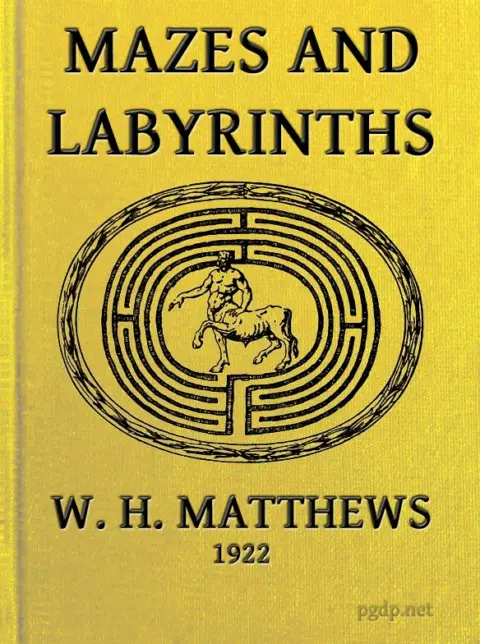
"Mazes and Labyrinths: A General Account of Their History and Development" by W. H. Matthews is a historical account published in the early 20th century, specifically in 1922. The book explores the history, significance, and various forms of mazes and labyrinths across cultures, from ancient Egypt to medieval Europe. It aims to provide a comprehensive survey of the labyrinthine concept that has fascinated humanity for centuries. The opening of the book begins with a preface that discusses the author’s inspiration for exploring the subject of mazes and labyrinths, rooted in a child's innocent inquiry about their origins during seaside sand constructions. Matthews expresses a desire to offer a readable examination of labyrinths, recognizing their allure beyond their historical and archaic significance. He sets the stage for an exploration that will include archaeological insights and literary references, diverging from solely academic interpretations to engage a broader audience. In this introduction, he emphasizes the ambiguity in the definitions of “maze” and “labyrinth,” hinting at the intricate relationships between their physical and metaphorical meanings, which will be further elaborated in the chapters to come.
Introduction adapted from the source catalogue; source summaries may be automatically generated.
Free to read · English · 62,708 words · No account needed
MAKE TIME FOR A GOOD BOOK
On by default. Untick to stop anonymous reading totals. Each page counts after 10 seconds in view. How this works.
Anonymous counting is on unless you have switched it off.
TROLLOPE, E. "Ancient and Mediaeval Labyrinths," with notes by ALBERT WAY, in Archaeological Journal, Vol. XV, 1858. Also in Reports of the Associated Architectural Societies in 1858, and appended to a paper on the Caerleon mosaic in the Proc. Monmouth and Caerleon Antiquarian Association, 1866.
(Mainly concerned with church labyrinths and British turf mazes.)
DE LAUNAY, R. "Les Fallacieux Détours du Labyrinthe" in Révue Archéologique, Series V, 1915-16.
(A bold and striking essay, chiefly concerned with the labyrinth as the architectural expression of a sun-myth.)
FRAZER, Sir J. G. "The Golden Bough," Pt. III, "The Dying God," 1911.
(In the section dealing with the octennial tenure of the kingship the labyrinth is treated from the point of view of the anthropologist and folk-lorist.)
COOK, A. B. "Zeus. A Study in Ancient Religions," 1914.
(The labyrinth, particularly that of Crete, is studied from the point of view of the classical archaeologist.)
KRAUSE, ERNST. "Die Trojaburgen Nordeuropas" and "Die Nordische Herkunft der Trojasage," Glogau, 1893. Also "Tuiskoland der Arischen Stämme und Götter Urheimat," 1891.
(A study of classic and northern mythologies with special reference to solar rites. The labyrinth is held to be distinctively northern, the classic legends being derivative.)
MASSMANN, H. F. "Wunderkreise und Irrgarten," Leipzig Basse, 1844.
(This work is mentioned in a German encyclopaedia, but the writer has not been able to obtain access to a copy. Written by a mathematician, it probably deals with the subject from a corresponding aspect.)
DAREMBERG, SAGLIO & POTTIER. "Dictionnaire des Antiquités," 1904,
Vol. III.
(The article "Labyrinthe" gives very full references to the occurrence of labyrinth figures on ancient monuments.)
Dictionary of Architecture (1867). Arts. "Maze" and "Meander."
Encyclopaedia Britannica. Art. "Labyrinth." By THOS. MOORE, F.L.S. (1821-87) (with especial reference to hedge mazes).
(Several other encyclopaedias, American, French, German and Italian, also contain good articles on the subject, notably Larousse, La Grande Encyclopédie, The New International Encyclopaedia, and Roscher's Lexikon der Mythologie, Vol. II, 1894-7.)
"Country Life." Two well-illustrated anonymous articles in issues of January 24 and March 14, 1903.
There is a popular article on Mazes by G. S. TYACK in W. ANDREWS'S "Ecclesiastical Curiosities," 1897; and a chapter of E. O. GORDON'S "Prehistoric London," 1914, treats of the matter in so far as it supports the theory of the Trojan origin of London (Troy-Novant).
Your reading position is saved on this browser. Take it to another device with a library code. Reading pages adapt to text, rather than matching a printed edition.
BEHIND THE BOOK
This eBook is for the use of anyone anywhere in the United States and most other parts of the world at no cost and with almost no restrictions whatsoever. You may copy it, give it away or re-use it under the terms of the Project Gutenberg License included with this eBook or online at www.gutenberg.org. If you are not located in the United States, you will have to check the laws of the country where you are located before using this eBook. Read the source licence.
The original source file, including credits and licence, is retained by this library. Request an original-format copy at no charge. Please include the book title and Project Gutenberg identifier #46238.
KEEP YOUR CURIOSITY GOING
Cécile Tormay

Moritz Busch
John L. Ransom
Frances Wright
Cécile Tormay

Mabel Potter Daggett