THE CLASSIC COLLECTION✦An outlaw’s diary: the CommuneCLASSIC FREE BOOKS
An outlaw’s diary: the Commune
Cécile Tormay
THE CLASSIC COLLECTION · 1922
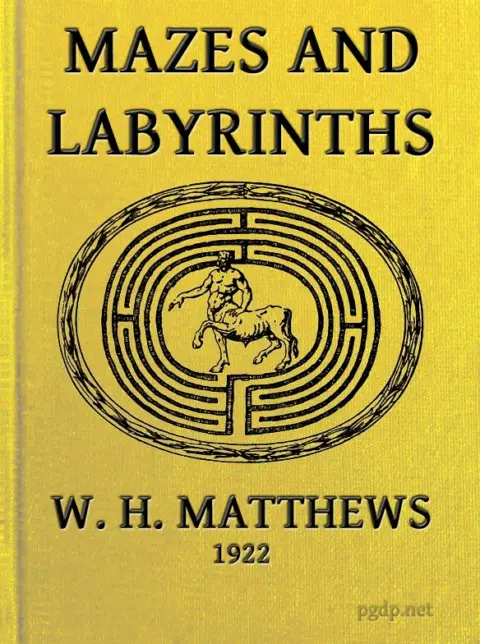
"Mazes and Labyrinths: A General Account of Their History and Development" by W. H. Matthews is a historical account published in the early 20th century, specifically in 1922. The book explores the history, significance, and various forms of mazes and labyrinths across cultures, from ancient Egypt to medieval Europe. It aims to provide a comprehensive survey of the labyrinthine concept that has fascinated humanity for centuries. The opening of the book begins with a preface that discusses the author’s inspiration for exploring the subject of mazes and labyrinths, rooted in a child's innocent inquiry about their origins during seaside sand constructions. Matthews expresses a desire to offer a readable examination of labyrinths, recognizing their allure beyond their historical and archaic significance. He sets the stage for an exploration that will include archaeological insights and literary references, diverging from solely academic interpretations to engage a broader audience. In this introduction, he emphasizes the ambiguity in the definitions of “maze” and “labyrinth,” hinting at the intricate relationships between their physical and metaphorical meanings, which will be further elaborated in the chapters to come.
Introduction adapted from the source catalogue; source summaries may be automatically generated.
Free to read · English · 62,708 words · No account needed
MAKE TIME FOR A GOOD BOOK
On by default. Untick to stop anonymous reading totals. Each page counts after 10 seconds in view. How this works.
Anonymous counting is on unless you have switched it off.
Compound words formed with "maze," on the other hand, are usually of an old-fashioned or local character, such as "Maze-Sunday," which in Devonshire dialect signifies a Sunday given up to feasting; such compounds are rarely formed for scientific or technical purposes. The sheet glass which is obscured by a system of wrinkles on its surface is, however, sometimes known as "maze-glass."
The word maze is probably of Scandinavian origin. Its oldest significance seems to be that of a state of bewilderment or confusion, or of being wrapped in thought--a use which we nowadays regard as metaphorical. In the Swedish and Norwegian languages are related words which mean on the one hand to dream, or lounge, or to move about in an idle or lazy manner, and on the other hand to chatter or indulge in aimless talk.
Some dictionaries formerly stated that it was derived from an Anglo-Saxon word mase, meaning "a whirlpool," but it has been shown that there was no such word.
In various dialects it is still used in its original sense. One may often hear from the older type of country folk such expressions as "It fair mazed me to see it," giving one the feeling that the syllable "a-" has been dropped, whereas it was never there. In Shakespeare the expression frequently occurs. Titania, in "Midsummer Night's Dream" (Act II, Sc. 2), says:
"... the spring, the summer,
The childing autumn, angry winter, change
Their wonted liveries; and the maz'd world,
By their increase, now knows not which is which."
Talbot of Shrewsbury, in his dire straits before the walls of Bordeaux ("King Henry VI," Pt. I, Act IV, Sc. 2), exclaims:
"O, negligent and heedless discipline!
How are we park'd and bounded in a pale,--
A little herd of England's timorous deer,
Maz'd with a yelping kennel of French curs!"
(See also "King Henry VIII," Act II, Sc. 4, line 185.)
That the word as here quoted has no identity with the word "amazed" is clear from a comparison of its context with that of the latter in the numerous instances of its employment by Shakespeare. The verb "to maze" is found in Chaucer:
"'Ye maze, maze, gode sire,' quod she,
'This thank have I for I have maad yow see.'"
(The Marchantes Tale, l. 2387.)
In the sense of crazy, wild, or thoughtless, we find it in the dialect expressions "Mazed-antic" and "Mazegerry."
As a metaphor it is employed in like manner to its Greek equivalent. In "The Taming of the Shrew" Petruchio declares: "I have thrust myself into this maze, Haply to wive and thrive as best I may." "Let us," says Pope, in the "Essay on Man,"
Your reading position is saved on this browser. Take it to another device with a library code. Reading pages adapt to text, rather than matching a printed edition.
BEHIND THE BOOK
This eBook is for the use of anyone anywhere in the United States and most other parts of the world at no cost and with almost no restrictions whatsoever. You may copy it, give it away or re-use it under the terms of the Project Gutenberg License included with this eBook or online at www.gutenberg.org. If you are not located in the United States, you will have to check the laws of the country where you are located before using this eBook. Read the source licence.
The original source file, including credits and licence, is retained by this library. Request an original-format copy at no charge. Please include the book title and Project Gutenberg identifier #46238.
KEEP YOUR CURIOSITY GOING
Cécile Tormay

Moritz Busch
John L. Ransom
Frances Wright
Cécile Tormay

Mabel Potter Daggett