THE CLASSIC COLLECTION✦A dead man’s diaryCLASSIC FREE BOOKS
A dead man’s diary
Coulson Kernahan
THE CLASSIC COLLECTION · 1930
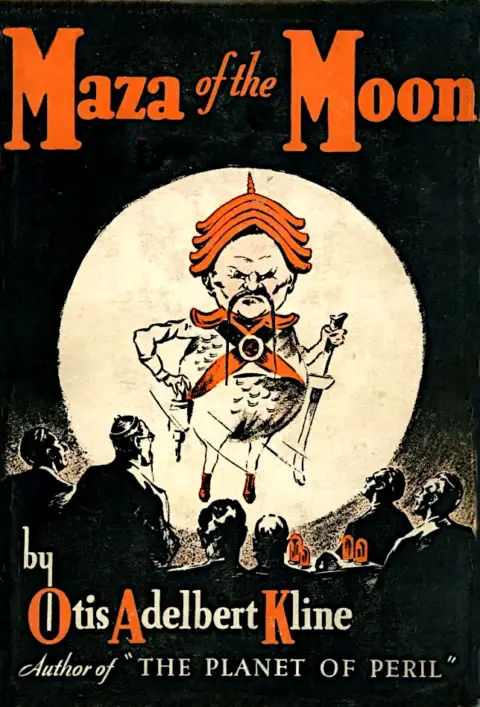
Maza of the Moon is a science fiction novel by Otis Adelbert Kline. It was first published in book form in 1930 by A C McClurg & Co. The novel was originally serialized in four parts in the magazine Argosy beginning in December 1929. (This summary is from Wikipedia.)
Introduction adapted from the source catalogue; source summaries may be automatically generated.
Free to read · English · 50,298 words · No account needed
MAKE TIME FOR A GOOD BOOK
On by default. Untick to stop anonymous reading totals. Each page counts after 10 seconds in view. How this works.
Anonymous counting is on unless you have switched it off.
“Yes. Some new wrinkle of the Lunites, I fancy. They are clever and resourceful and, for all we know, a thousand years ahead of us in scientific knowledge.”
“What do you suppose it is?”
“I don’t know. An observation might be made from here, seeing that this part of the country is unaffected, if it were not for the raging storm. But it would be suicidal to go up in an electroplane just now.”
“If I thought there were anything to be learned, I’d go up,” said Roger, “danger or no danger.”
“I mentioned it only as a possibility,” replied the professor. “The probability is, that if you did learn anything, it would be of no material value, even if you were to be so extremely fortunate as to get back alive with it.”
“Nevertheless,” replied Roger, “I’m going up, just on the strength of that possibility.”
“Don’t be an utter fool,” warned the professor, but Roger was already
calling Bevans.
“Have the Blettendorf 800 ready in five minutes,” he said. “I’ll be up
in a jiffy.”
He dressed rapidly while the professor remonstrated with him.
“No use,” said Roger, “I’m going.”
“Very well,” replied the professor. “If you must go I’ll go with you. Perhaps the two of us can bring back some information of value—if we get back.”
They took the elevator to the top, stepped out on the roof, and battled their way through the driving rain, in which there was beginning to be a hint of sleet, to the electroplane. Eight men held it, just outside the hangar, while Bevans, in the pilot’s seat, tested the motor.
The two men entered and took their seats. Then Roger gave the order to ascend. Came a roar from the helicopter blades, and they were off.
As they rose above the skyscrapers of Chicago, their craft tossing and careening like a leaf in a gale, Roger took two parcels from beneath the seat, one of which he handed to the professor.
“Folding parachutes,” he said. “Bevans is wearing one. Watch how I strap mine on, and do likewise. We may need them.”
The wind swept them out over Lake Michigan—then they plunged into a swirling, blinding snowstorm, and everything below, even the powerful guide-lights of Chicago’s great landing fields, vanished.
With propeller and helicopter blades roaring, Bevans drove the plane higher and higher, until they at length emerged above the seething, moon-silvered clouds.
“No green moonlight here,” said the professor.
“But look—look to the southeast!” exclaimed Roger.
Your reading position is saved on this browser. Take it to another device with a library code. Reading pages adapt to text, rather than matching a printed edition.
BEHIND THE BOOK
This eBook is for the use of anyone anywhere in the United States and most other parts of the world at no cost and with almost no restrictions whatsoever. You may copy it, give it away or re-use it under the terms of the Project Gutenberg License included with this eBook or online at www.gutenberg.org. If you are not located in the United States, you will have to check the laws of the country where you are located before using this eBook. Read the source licence.
The original source file, including credits and licence, is retained by this library. Request an original-format copy at no charge. Please include the book title and Project Gutenberg identifier #77596.
KEEP YOUR CURIOSITY GOING
Coulson Kernahan

Maurice Baring
Frances Wright
Cécile Tormay

Frederic Jesup Stimson

W. H. P. (William Henry Pope) Jarvis