THE CLASSIC COLLECTION✦A dead man’s diaryCLASSIC FREE BOOKS
A dead man’s diary
Coulson Kernahan
THE CLASSIC COLLECTION · 1930
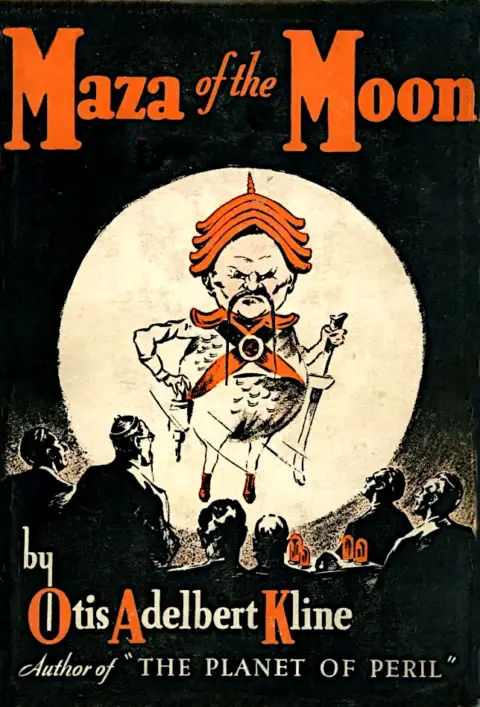
Maza of the Moon is a science fiction novel by Otis Adelbert Kline. It was first published in book form in 1930 by A C McClurg & Co. The novel was originally serialized in four parts in the magazine Argosy beginning in December 1929. (This summary is from Wikipedia.)
Introduction adapted from the source catalogue; source summaries may be automatically generated.
Free to read · English · 50,298 words · No account needed
MAKE TIME FOR A GOOD BOOK
On by default. Untick to stop anonymous reading totals. Each page counts after 10 seconds in view. How this works.
Anonymous counting is on unless you have switched it off.
“He went alone in a small interplanetary vehicle of his own invention, knowing that the war would be in full swing before his larger vehicle could be completed.”
“Well I’ll be damned!” exploded the President. “This is a pretty how d’ye do. Gone just when we need him most.”
“I’m sorry,” answered Roger, “but he hoped to be able to stop the war by this trip. If there’s anything I can do—”
“Maybe there is,” said the President, with forced calmness. “Perhaps you can explain some things that I had hoped he could explain. For instance, what is the cause of this intensely cold weather in the middle of the summer, and why does the moonlight appear green?”
“We can’t see the moon from here,” replied Roger, “and it’s not cold. There is a terrific storm raging, plenty of lightning, rain and wind, but no cold.”
“A devastating cold wave has spread over this part of the country, affecting Washington and Baltimore, and extending as far south as Richmond,” said the President. “The Potomac is frozen solid, and although we have our heating plants going to the utmost capacity, it is impossible to keep warm. Thousands of people, caught unexpectedly, have perished from the intense cold. My thermometer here in the White House registers 10° above zero. Outside, I am told the thermometers have dropped under 60° below zero, Fahrenheit.”
“And you say the moon looks green?”
“As green as grass. The country is bathed in a weird, green light at
this moment.”
“Must be some connection,” mused Roger, “I mean between the green light and the intense cold localized around Washington. Wish Mr. Dustin were here.”
“But he isn’t,” snapped the President, “so see what you can find out, and report back, either by radiovisiphone or in person at your earliest convenience. Off!”
As the face of the President disappeared from the disc, Roger slumped down in his chair and lighted a cigarette. What should he do? What could he do?
There was a tap at the door.
“Come in,” he said, listlessly.
Professor Ederson entered.
“No use to try to use the radio tonight,” he said. “With the unknown interference we have been getting lately and this storm, it would be useless to try to communicate with the moon. I had our operator notify all stations that we wouldn’t attempt it tonight.”
“Hear about the cold snap in the east?” asked Roger.
“Yes. Got it on the small set just before I came down. Terrible thing,
isn’t it?”
“And about the green moonlight?”
Your reading position is saved on this browser. Take it to another device with a library code. Reading pages adapt to text, rather than matching a printed edition.
BEHIND THE BOOK
This eBook is for the use of anyone anywhere in the United States and most other parts of the world at no cost and with almost no restrictions whatsoever. You may copy it, give it away or re-use it under the terms of the Project Gutenberg License included with this eBook or online at www.gutenberg.org. If you are not located in the United States, you will have to check the laws of the country where you are located before using this eBook. Read the source licence.
The original source file, including credits and licence, is retained by this library. Request an original-format copy at no charge. Please include the book title and Project Gutenberg identifier #77596.
KEEP YOUR CURIOSITY GOING
Coulson Kernahan

Maurice Baring
Frances Wright
Cécile Tormay

Frederic Jesup Stimson

W. H. P. (William Henry Pope) Jarvis