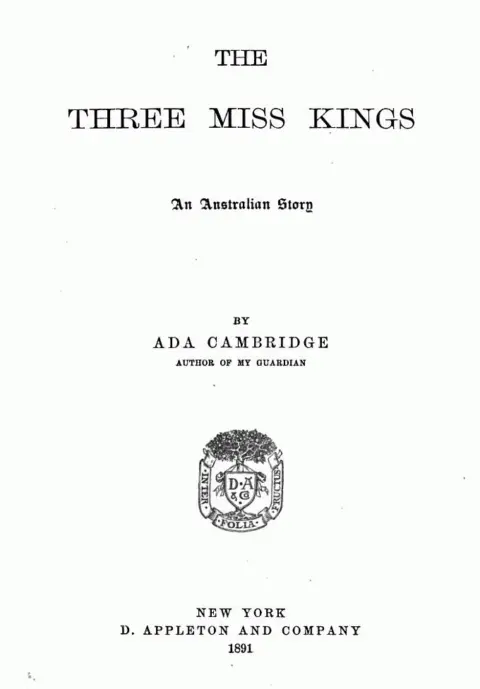
The Three Miss Kings: An Australian Story
Ada Cambridge
THE CLASSIC COLLECTION · 1898
"Materfamilias" by Ada Cambridge is a novel written in the late 19th century. The story centers on Mary, who navigates difficult personal choices after her father's remarriage to her governess, highlighting themes of love, duty, and resilience. As she embarks on a journey to re-establish a connection with her estranged husband, Edward, the narrative explores her relationships, self-discovery, and the societal pressures of the time. The opening of "Materfamilias" introduces us to Mary as she grapples with familial upheaval following her father's second marriage, and her decision to leave home rather than accept a new mother figure. Striking out on her own, Mary marries Edward in secrecy, but finds herself struggling with the harsh realities of life, particularly when she learns of her husband's illness in Australia. Determined to be by his side, she embarks on a challenging voyage aboard a small ship captained by Thomas Braye. Her feelings of vulnerability and the budding sense of companionship with Captain Braye set the stage for Mary’s growth and transformation throughout the narrative. The opening thus lays the groundwork for an exploration of marriage, independence, and the complexities of motherhood amid societal expectations.
Introduction adapted from the source catalogue; source summaries may be automatically generated.
Free to read · English · 62,007 words · No account needed
MAKE TIME FOR A GOOD BOOK
On by default. Untick to stop anonymous reading totals. Each page counts after 10 seconds in view. How this works.
Anonymous counting is on unless you have switched it off.
The woman--who, I found, was actually privy to the whole affair--Tom's doing, no doubt--began to give her opinion, as is the way of those nurses. "If you'll take my advice," said she, "you'll let him see her now, and sleep afterwards. It'll tire him less than fretting for her."
"And if you will be so good as to mind your own business," I replied, quietly but firmly, "I shall be infinitely obliged to you."
I had not been out of the room five minutes before Tom came to seek me, looking quite hoity-toity, as if he thought himself aboard ship again, with sailors.
"Now then, Polly," he said, "I'm not going to have any more nonsense
about this. The boy is too weak to be worried. I am going to fetch
Emily."
"Since when," I asked, "has it been your habit to call her Emily?"
He stared, and looked confused. "I suppose," he said, "I've caught it
from Harry."
"Talking with him so much about her, when it was so necessary to keep him calm? And to that nurse woman, behind my back--as if the private concerns of our family were any concern of servants! Tom, I didn't think you would ever be disloyal to me."
"I don't think I ever have been, Polly. What's more, I don't think you would ever imagine such a thing in cool blood. Come, you are not going to spoil this happy day for us all, are you? The boy has been given back to us by a miracle----"
That was enough. I flung myself into his arms.
"Forgive me! Forgive me!" I cried. "I know it is wicked of me. But you don't know how I feel it, Tom!"
"Yes, I do, pet; I know exactly."
"No one but a mother can know. I used to be everything to him once, and now he is only glad to get well because of her!"
"Well, it's natural. We----"
"No, we didn't. We had no mothers. But never mind--I won't be selfish. I will go and fetch her at once."
"Would you rather I went?"
"Certainly not! Do you suppose I want them to go on thinking that you are their only friend, and I their implacable enemy? I want to make him happy as much as ever you can do."
"That's right, old girl. If you're going to do a kind thing, do it the kindest way you know. They'll be just fit to worship you, both of 'em."
I did not ask to be worshipped, but I did want my boy to love his mother a little. I ran to him, brushing the nurse aside.
Your reading position is saved on this browser. Take it to another device with a library code. Reading pages adapt to text, rather than matching a printed edition.
Ada Cambridge
Ada Cambridge
Ada Cambridge
Ada Cambridge
BEHIND THE BOOK
This eBook is for the use of anyone anywhere in the United States and most other parts of the world at no cost and with almost no restrictions whatsoever. You may copy it, give it away or re-use it under the terms of the Project Gutenberg License included with this eBook or online at www.gutenberg.org. If you are not located in the United States, you will have to check the laws of the country where you are located before using this eBook. Read the source licence.
The original source file, including credits and licence, is retained by this library. Request an original-format copy at no charge. Please include the book title and Project Gutenberg identifier #40659.
KEEP YOUR CURIOSITY GOING
Coulson Kernahan

Maurice Baring
Frances Wright
Cécile Tormay

Frederic Jesup Stimson

W. H. P. (William Henry Pope) Jarvis