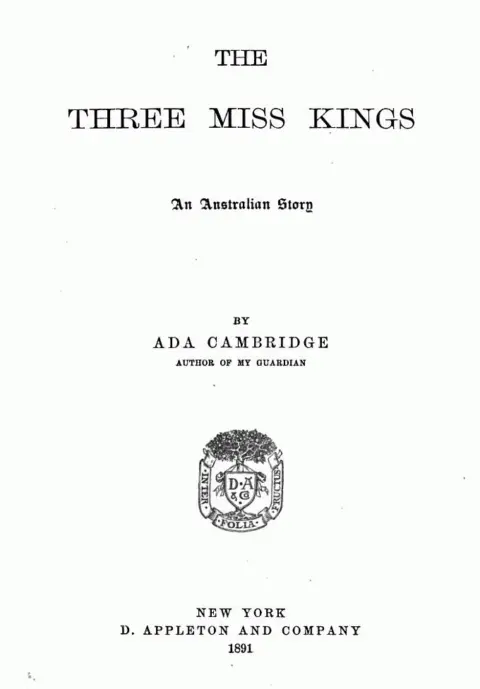
The Three Miss Kings: An Australian Story
Ada Cambridge
THE CLASSIC COLLECTION · 1898
"Materfamilias" by Ada Cambridge is a novel written in the late 19th century. The story centers on Mary, who navigates difficult personal choices after her father's remarriage to her governess, highlighting themes of love, duty, and resilience. As she embarks on a journey to re-establish a connection with her estranged husband, Edward, the narrative explores her relationships, self-discovery, and the societal pressures of the time. The opening of "Materfamilias" introduces us to Mary as she grapples with familial upheaval following her father's second marriage, and her decision to leave home rather than accept a new mother figure. Striking out on her own, Mary marries Edward in secrecy, but finds herself struggling with the harsh realities of life, particularly when she learns of her husband's illness in Australia. Determined to be by his side, she embarks on a challenging voyage aboard a small ship captained by Thomas Braye. Her feelings of vulnerability and the budding sense of companionship with Captain Braye set the stage for Mary’s growth and transformation throughout the narrative. The opening thus lays the groundwork for an exploration of marriage, independence, and the complexities of motherhood amid societal expectations.
Introduction adapted from the source catalogue; source summaries may be automatically generated.
Free to read · English · 62,007 words · No account needed
MAKE TIME FOR A GOOD BOOK
On by default. Untick to stop anonymous reading totals. Each page counts after 10 seconds in view. How this works.
Anonymous counting is on unless you have switched it off.
Does love fly out of the window when poverty walks in at the door? No, no--of course not! Only when love is an imitation love, selfish and cowardly, as true love can never be. I am sure ours stayed with us always, no matter how cramped and starved. We never felt a regret for having married each other, even when the practical consequences were most unpleasant--never, never, not for a single instant. And yet--and yet--well, it is all over now. One need not make one's self gratuitously uncomfortable by reviving memories of hardships long gone by, and never likely to be repeated.
Another thing. Is it fair that a sea-captain should have such miserable wage for such magnificent work? He has no play-hours, like other working men, no nights' rest, no evenings at home, no Saturday holidays--no Sundays even--and no comfort of his wife and family. He is exposed to weather that you would not turn a dog into, and to fatigue only measured by the extent of human endurance; and accepts both without a thought of protest. He has the most awful responsibilities continually on his mind, as to which he is more inflexibly conscientious than any landsman living; and he is broken and ruined if an accident happens that he is but technically to blame for and did his utmost to prevent. Yet all he gets in return is a paltry twenty pounds a month! At least, that is what Tom got--with an English certificate and a record without a flaw. It is because sailors are not money-grubbers, as landsmen are, that the money-grubbers take advantage of them.
Tom used to bring his money home and give it all to me, and he almost apologised for having to ask for a little now and then, to provide himself with clothes and tobacco. Moreover, he never pried into my spendings, though anxious that I should be strict and careful, and pleased to be asked to advise me and to audit my small accounts. In this he was the most gentlemanly husband I ever heard of. And of course I strained every nerve to manage for the best, and prove myself worthy of the confidence reposed in me. But I was not much of a housekeeper in those days. At home Miss Coleman had attended to everything, even to the buying of my frocks; for my father had never made me an allowance--which I do think is so wrong of fathers! If you are not taught the value of money when you are a girl, how are you to help muddling and blundering when you are a married woman?--especially if you marry a poor man. I thought at first that twenty pounds a month was riches. But even at the first, and though we used enough of Aunt Kate's wedding present to cover the cost of setting up a house, there seemed nothing left over at the month's end, try as I would to be economical. When the second draft came I had doctor's and nurse's fees like lead upon my mind; we did not invest that hundred at all, and it melted like smoke. And then--before Harry was fairly out of arms--Phyllis was born, and I was delicate for a long time; without a second servant my nursery cares would have killed me. I thought Aunt Kate would have sent me help again, but she did not--perhaps because I had neglected to write to her, being always so taken up with household cares. And I got into arrears with the tradesmen, and into the way of paying them "something on account," as I could spare the money and not as it was due; and this wrecked the precise system that Tom had made such a point of, so that I kept things from him rather than have him worried when he wanted rest. And it was miserable to be struggling by myself, weighed down with sordid anxieties, tossing awake at night to think and think what I could do, never any nearer to a solution of the everlasting difficulty, but rather further and further off. And I know I was very cross and fretful--how could I help it?--and that my poor boy must often have found the home that should have cheered him a depressing place. He seemed not to like to sleep while I was muddling about, and used to look after the children, or clean the knives and boots, when he should have been recruiting in his bed for the next voyage. For I was again obliged to do as I could with one poor maid-of-all-work, and I am afraid--I really am a little afraid sometimes--that I have a tendency to be inconsiderate when I have much to think of.
Your reading position is saved on this browser. Take it to another device with a library code. Reading pages adapt to text, rather than matching a printed edition.
Ada Cambridge
Ada Cambridge
Ada Cambridge
Ada Cambridge
BEHIND THE BOOK
This eBook is for the use of anyone anywhere in the United States and most other parts of the world at no cost and with almost no restrictions whatsoever. You may copy it, give it away or re-use it under the terms of the Project Gutenberg License included with this eBook or online at www.gutenberg.org. If you are not located in the United States, you will have to check the laws of the country where you are located before using this eBook. Read the source licence.
The original source file, including credits and licence, is retained by this library. Request an original-format copy at no charge. Please include the book title and Project Gutenberg identifier #40659.
KEEP YOUR CURIOSITY GOING
Coulson Kernahan

Maurice Baring
Frances Wright
Cécile Tormay

Frederic Jesup Stimson

W. H. P. (William Henry Pope) Jarvis