THE CLASSIC COLLECTION✦South Australia and Western AustraliaCLASSIC FREE BOOKS
South Australia and Western Australia
Anthony Trollope
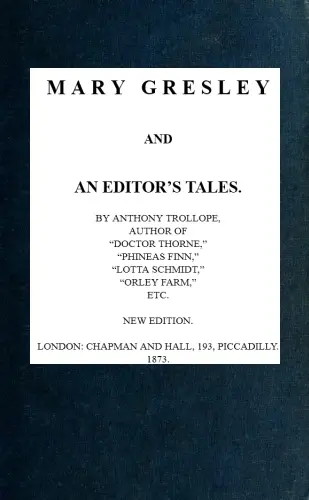
THE CLASSIC COLLECTION · 1873
"Mary Gresley and An Editor's Tales" by Anthony Trollope is a fictional narrative written in the late 19th century. The story introduces Mary Gresley, a young woman whose beauty belies her profound emotional depth, as she navigates the challenges of her life marked by a heartbreaking engagement and aspirations to become a writer. Her journey highlights themes of love, ambition, and the struggles inherent in seeking validation and support in a world that often feels indifferent. The opening of the narrative centers around the character of Mary Gresley, who, despite her trials, is portrayed as possessing an alluring charm that captivates those around her. As she faces the reality of her engagement to a curate while grappling with her literary ambitions, the narration explores her inner conflict and her interactions with an editor who becomes pivotal in her pursuit of a writing career. The tone is reflective, guiding readers through the emotional landscape of Mary’s life and setting the stage for the complexities of her aspirations and relationships. The interplay between Mary's emotional struggles and her literary ambitions underlines the poignancy of her character and the societal expectations that shape her fate.
Introduction adapted from the source catalogue; source summaries may be automatically generated.
Free to read · English · 80,796 words · No account needed
MAKE TIME FOR A GOOD BOOK
On by default. Untick to stop anonymous reading totals. Each page counts after 10 seconds in view. How this works.
Anonymous counting is on unless you have switched it off.
A fortnight had been given to us to prepare our matter, and during that fortnight I saw none of my colleagues. I purposely kept myself apart from them in order that I might thus give a fairer chance to the scheme which had been adopted. Others might borrow or lend their pages, but I would do the work allotted to me, and would attend the next meeting as anxious for the establishment and maintenance of the Panjandrum as I had been when I had hoped that the great consideration which I had given personally to the matter might have been allowed to have some weight. And gradually, as I devoted the first day of my fortnight to thinking of my work, I taught myself to hope again, and to look forward to a time when, by the sheer weight of my own industry and persistency, I might acquire that influence with my companions of which I had dreamed of becoming the master. After all, could I blame them for not trusting me, when as yet I had given them no ground for such confidence? What had I done that they should be willing to put their thoughts, their aspirations, their very brains and inner selves under my control? But something might be done which would force them to regard me as their leader. So I worked hard at my twenty-one pages, and during the fortnight spoke no word of the “Panjandrum” to any human being.
But my work did not get itself done without very great mental distress. The choice of a subject had been left free to each contributor. For myself I would almost have preferred that some one should have dictated to me the matter to which I should devote myself. How would it be with our first number if each of us were to write a political essay of exactly twenty-one pages, or a poem of that length in blank verse, or a humorous narrative? Good Heavens! How were we to expect success with the public if there were no agreement between ourselves as to the nature of our contributions no editorial power in existence for our mutual support. I went down and saw Mr. X., and found him to be almost indifferent as to the magazine. “You see, Sir,” said he, “the matter isn’t in my hands. If I can give any assistance, I shall be very happy; but it seems to me that you want some one with experience.” “I could have put them right if they’d have let me,” I replied. He was very civil, but it was quite clear to me that Mr. X.’s interest in the matter was over since the day of his banishment from Mrs. St. Quinten’s tea-table. “What do you think is a good sort of subject,” I asked him,--as it were cursorily; “with a view, you know, to the eye of the public, just at the present moment?” He declined to suggest any subject, and I was thrown back among the depths of my own feelings and convictions. Now, could we have blended our elements together, and discussed all this in really amicable council, each would have corrected what there might have been of rawness in the other, and in the freedom of conversation our wits would have grown from the warmth of mutual encouragement. Such, at least, was my belief then. Since that I have learned to look at the business with eyes less enthusiastic. Let a man have learned the trick of the pen, let him not smoke too many cigars overnight, and let him get into his chair within half an hour after breakfast, and I can tell you almost to a line how much of a magazine article he will produce in three hours. It does not much matter what the matter be,--only this, that if his task be that of reviewing, he may be expected to supply a double quantity. Three days, three out of the fourteen, passed by, and I could think of no fitting subject on which to begin the task I had appointed myself of teaching the British public. Politics at the moment were rather dull, and no very great question was agitating the minds of men. Lord Melbourne was Prime Minister, and had in the course of the Session been subjected to the usual party attacks. We intended to go a great deal further than Lord Melbourne in advocating Liberal measures, and were disposed to regard him and his colleagues as antiquated fogies in Statecraft; but, nevertheless, as against Sir Robert Peel, we should have given him the benefit of our defence. I did not, however, feel any special call to write up Lord Melbourne. Lord John was just then our pet minister; but even on his behalf I did not find myself capable of filling twenty-one closely-printed pages with matter which should really stir the public mind. In a first number, to stir the public mind is everything. I didn’t think that my colleagues sufficiently realised that fact,--though I had indeed endeavoured to explain it to them. In the second, third, or fourth publication you may descend gradually to an ordinary level; you may become,--not exactly dull, for dulness in a magazine should be avoided,--but what I may perhaps call “adagio” as compared with the “con forza” movement with which the publication certainly should be opened. No reader expects to be supplied from month to month with the cayenne pepper and shallot style of literature; but in the preparation of a new literary banquet, the first dish cannot be too highly spiced. I knew all that,--and then turned it over in my mind whether I could not do something about the ballot.
Your reading position is saved on this browser. Take it to another device with a library code. Reading pages adapt to text, rather than matching a printed edition.
Anthony Trollope

Anthony Trollope

Anthony Trollope

Anthony Trollope
BEHIND THE BOOK
This eBook is for the use of anyone anywhere in the United States and most other parts of the world at no cost and with almost no restrictions whatsoever. You may copy it, give it away or re-use it under the terms of the Project Gutenberg License included with this eBook or online at www.gutenberg.org. If you are not located in the United States, you will have to check the laws of the country where you are located before using this eBook. Read the source licence.
The original source file, including credits and licence, is retained by this library. Request an original-format copy at no charge. Please include the book title and Project Gutenberg identifier #54783.
KEEP YOUR CURIOSITY GOING
Coulson Kernahan

Maurice Baring
Frances Wright
Cécile Tormay

Frederic Jesup Stimson

W. H. P. (William Henry Pope) Jarvis