THE CLASSIC COLLECTION✦South Australia and Western AustraliaCLASSIC FREE BOOKS
South Australia and Western Australia
Anthony Trollope
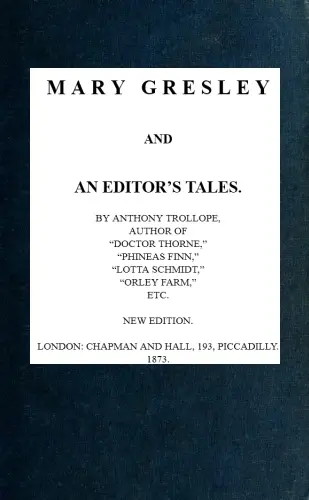
THE CLASSIC COLLECTION · 1873
"Mary Gresley and An Editor's Tales" by Anthony Trollope is a fictional narrative written in the late 19th century. The story introduces Mary Gresley, a young woman whose beauty belies her profound emotional depth, as she navigates the challenges of her life marked by a heartbreaking engagement and aspirations to become a writer. Her journey highlights themes of love, ambition, and the struggles inherent in seeking validation and support in a world that often feels indifferent. The opening of the narrative centers around the character of Mary Gresley, who, despite her trials, is portrayed as possessing an alluring charm that captivates those around her. As she faces the reality of her engagement to a curate while grappling with her literary ambitions, the narration explores her inner conflict and her interactions with an editor who becomes pivotal in her pursuit of a writing career. The tone is reflective, guiding readers through the emotional landscape of Mary’s life and setting the stage for the complexities of her aspirations and relationships. The interplay between Mary's emotional struggles and her literary ambitions underlines the poignancy of her character and the societal expectations that shape her fate.
Introduction adapted from the source catalogue; source summaries may be automatically generated.
Free to read · English · 80,796 words · No account needed
MAKE TIME FOR A GOOD BOOK
On by default. Untick to stop anonymous reading totals. Each page counts after 10 seconds in view. How this works.
Anonymous counting is on unless you have switched it off.
After that I was silent for awhile, thinking it well to keep myself in the background. But no one seemed to be ready for speech. Walter Watt fingered his manuscript uneasily, and Mrs. St. Quinten made some remark not distinctly audible as to the sheets on the sofa. “But I must get rid of the tray first,” she said. Churchill Smith sat perfectly still with his roll in his pocket. “Mrs. St. Quinten and gentlemen,” I said, “I am happy to tell you that I have had a contribution handed to me which will go far to grace our first number. Our friend Regan has done ‘Lord Bateman’ into Latin verse with a Latinity and a rhythm so excellent that it will go far to make us at any rate equal to anything else in that line.” Then I produced the translated ballad, and the little episode took place which I have already described. Mrs. St. Quinten insisted on understanding in detail, and it was rejected. “Then upon my word I don’t know what you are to get,” said I. “Latin translations are not indispensable,” said Walter Watt. “No doubt we can live without them,” said Pat, with a fine good humour. He bore the disgrace of having his first contribution rejected with admirable patience. There was nothing he could not bear. To this day he bears being Attorney-General at the Turtle Islands.
Something must be done. “Perhaps,” said I, turning to the lady, “Mrs. St. Quinten will begin by giving us her ideas as to our first number. She will tell us what she intends to do for us herself.” She was still embarrassed by the tea-things. And I acknowledge that I was led to appeal to her at that moment because it was so. If I could succeed in extracting ideas they would be of infinitely more use to us than the reading of manuscript. To get the thing “licked into shape” must be our first object. As I had on this evening walked up to the sombre street leading into the new road in which Mrs. St. Quinten lived I had declared to myself a dozen times that to get the thing “licked into shape” was the great desideratum. In my own imaginings I had licked it into some shape. I had suggested to myself my own little introductory poem as a commencement, and Pat Regan’s Latin ballad as a pretty finish to the first number. Then there should be some thirty pages of dialogue,--or trialogue,--or hexalogue if necessary, between the different members of our Board, each giving, under an assumed name, his view of what a perfect magazine should be. This I intended to be the beginning of a conversational element which should be maintained in all subsequent numbers, and which would enable us in that light and airy fashion which becomes a magazine to discuss all subjects of politics, philosophy, manners, literature, social science, and even religion if necessary, without inflicting on our readers the dulness of a long unbroken essay. I was very strong about these conversations, and saw my way to a great success,--if I could only get my friends to act in concert with me. Very much depended on the names to be chosen, and I had my doubts whether Watt and Churchill Smith would consent to this slightly theatrical arrangement. Mrs. St. Quinten had already given in her adhesion, but was doubting whether she would call herself “Charlotte,”--partly after Charlotte Corday and partly after the lady who cut bread and butter, or “Mrs. Freeman,”--that name having, as she observed, been used before as a nom de plume,--or “Sophronie,” after Madame de Sévigné, who was pleased so to call herself among the learned ladies of Madame de Rambouillet’s bower. I was altogether in favour of Mrs. Freeman, which has the merit of simplicity; but that was a minor point. Jack Hallam had chosen his appellation. Somewhere in the Lowlands he had seen over a small shop-door the name of John Neverapenny; and “John Neverapenny” he would be. I turned it over on my tongue a score of times, and thought that perhaps it might do. Pat wanted to call himself “The O’Blazes,” but was at last persuaded to adopt the quieter name of “Tipperary,” in which county his family had been established since Ireland was,--settled I think he said. For myself I was indifferent. They might give me what title they pleased. I had had my own notion, but that had been rejected. They might call me “Jones” or “Walker,” if they thought proper. But I was very much wedded to the idea, and I still think that had it been stoutly carried out the results would have been happy.
Your reading position is saved on this browser. Take it to another device with a library code. Reading pages adapt to text, rather than matching a printed edition.
Anthony Trollope

Anthony Trollope

Anthony Trollope

Anthony Trollope
BEHIND THE BOOK
This eBook is for the use of anyone anywhere in the United States and most other parts of the world at no cost and with almost no restrictions whatsoever. You may copy it, give it away or re-use it under the terms of the Project Gutenberg License included with this eBook or online at www.gutenberg.org. If you are not located in the United States, you will have to check the laws of the country where you are located before using this eBook. Read the source licence.
The original source file, including credits and licence, is retained by this library. Request an original-format copy at no charge. Please include the book title and Project Gutenberg identifier #54783.
KEEP YOUR CURIOSITY GOING
Coulson Kernahan

Maurice Baring
Frances Wright
Cécile Tormay

Frederic Jesup Stimson

W. H. P. (William Henry Pope) Jarvis