THE CLASSIC COLLECTION✦South Australia and Western AustraliaCLASSIC FREE BOOKS
South Australia and Western Australia
Anthony Trollope
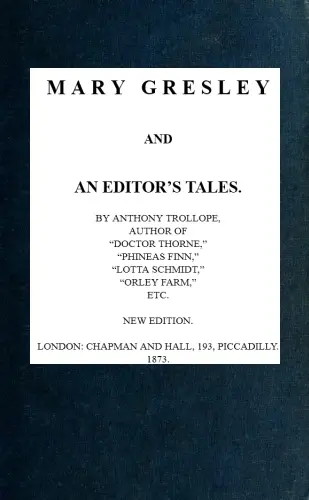
THE CLASSIC COLLECTION · 1873
"Mary Gresley and An Editor's Tales" by Anthony Trollope is a fictional narrative written in the late 19th century. The story introduces Mary Gresley, a young woman whose beauty belies her profound emotional depth, as she navigates the challenges of her life marked by a heartbreaking engagement and aspirations to become a writer. Her journey highlights themes of love, ambition, and the struggles inherent in seeking validation and support in a world that often feels indifferent. The opening of the narrative centers around the character of Mary Gresley, who, despite her trials, is portrayed as possessing an alluring charm that captivates those around her. As she faces the reality of her engagement to a curate while grappling with her literary ambitions, the narration explores her inner conflict and her interactions with an editor who becomes pivotal in her pursuit of a writing career. The tone is reflective, guiding readers through the emotional landscape of Mary’s life and setting the stage for the complexities of her aspirations and relationships. The interplay between Mary's emotional struggles and her literary ambitions underlines the poignancy of her character and the societal expectations that shape her fate.
Introduction adapted from the source catalogue; source summaries may be automatically generated.
Free to read · English · 80,796 words · No account needed
MAKE TIME FOR A GOOD BOOK
On by default. Untick to stop anonymous reading totals. Each page counts after 10 seconds in view. How this works.
Anonymous counting is on unless you have switched it off.
We had taken a chair,--well aware that nothing god-like could be thus achieved, and contented to obtain the larger amount of human comfort. The chairs are placed two and two, and a custom has grown up,--of which we scarcely think that the origin has been eastern,--in accordance with which friends occupying these chairs will spend their time in conversation. The true devotee to the Turkish bath will, we think, never speak at all; but when the speaking is low in tone, just something between a whisper and an articulate sound, the slight murmuring hum produced is not disagreeable. We cannot quite make up our mind whether this use of the human voice be or be not oriental; but we think that it adds to the mystery, and upon the whole it gratifies. Let it be understood, however, that harsh, resonant, clearly-expressed speech is damnable. The man who talks aloud to his friend about the trivial affairs of life is selfish, ignorant, unpoetical,--and English in the very worst sense of the word. Who but an ass proud of his own capacity for braying would venture to dispel the illusions of a score of bathers by observing aloud that the House sat till three o’clock that morning?
But though friends may talk in low voices, a man without a friend will hardly fall into conversation at the Turkish bath. It is said that our countrymen are unapt to speak to each other without introduction, and this inaptitude is certainly not decreased by the fact that two men meet each other with nothing on but a towel a piece. Finding yourself next to a man in such a garb you hardly know where to begin. And then there lies upon you the weight of that necessity of maintaining a certain dignity of deportment which has undoubtedly grown upon you since you succeeded in freeing yourself from your socks and trousers. For ourselves we have to admit that the difficulty is much increased by the fact that we are short-sighted, and are obligated, by the sudorific processes and by the shampooing and washing that are to come, to leave our spectacles behind us. The delicious wonder of the place is no doubt increased to us, but our incapability of discerning aught of those around us in that low gloomy light is complete. Jones from Friday Street, or even Walker from the Treasury, is the same to us as one of those Asiatic slaves who administer to our comfort, and flit about the place with admirable decorum and self-respect. On this occasion we had barely seated ourselves, when another bather, with slow, majestic step, came to the other chair; and, with a manner admirably adapted to the place, stretching out his naked legs, and throwing back his naked shoulders, seated himself beside us. We are much given to speculations on the characters and probable circumstances of those with whom we are brought in contact. Our editorial duties require that it should be so. How should we cater for the public did we not observe the public in all its moods? We thought that we could see at once that this was no ordinary man, and we may as well aver here, at the beginning of our story, that subsequent circumstances proved our first conceptions to be correct. The absolute features of the gentleman we did not, indeed, see plainly. The gloom of the place and our own deficiency of sight forbade it. But we could discern the thorough man of the world, the traveller who had seen many climes, the cosmopolitan to whom East and West were alike, in every motion that he made. We confess that we were anxious for conversation, and that we struggled within ourselves for an apt subject, thinking how we might begin. But the apt subject did not occur to us, and we should have passed that half-hour of repose in silence had not our companion been more ready than ourselves. “Sir,” said he, turning round in his seat with a peculiar and captivating grace, “I shall not, I hope, offend or transgress any rule of politeness by speaking to a stranger.” There was ease and dignity in his manner, and at the same time some slight touch of humour which was very charming. I thought that I detected just a hint of an Irish accent in his tone; but if so the dear brogue of his country, which is always delightful to me, had been so nearly banished by intercourse with other tongues as to leave the matter still a suspicion,--a suspicion, or rather a hope.
Your reading position is saved on this browser. Take it to another device with a library code. Reading pages adapt to text, rather than matching a printed edition.
Anthony Trollope

Anthony Trollope

Anthony Trollope

Anthony Trollope
BEHIND THE BOOK
This eBook is for the use of anyone anywhere in the United States and most other parts of the world at no cost and with almost no restrictions whatsoever. You may copy it, give it away or re-use it under the terms of the Project Gutenberg License included with this eBook or online at www.gutenberg.org. If you are not located in the United States, you will have to check the laws of the country where you are located before using this eBook. Read the source licence.
The original source file, including credits and licence, is retained by this library. Request an original-format copy at no charge. Please include the book title and Project Gutenberg identifier #54783.
KEEP YOUR CURIOSITY GOING
Coulson Kernahan

Maurice Baring
Frances Wright
Cécile Tormay

Frederic Jesup Stimson

W. H. P. (William Henry Pope) Jarvis