THE CLASSIC COLLECTION✦South Australia and Western AustraliaCLASSIC FREE BOOKS
South Australia and Western Australia
Anthony Trollope
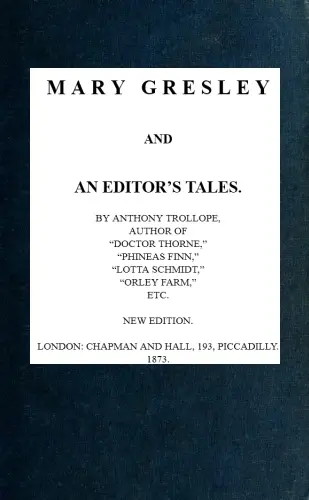
THE CLASSIC COLLECTION · 1873
"Mary Gresley and An Editor's Tales" by Anthony Trollope is a fictional narrative written in the late 19th century. The story introduces Mary Gresley, a young woman whose beauty belies her profound emotional depth, as she navigates the challenges of her life marked by a heartbreaking engagement and aspirations to become a writer. Her journey highlights themes of love, ambition, and the struggles inherent in seeking validation and support in a world that often feels indifferent. The opening of the narrative centers around the character of Mary Gresley, who, despite her trials, is portrayed as possessing an alluring charm that captivates those around her. As she faces the reality of her engagement to a curate while grappling with her literary ambitions, the narration explores her inner conflict and her interactions with an editor who becomes pivotal in her pursuit of a writing career. The tone is reflective, guiding readers through the emotional landscape of Mary’s life and setting the stage for the complexities of her aspirations and relationships. The interplay between Mary's emotional struggles and her literary ambitions underlines the poignancy of her character and the societal expectations that shape her fate.
Introduction adapted from the source catalogue; source summaries may be automatically generated.
Free to read · English · 80,796 words · No account needed
MAKE TIME FOR A GOOD BOOK
On by default. Untick to stop anonymous reading totals. Each page counts after 10 seconds in view. How this works.
Anonymous counting is on unless you have switched it off.
“Yes;--a ten-pound note,--just flung into the gutter. I wonder that you allowed yourself to have anything to do with such a woman.” We protested against this injustice, giving Mr. X. to know that he didn’t understand and couldn’t understand our business. “I’m not so sure of that,” said Mr. X. There was almost a quarrel, and we began to doubt whether Mrs. Brumby would not be the means of taking the very bread from out of our mouths. Mr. Sharp at last suggested that in spite of what he had seen from Mrs. Brumby, the lieutenant would probably be a gentleman. “Not a doubt about it,” said Mr. X., who was always fond of officers and of the army, and at the moment seemed to think more of a paltry lieutenant than of his own Editor.
Mr. Sharp actually pressed upon us and upon Mr. X. that we should call upon the lieutenant and explain matters to him. Mrs. Brumby had always been with us at twelve o’clock. “Go at noon,” said Mr. Sharp, “and you’ll certainly find her out.” He instructed us to tell the lieutenant “just the plain truth,” as he called it, and to explain that in no way could the proprietors of a magazine be made liable to payment for an article because the Editor in discharge of his duty had consented to read it. “Perhaps the lieutenant doesn’t know that his name has been used at all,” said Mr. Sharp. “At any rate, it will be well to learn what sort of a man he is.”
“A high minded gentleman, no doubt,” said Mr. X. the name of whose second boy was already down at the Horse Guards for a commission.
Though it was sorely against the grain, and in direct opposition to our own opinion, we were constrained to go to Harpur Street, Theobald’s Road, and to call upon Lieutenant Brumby. We had not explained to Mr. X. or to Mr. Sharp what had passed between Mrs. Brumby and ourselves when she suggested such a visit, but the memory of the words which we and she had then spoken was on us as we endeavoured to dissuade our lawyer and our publisher. Nevertheless, at their instigation, we made the visit. The house in Harpur Street was small, and dingy, and old. The door was opened for us by the normal lodging-house maid-of-all-work, who when we asked for the lieutenant, left us in the passage, that she might go and see. We sent up our name, and in a few minutes were ushered into a sitting-room up two flights of stairs. The room was not untidy, but it was as comfortless as any chamber we ever saw. The lieutenant was lying on an old horsehair sofa, but we had been so far lucky as to find him alone. Mr. Sharp had been correct in his prediction as to the customary absence of the lady at that hour in the morning. In one corner of the room we saw an old ram-shackle desk, at which, we did not doubt, were written those essays on costume and other subjects, in the disposing of which the lady displayed so much energy. The lieutenant himself was a small gray man, dressed, or rather enveloped, in what I supposed to be an old wrapper of his wife’s. He held in his hands a well-worn volume of a novel, and when he rose to greet us he almost trembled with dismay and bashfulness. His feet were thrust into slippers which were too old to stick on them, and round his throat he wore a dirty, once white, woollen comforter. We never learned what was the individual character of the corps which specially belonged to H.R.H. the Duke of Sussex; but if it was conspicuous for dash and gallantry, Lieutenant Brumby could hardly have held his own among his brother officers. We knew, however, from his wife that he had been invalided, and as an invalid we respected him. We proceeded to inform him that we had been called upon to pay him a sum of twenty-five guineas, and to explain how entirely void of justice any such claim must be. We suggested to him that he might be made to pay some serious sum by the lawyers he employed, and that the matter to us was an annoyance and a trouble,--chiefly because we had no wish to be brought into conflict with any one so respectable as Lieutenant Brumby. He looked at us with imploring eyes, as though begging us not to be too hard upon him in the absence of his wife, trembled from head to foot, and muttered a few words which were nearly inaudible. We will not state as a fact that the lieutenant had taken to drinking spirits early in life, but that certainly was our impression during the only interview we ever had with him. When we pressed upon him as a question which he must answer whether he did not think that he had better withdraw his claim, he fell back upon his sofa, and began to sob. While he was thus weeping Mrs. Brumby entered the room. She had in her hand the card which we had given to the maid-of-all-work, and was therefore prepared for the interview. “Sir,” she said, “I hope you have come to settle my husband’s just demands.”
Your reading position is saved on this browser. Take it to another device with a library code. Reading pages adapt to text, rather than matching a printed edition.
Anthony Trollope

Anthony Trollope

Anthony Trollope

Anthony Trollope
BEHIND THE BOOK
This eBook is for the use of anyone anywhere in the United States and most other parts of the world at no cost and with almost no restrictions whatsoever. You may copy it, give it away or re-use it under the terms of the Project Gutenberg License included with this eBook or online at www.gutenberg.org. If you are not located in the United States, you will have to check the laws of the country where you are located before using this eBook. Read the source licence.
The original source file, including credits and licence, is retained by this library. Request an original-format copy at no charge. Please include the book title and Project Gutenberg identifier #54783.
KEEP YOUR CURIOSITY GOING
Coulson Kernahan

Maurice Baring
Frances Wright
Cécile Tormay

Frederic Jesup Stimson

W. H. P. (William Henry Pope) Jarvis