THE CLASSIC COLLECTION✦South Australia and Western AustraliaCLASSIC FREE BOOKS
South Australia and Western Australia
Anthony Trollope
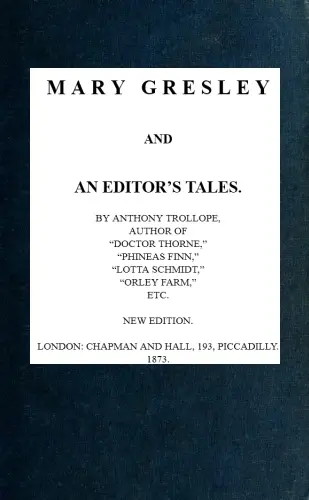
THE CLASSIC COLLECTION · 1873
"Mary Gresley and An Editor's Tales" by Anthony Trollope is a fictional narrative written in the late 19th century. The story introduces Mary Gresley, a young woman whose beauty belies her profound emotional depth, as she navigates the challenges of her life marked by a heartbreaking engagement and aspirations to become a writer. Her journey highlights themes of love, ambition, and the struggles inherent in seeking validation and support in a world that often feels indifferent. The opening of the narrative centers around the character of Mary Gresley, who, despite her trials, is portrayed as possessing an alluring charm that captivates those around her. As she faces the reality of her engagement to a curate while grappling with her literary ambitions, the narration explores her inner conflict and her interactions with an editor who becomes pivotal in her pursuit of a writing career. The tone is reflective, guiding readers through the emotional landscape of Mary’s life and setting the stage for the complexities of her aspirations and relationships. The interplay between Mary's emotional struggles and her literary ambitions underlines the poignancy of her character and the societal expectations that shape her fate.
Introduction adapted from the source catalogue; source summaries may be automatically generated.
Free to read · English · 80,796 words · No account needed
MAKE TIME FOR A GOOD BOOK
On by default. Untick to stop anonymous reading totals. Each page counts after 10 seconds in view. How this works.
Anonymous counting is on unless you have switched it off.
But she cared nothing for our “Madam,” and condescended to no apology. Rising from her chair, she asked us why we had not kept the promise we had made her to use her article in our next number. We don’t know how far our readers will understand all that was included in this accusation. Use her contribution in our next number! It had never occurred to us as probable, or hardly as possible, that we should use it in any number. Our eye glanced at the heap to see whether her fingers had been at work, but we perceived that the heap had not been touched. We have always flattered ourselves that no one can touch our heap without our knowing it. She saw the motion of our eye, and at once understood it. Mrs. Brumby, no doubt, possessed great intelligence, and, moreover, a certain majesty of demeanour. There was always something of the helmet of Minerva in the bonnet which she wore. Her shawl was an old shawl, but she was never ashamed of it; and she could always put herself forward, as though there were nothing behind her to be concealed, the concealing of which was a burden to her. “I cannot suppose,” she said, “that my paper has been altogether neglected!”
We picked out the roll with all the audacity we could assume, and proceeded to explain how very much in error she was in supposing that we had ever even hinted at its publication. We had certainly said that we would read it, mentioning no time. We never did mention any time in making any such promise. “You named a week, Sir,” said Mrs. Brumby, “and now a month has passed by. You assured me that it would be accepted unless returned within seven days. Of course it will be accepted now.” We contradicted her flatly. We explained, we protested, we threatened. We endeavoured to put the manuscript into her hand, and made a faint attempt to stick it into her bag. She was indignant, dignified, and very strong. She said nothing on that occasion about legal proceedings, but stuck manfully to her assertion that we had bound ourselves to decide upon her manuscript within a week. “Do you think, Sir,” said she, “that I would entrust the very essence of my brain to the keeping of a stranger, without some such assurance as that?” We acknowledged that we had undertaken to read the paper, but again disowned the week. “And how long would you be justified in taking?” demanded Mrs. Brumby. “If a month, why not a year? Does it not occur to you, Sir, that when the very best of my intellect, my inmost thoughts, lie there at your disposal,” and she pointed to the heap, “it may be possible that a property has been confided to you too valuable to justify neglect? Had I given you a ring to keep you would have locked it up, but the best jewels of my mind are left to the tender mercies of your charwoman.” What she said was absolutely nonsense,--abominable, villanous trash; but she said it so well that we found ourselves apologising for our own misconduct. There had perhaps been a little undue delay. In our peculiar business such would occasionally occur. When we had got to this, any expression of our wrath at her intrusion was impossible. As we entered the room we had intended almost to fling her manuscript at her head. We now found ourselves handling it almost affectionately while we expressed regret for our want of punctuality. Mrs. Brumby was gracious, and pardoned us, but her forgiveness was not of the kind which denotes the intention of the injured one to forget as well as forgive the trespass. She had suffered from us a great injustice; but she would say no more on that score now, on the condition that we would at once attend to her essay. She thrice repeated the words, “at once,” and she did so without rebuke from us. And then she made us a proposition, the like of which never reached us before or since. Would we fix an hour within the next day or two at which we would call upon her in Harpur Street and arrange as to terms? The lieutenant, she said, would be delighted to make our acquaintance. Call upon her!--upon Mrs. Brumby! Travel to Harpur Street, Theobald’s Road, on the business of a chance bit of scribbling, which was wholly indifferent to us except in so far as it was a trouble to us! And then we were invited to make arrangements as to terms! Terms!! Had the owner of the most illustrious lips in the land offered to make us known in those days to the partner of her greatness, she could not have done so with more assurance that she was conferring on us an honour, than was assumed by Mrs. Brumby when she proposed to introduce us to the lieutenant.
Your reading position is saved on this browser. Take it to another device with a library code. Reading pages adapt to text, rather than matching a printed edition.
Anthony Trollope

Anthony Trollope

Anthony Trollope

Anthony Trollope
BEHIND THE BOOK
This eBook is for the use of anyone anywhere in the United States and most other parts of the world at no cost and with almost no restrictions whatsoever. You may copy it, give it away or re-use it under the terms of the Project Gutenberg License included with this eBook or online at www.gutenberg.org. If you are not located in the United States, you will have to check the laws of the country where you are located before using this eBook. Read the source licence.
The original source file, including credits and licence, is retained by this library. Request an original-format copy at no charge. Please include the book title and Project Gutenberg identifier #54783.
KEEP YOUR CURIOSITY GOING
Coulson Kernahan

Maurice Baring
Frances Wright
Cécile Tormay

Frederic Jesup Stimson

W. H. P. (William Henry Pope) Jarvis