THE CLASSIC COLLECTION✦Lost DiariesCLASSIC FREE BOOKS
Lost Diaries
Maurice Baring
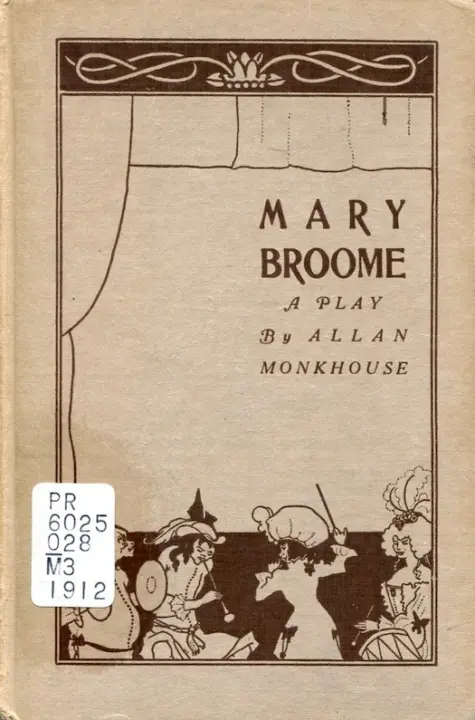
THE CLASSIC COLLECTION · 1912
"Mary Broome: A Comedy, in Four Acts" by Allan Monkhouse is a play written in the early 20th century. The story revolves around Mary Broome, a housemaid whose life takes a dramatic turn when the son of her employer becomes embroiled in an unexpected romantic entanglement with her. The play delves into themes of class, responsibility, and societal expectations, highlighting the contrasts between the lives of the upper middle class and their servants. At the start of the play, we are introduced to the various characters in the setting of a suburban home, preparing for an upcoming wedding. As preparations unfold, tension arises as Edgar Timbrell expresses his concerns about his best man, Leonard, who is depicted as charming yet irresponsible. The dynamics between the characters, particularly between Mary and Leonard, unfold in a way that hints at deeper issues, as Mary later confronts Leonard about his plans and intentions, leading to a moment of honesty that challenges societal norms regarding class and familial duty. The opening sets the stage for a complex exploration of these social themes as the characters navigate their relationships and the implications of their actions.
Introduction adapted from the source catalogue; source summaries may be automatically generated.
Free to read · English · 19,355 words · No account needed
MAKE TIME FOR A GOOD BOOK
On by default. Untick to stop anonymous reading totals. Each page counts after 10 seconds in view. How this works.
Anonymous counting is on unless you have switched it off.
LEONARD. Oh! I'm sure I shall find them quite amusing. No, I don't mean that. I mean interesting. Interesting; that's what I mean when I say amusing. They're coming up.
MARY. That's my father's voice.
LEONARD. Let's see--what does he do?
MARY. He's a cabman.
LEONARD. Heavens! Are there such things still! A growler or what?
[The door opens and MRS. GREAVES ushers in MR. AND MRS. BROOME. He is dingily arrayed but confronts misfortunes with a slightly defiant air. She is a rather sharp, quiet woman, shabbily dressed. She does not display much tenderness to her daughter but regards her with some solicitude. MRS. GREAVES watches the greetings curiously before retiring.]
MARY. [After kisses from father and mother.] This is my husband.
[There is some rather stiff hand shaking.]
MARY. Sit down, mother.
LEONARD. Sit down, Mr. Broome.
MARY. Baby's not very well as I told you, mother, and he's just off for the doctor. [To LEONARD.] Will you go?
LEONARD. Yes, certainly.
BROOME. Is he coming back?
LEONARD. Good, Mr. Broome, good. You read my thoughts.
BROOME. What?
LEONARD. I was just wondering whether I was coming back. How soon, I
mean.
BROOME. Well, it'd only be polite--and you've nothing to do, it seems?
You're out of a job too?
MARY. Are you, father?
MRS. BROOME. [Bitterly.] Ay, they've chucked him at last.
MARY. When?
MRS. BROOME. Only yesterday.
BROOME. [With gloomy joviality to LEONARD.] So there's two on us at
a loose end.
LEONARD. [Politely.] Yes, we ought to see something of one another, Mr. Broome. But I'm not exactly out of a job. I've never been in one.
BROOME. Oh! A gentleman of means.
LEONARD. Without means, Mr. Broome, without means.
BROOME. Then you've got someone to keep you.
LEONARD. No, Mr. Broome. No.
BROOME. Then how are you going to get along?
LEONARD. That's just what's been bothering us.
BROOME. You're a cool customer.
LEONARD. And how do you propose to get along, Mr. Broome?
BROOME. It's them bloomin' taxis that's done for me.
MARY. Can't you drive one, father?
BROOME. They wouldn't give me a try if I wanted. And I don't want. I
wouldn't touch the things.
LEONARD. You've had the bad luck to be attached to a decaying
industry.
BROOME. Decaying my eye! There's no call for it to decay.
LEONARD. You don't hold with modern notions--progress and things, Mr.
Broome?
BROOME. I don't hold with taxis. They'll find out their mistake.
MRS. BROOME. He will talk like that.
BROOME. And so would you if you'd druv a cab twenty-nine years.
MARY. But the taxis go faster, father, and you've only got to pay the
same.
Your reading position is saved on this browser. Take it to another device with a library code. Reading pages adapt to text, rather than matching a printed edition.
BEHIND THE BOOK
This eBook is for the use of anyone anywhere in the United States and most other parts of the world at no cost and with almost no restrictions whatsoever. You may copy it, give it away or re-use it under the terms of the Project Gutenberg License included with this eBook or online at www.gutenberg.org. If you are not located in the United States, you will have to check the laws of the country where you are located before using this eBook. Read the source licence.
The original source file, including credits and licence, is retained by this library. Request an original-format copy at no charge. Please include the book title and Project Gutenberg identifier #46298.
KEEP YOUR CURIOSITY GOING
Maurice Baring
W. B. (William Butler) Yeats
Edward Martyn

John Brougham & Charlotte Brontë
Marguerite Merington
Leonid Andreyev