THE CLASSIC COLLECTION✦Lost DiariesCLASSIC FREE BOOKS
Lost Diaries
Maurice Baring
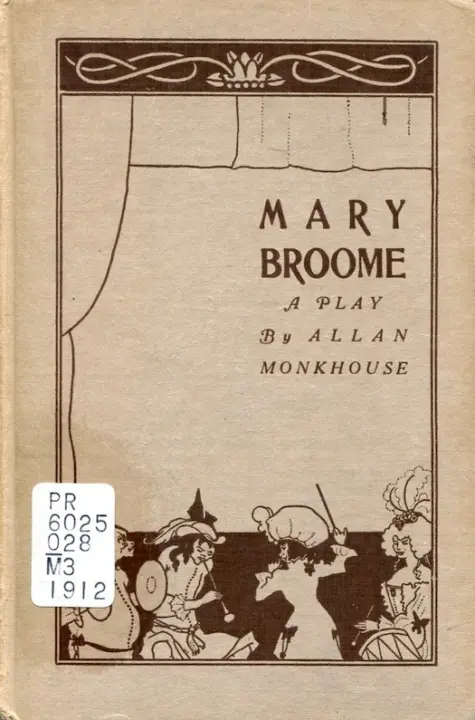
THE CLASSIC COLLECTION · 1912
"Mary Broome: A Comedy, in Four Acts" by Allan Monkhouse is a play written in the early 20th century. The story revolves around Mary Broome, a housemaid whose life takes a dramatic turn when the son of her employer becomes embroiled in an unexpected romantic entanglement with her. The play delves into themes of class, responsibility, and societal expectations, highlighting the contrasts between the lives of the upper middle class and their servants. At the start of the play, we are introduced to the various characters in the setting of a suburban home, preparing for an upcoming wedding. As preparations unfold, tension arises as Edgar Timbrell expresses his concerns about his best man, Leonard, who is depicted as charming yet irresponsible. The dynamics between the characters, particularly between Mary and Leonard, unfold in a way that hints at deeper issues, as Mary later confronts Leonard about his plans and intentions, leading to a moment of honesty that challenges societal norms regarding class and familial duty. The opening sets the stage for a complex exploration of these social themes as the characters navigate their relationships and the implications of their actions.
Introduction adapted from the source catalogue; source summaries may be automatically generated.
Free to read · English · 19,355 words · No account needed
MAKE TIME FOR A GOOD BOOK
On by default. Untick to stop anonymous reading totals. Each page counts after 10 seconds in view. How this works.
Anonymous counting is on unless you have switched it off.
TIMBRELL. [With real dejection.] I do my best but I can't understand your language. You puzzle me, my boy.
LEONARD. Don't mind me, sir. I'm a rotter.
MRS. TIMBRELL. You want your dinner, Leonard.
LEONARD. Well, well, little mother. I'd like to know what you think
about it all.
MRS. TIMBRELL. He's a wild boy, Mary.
MARY. He can be very sensible if he likes.
LEONARD. Don't deny me my wildness. Don't make me out a sham.
MRS. TIMBRELL. Wild, wild.
LEONARD. And where does it come from? How do I get it? Mr. Pendleton, who are the wild people here?
PENDLETON. Nay, my boy. I'm not up to your tricks and turns.
LEONARD. I'll tell you. Mary and my mother--they're very much alike.
TIMBRELL. I think we'll leave this subject.
EDGAR. You won't get him away from himself.
LEONARD. Brother, brother, I'll be silent if you've anything worth
saying.
MARY. You shouldn't say I'm like your Mother.
LEONARD. But you are.
MARY. You make me unhappy.
LEONARD. Then I shouldn't say it. But you are.
MRS. TIMBRELL. I'd be glad to think that I'm like you, Mary.
MARY. It's all unhappy for me. I spoil everything.
ADA. It isn't your fault.
MARY. [To ADA.] You want to blame it all on him. That's no use. It
isn't all him.
SHEILA. We want to be kind to you.
MARY. It doesn't matter about me. I'd rather you were down on me and kind to him. This is his family. And I'm not comfortable ma'am and it's partly this dress and I wonder if you would mind if I went home and you'd all get on better together. I spoil everything.
MRS. TIMBRELL. You silly girl; you spoil nothing and you're as good as
gold and we all like you.
ADA. You mustn't go, and the dress looks very nice.
SHEILA. Very nice, indeed.
MRS. TIMBRELL. And you shall have a little shawl over your shoulders
if you like.
TIMBRELL. All we want is our dinner.
MARY. I'm sure you're all very kind--but--
LEONARD. We're getting on fine now.
EDGAR. You see, you've been out of the conversation for about two
minutes.
LEONARD. Is that it, brother?
EDGAR. What's this trick of calling me brother?
LEONARD. I'm tasting the relationship. There's a certain piquancy in
calling you brother.
MRS. TIMBRELL. Leonard, you won't quarrel with your brother.
LEONARD. No. And yet he's one of the men I could quarrel with. Once or twice I've been angry with Edgar. I've had the true intoxication of anger. [To EDGAR.] Do you know it? It's a delirious joy. Your brain streams out like a scarlet banner.
EDGAR. You quarrelled over trifles.
Your reading position is saved on this browser. Take it to another device with a library code. Reading pages adapt to text, rather than matching a printed edition.
BEHIND THE BOOK
This eBook is for the use of anyone anywhere in the United States and most other parts of the world at no cost and with almost no restrictions whatsoever. You may copy it, give it away or re-use it under the terms of the Project Gutenberg License included with this eBook or online at www.gutenberg.org. If you are not located in the United States, you will have to check the laws of the country where you are located before using this eBook. Read the source licence.
The original source file, including credits and licence, is retained by this library. Request an original-format copy at no charge. Please include the book title and Project Gutenberg identifier #46298.
KEEP YOUR CURIOSITY GOING
Maurice Baring
W. B. (William Butler) Yeats
Edward Martyn

John Brougham & Charlotte Brontë
Marguerite Merington
Leonid Andreyev