THE CLASSIC COLLECTION✦Lost DiariesCLASSIC FREE BOOKS
Lost Diaries
Maurice Baring
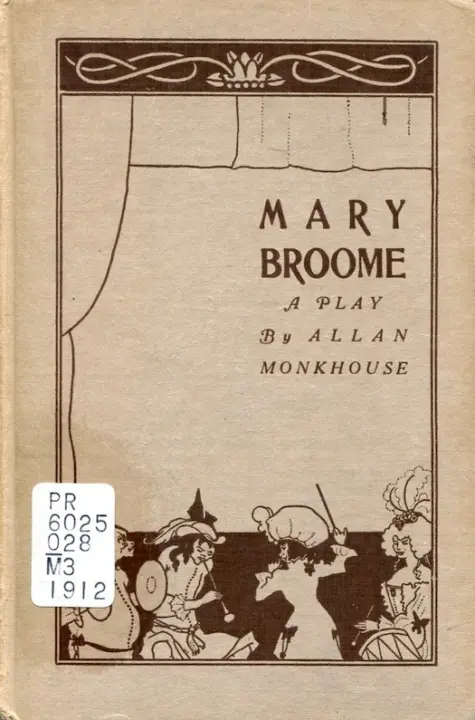
THE CLASSIC COLLECTION · 1912
"Mary Broome: A Comedy, in Four Acts" by Allan Monkhouse is a play written in the early 20th century. The story revolves around Mary Broome, a housemaid whose life takes a dramatic turn when the son of her employer becomes embroiled in an unexpected romantic entanglement with her. The play delves into themes of class, responsibility, and societal expectations, highlighting the contrasts between the lives of the upper middle class and their servants. At the start of the play, we are introduced to the various characters in the setting of a suburban home, preparing for an upcoming wedding. As preparations unfold, tension arises as Edgar Timbrell expresses his concerns about his best man, Leonard, who is depicted as charming yet irresponsible. The dynamics between the characters, particularly between Mary and Leonard, unfold in a way that hints at deeper issues, as Mary later confronts Leonard about his plans and intentions, leading to a moment of honesty that challenges societal norms regarding class and familial duty. The opening sets the stage for a complex exploration of these social themes as the characters navigate their relationships and the implications of their actions.
Introduction adapted from the source catalogue; source summaries may be automatically generated.
Free to read · English · 19,355 words · No account needed
MAKE TIME FOR A GOOD BOOK
On by default. Untick to stop anonymous reading totals. Each page counts after 10 seconds in view. How this works.
Anonymous counting is on unless you have switched it off.
LEONARD. But if he cares for you he ought to want to marry you now.
MARY. You think you understand things but you don't.
TIMBRELL. Mary, will you marry my son?
MARY. He'd hate me.
TIMBRELL. Nonsense, will you marry him?
MARY. I'd like to marry someone. I've got to face my father. He'll be
nasty.
LEONARD. May I point out to you, sir--
TIMBRELL. Silence. You will do what you are told. You are not one of us. You never have been. A useless dilettante. Here's a chance for you. Don't you see that? A chance. If you can't take it, it shall be forced on you. Will you marry him Mary, or let him go out into the street?
MARY. If he's like as you say, it's no great catch.
MRS. TIMBRELL. Mary!
LEONARD. She's right. I'm no great catch. She's the sensible person in this conference. Let's end it. Let's do something else.
TIMBRELL. We'll finish this now. Edgar, fetch me the Bible--the Family Bible. You know where it is--in the dining-room.
EDGAR. But--what--
TIMBRELL. [Loudly.] At once. [EDGAR goes.]
MRS. TIMBRELL. My dear--[TIMBRELL holds up his hand and she stops.]
LEONARD. The Family Bible! It's like bringing out an obsolete instrument of torture. I'd forgotten that we had a Family Bible.
TIMBRELL. The names of my father's children and their wives and
children are recorded there.
LEONARD. And a very nice old custom, too.
TIMBRELL. Your ribaldry is ill-timed, sir.
LEONARD. Ribaldry! I can't make a remark that suits you unless I'm hypocritical. I think it is a nice custom.
MRS. TIMBRELL. Edward, let us think over this a little more. Let us try to see things more clearly.
TIMBRELL. Where is Edgar? What's he doing?
MARY. Oh! send me away and be done. I don't want to make trouble.
TIMBRELL. [Loudly.] Edgar! Where is Edgar? [Voices are heard outside. EDGAR enters with the Bible.]
TIMBRELL. What's that? Who's there? What have you been doing?
EDGAR. It's Ada and--it's Ada.
LEONARD. Better stop up the keyhole, sir, if you wish these rites to
be secret.
MRS. TIMBRELL. Oh! be quiet, Leonard.
LEONARD. I must keep up my spirits somehow, Mother.
TIMBRELL. [Loudly.] Ada! And is Sheila there? Come in. [They enter
immediately.]
LEONARD. I told you so.
ADA. What is it, father? What's going to happen?
TIMBRELL. Put that Bible down here. [Pointing to table.] Pen and ink. [EDGAR brings pen and ink.]
ADA. Father, what are you going to do?
TIMBRELL. Sheila, I thought your name would be the next to be entered in this Book, but another is before you.
Your reading position is saved on this browser. Take it to another device with a library code. Reading pages adapt to text, rather than matching a printed edition.
BEHIND THE BOOK
This eBook is for the use of anyone anywhere in the United States and most other parts of the world at no cost and with almost no restrictions whatsoever. You may copy it, give it away or re-use it under the terms of the Project Gutenberg License included with this eBook or online at www.gutenberg.org. If you are not located in the United States, you will have to check the laws of the country where you are located before using this eBook. Read the source licence.
The original source file, including credits and licence, is retained by this library. Request an original-format copy at no charge. Please include the book title and Project Gutenberg identifier #46298.
KEEP YOUR CURIOSITY GOING
Maurice Baring
W. B. (William Butler) Yeats
Edward Martyn

John Brougham & Charlotte Brontë
Marguerite Merington
Leonid Andreyev