THE CLASSIC COLLECTION✦Japanese Homes and Their SurroundingsCLASSIC FREE BOOKS
Japanese Homes and Their Surroundings
Edward Sylvester Morse
THE CLASSIC COLLECTION · 1906
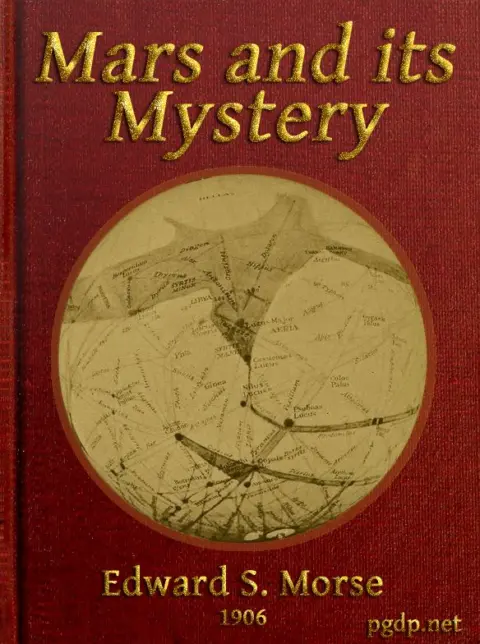
"Mars and Its Mystery" by Edward Sylvester Morse is a scientific publication written in the early 20th century." This work dives into the intriguing question of whether Mars is inhabited, exploring the planet's surface markings and the potential for intelligence existing on this neighboring world. Morse draws on both his own observations as well as historical findings, making a case for the rationality of the idea of Martian life through comparison with terrestrial environments. "The opening of the book sets the stage for a deep exploration of Mars by outlining the author's motivations and methods." Morse expresses his fascination with the ongoing debates about Mars and reflects on the ways this neighboring planet resembles Earth. He outlines his observations made through telescopes, particularly at the Lowell Observatory, and emphasizes the need for a multidisciplinary approach to understanding the potential for life on Mars. By combining insights from astronomy, physical geography, and a bit of imagination, Morse challenges readers to reconsider preconceived notions about the planet's suitability for life and the significance of its markings.
Introduction adapted from the source catalogue; source summaries may be automatically generated.
Free to read · English · 39,478 words · No account needed
MAKE TIME FOR A GOOD BOOK
On by default. Untick to stop anonymous reading totals. Each page counts after 10 seconds in view. How this works.
Anonymous counting is on unless you have switched it off.
Newcomb's, Professor, opinion, 24;
other worlds inhabited, 28;
"Reminiscences," 27.
Number of acres under irrigation, 122.
Observations of Mars, 1st period, 51;
2d period, 52;
3d period, 53;
4th period, Lowell's work, 54.
Orr's, J., theory, 102.
Parallel case of interpretation, 181.
Patterson's, John A., expressions, 56.
Perrotin, brief sketch of, 177.
Perrotin and Janssen describes the canals, 63;
and Thollon, 58.
Perrotin's painstaking care, 63, 64.
Phillips', Rev. Theo. E. R., drawing, 62.
Pickering, W. H., canals seen by, 63;
shows importance of steady atmosphere, 87;
observations in Jamaica by, 88;
polariscope observations by, 36-38;
theory of, 105.
Planetology, 77.
Plurality of worlds, astronomer's belief in, 18;
Edward Hitchcock's views of the, 21;
Flammarion's views of the, 19;
Newcomb's attitude in regard to the, 28;
Newcomb's belief in the, 29;
O. M. Mitchell's views in regard to the, 19;
Sir David Brewster's views of the, 17;
Sir Richard Owen's views in regard to the, 19;
Tyndall's views of the, 22.
Polar snow cap, proof deduced from Lowell, Douglass, and
Pickering, 135.
Profound changes by man, 123.
Railroads in Iowa and Texas, 142.
Review of Lowell's book, 66.
Rift in Southern Africa, 112.
Schiaparelli, abstemiousness when observing, 84;
brief sketch of, 172;
canals artificial, 62;
canali natural, 60;
discovery, 57;
discovery of canals, 39;
does not deny intelligence in Mars, 60;
suggestion as to doubling, 120.
Sea, so-called, land areas, 39.
Seasonal changes, 136.
Snow storms in Mars, W. H. Pickering, 138.
Solar system a standard for universe, 26.
Stars, bright points of light, 7;
similar to our sun, 9.
Stetefeldt's, C. A., views, 129.
Study of planetary markings, 70.
Sun and planets reduced to minute scale, 11.
Temperature under which man exists, 149.
Terby, Dr., identifies many canals, 64.
Theories regarding canals, 100.
Thollon, brief sketch of, 178.
Titles of papers in astronomical journals, 71.
Todd, Professor, says canals result of design, 68.
Turner, H. H., "Astronomical Discovery," 78;
on the difficulties of seeing, 91.
Tycho Brahe, 8.
Tyndall on imagination, 77.
Tyndall's expressions on the Nebular Theory, 15;
reference to Nebular Theory, 24.
Unfolding of plant life on the earth, 45.
Variation in drawings by different observers, 94, 95;
of Milky Way, 95;
of Nebula of Orion, 95;
of Solar Corona, 95, 96.
Variety of conditions under which life exists, 147.
Vastness of the universe, 10.
Wallace, Alfred Russel, human paradox, 29;
review of, in London "Nature," 18.
Water vapor, no spectroscopic proof of, Campbell, 135.
Webb's, Rev. T. W., difficulties of seeing, 91, 92.
What the Martians might say of us, 166.
White spots in equatorial regions of Mars, 48.
White weed in New England, 49.
Williams, A. Stanley, difficulty in observation, 82.
Would the work of man show in Mars? 122.
Young, C. A., on snow caps, 76, 126;
on Schiaparelli's discovery, 183.
[1] Some of our readers may not know that light travels, in round numbers, at the rate of 186,000 miles a second.
Your reading position is saved on this browser. Take it to another device with a library code. Reading pages adapt to text, rather than matching a printed edition.
BEHIND THE BOOK
This eBook is for the use of anyone anywhere in the United States and most other parts of the world at no cost and with almost no restrictions whatsoever. You may copy it, give it away or re-use it under the terms of the Project Gutenberg License included with this eBook or online at www.gutenberg.org. If you are not located in the United States, you will have to check the laws of the country where you are located before using this eBook. Read the source licence.
The original source file, including credits and licence, is retained by this library. Request an original-format copy at no charge. Please include the book title and Project Gutenberg identifier #44270.
KEEP YOUR CURIOSITY GOING
Coulson Kernahan

Maurice Baring
Frances Wright
Cécile Tormay
Francis Greenleaf Allinson & Anne C. E. (Anne Crosby Emery) Allinson

Frederic Jesup Stimson