THE CLASSIC COLLECTION✦Japanese Homes and Their SurroundingsCLASSIC FREE BOOKS
Japanese Homes and Their Surroundings
Edward Sylvester Morse
THE CLASSIC COLLECTION · 1906
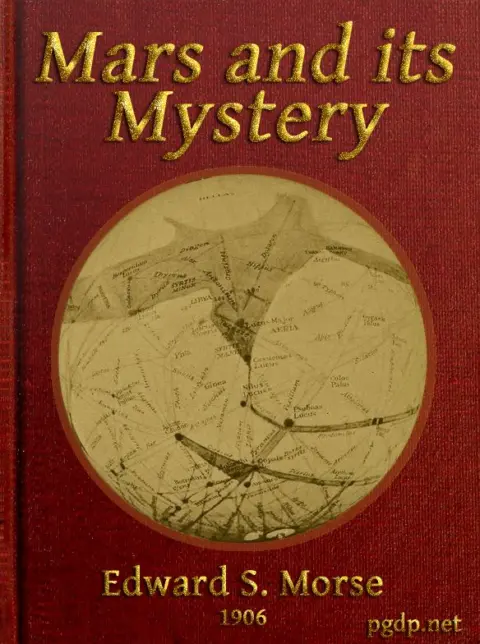
"Mars and Its Mystery" by Edward Sylvester Morse is a scientific publication written in the early 20th century." This work dives into the intriguing question of whether Mars is inhabited, exploring the planet's surface markings and the potential for intelligence existing on this neighboring world. Morse draws on both his own observations as well as historical findings, making a case for the rationality of the idea of Martian life through comparison with terrestrial environments. "The opening of the book sets the stage for a deep exploration of Mars by outlining the author's motivations and methods." Morse expresses his fascination with the ongoing debates about Mars and reflects on the ways this neighboring planet resembles Earth. He outlines his observations made through telescopes, particularly at the Lowell Observatory, and emphasizes the need for a multidisciplinary approach to understanding the potential for life on Mars. By combining insights from astronomy, physical geography, and a bit of imagination, Morse challenges readers to reconsider preconceived notions about the planet's suitability for life and the significance of its markings.
Introduction adapted from the source catalogue; source summaries may be automatically generated.
Free to read · English · 39,478 words · No account needed
MAKE TIME FOR A GOOD BOOK
On by default. Untick to stop anonymous reading totals. Each page counts after 10 seconds in view. How this works.
Anonymous counting is on unless you have switched it off.
That there may be types of life of some kind on Mars is, I
should think, quite likely.
In the following chapter are presented abstracts from memoirs, communications, etc., of a few among the many astronomers and observers who have recognized the markings on the planet, and, in many cases, have made drawings of them. Before presenting these few brief records, I have compiled, from Camille Flammarion's great work on Mars, the names of those astronomers whose drawings he reproduces in this monograph, for such it is. A brief examination of Flammarion's volume will give one an idea of the extent and variety of work which has already been accomplished in interpreting the surface features of Mars, and the number of astronomers who have made contributions to the subject.
Flammarion divides these observations into three periods; the first, beginning with the rude drawing of Fontana, in 1636, followed by Huyghens, in 1659, Cassini, in 1666, and many others up to Harding, in 1824. In this period the drawings were rude, though a number of the more conspicuous features were established, and above all, the existence of what was interpreted as snow in the white polar caps. Astronomically many points were determined, such as an approximation of the period of revolution, the distance of Mars from the Sun, the diameter of the planet, its mass, the inclination of its axis, the eccentricity of its orbit, its period of rotation, etc.
The second period begins with the remarkable work of Beer and Mäedler, in 1830 and subsequent years. To them belongs the honor of being the first astronomers to make a chart of the planet. An advance standard was set for future studies, and the work which followed revealed details in the surface markings never before suspected. The second period, from 1830 to 1877, includes the observations and drawings of Beer and Mäedler, 1830; Sir John Herschel, 1830; Galle, 1837; Warren de la Rue, 1856; Webb, 1856; Secchi, 1858; Liais, 1860; Schmidt, 1862; Lockyer, 1862; Phillips, 1862; Lassell, 1862; Knott, 1862; Kaiser, 1862; Dawes, 1864; Franzenne, 1864; Williams, 1867; Proctor, 1867; Lahardeley, 1871; Burton, 1871; Wilson, 1871; Gledhill, 1871; Flammarion, 1873; Terby, 1873; Green, 1873; Trouvelot, 1873; Lohse, 1873; Holden, 1875.
The third period extends from 1877 to 1892, when Flammarion published his book. The following drawings are given: Flammarion, 1877-88; Paul and Prosper Henry, 1877; Neisten, 1877-79-81-88; Terby, 1877-79-88; Van Ertborn, 1877; Cruls, 1877; Dreyer, 1877-79; Lohse, 1877-79-83-84; Green, 1877; Schiaparelli, 1877-79; Maunder, 1879; Konkoly, 1879; Boeddicker, 1881-84; Burton, 1882; Trouvelot, 1884; Knoble, 1884; Denning, 1886; Perrotin and Thollon, 1886; Proctor, 1888; Perrotin, 1888; Holden and Keeler, 1888; Wislicenus, 1888-90; W. H. Pickering, 1890; Williams, 1890; Giovannozzi, 1890; Guillaume, 1890.
Your reading position is saved on this browser. Take it to another device with a library code. Reading pages adapt to text, rather than matching a printed edition.
BEHIND THE BOOK
This eBook is for the use of anyone anywhere in the United States and most other parts of the world at no cost and with almost no restrictions whatsoever. You may copy it, give it away or re-use it under the terms of the Project Gutenberg License included with this eBook or online at www.gutenberg.org. If you are not located in the United States, you will have to check the laws of the country where you are located before using this eBook. Read the source licence.
The original source file, including credits and licence, is retained by this library. Request an original-format copy at no charge. Please include the book title and Project Gutenberg identifier #44270.
KEEP YOUR CURIOSITY GOING
Coulson Kernahan

Maurice Baring
Frances Wright
Cécile Tormay
Francis Greenleaf Allinson & Anne C. E. (Anne Crosby Emery) Allinson

Frederic Jesup Stimson