THE CLASSIC COLLECTION✦Japanese Homes and Their SurroundingsCLASSIC FREE BOOKS
Japanese Homes and Their Surroundings
Edward Sylvester Morse
THE CLASSIC COLLECTION · 1906
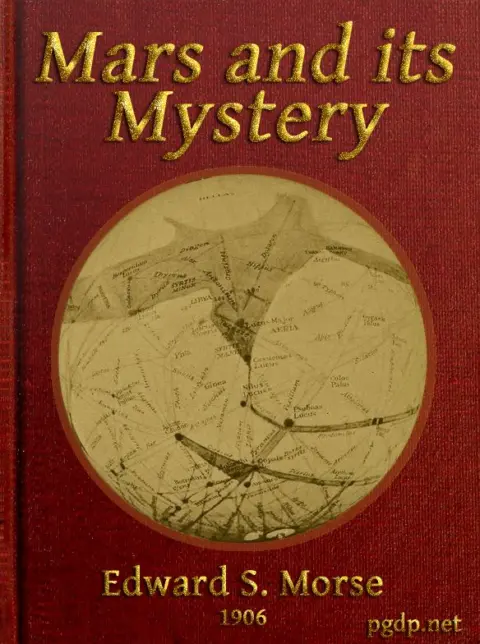
"Mars and Its Mystery" by Edward Sylvester Morse is a scientific publication written in the early 20th century." This work dives into the intriguing question of whether Mars is inhabited, exploring the planet's surface markings and the potential for intelligence existing on this neighboring world. Morse draws on both his own observations as well as historical findings, making a case for the rationality of the idea of Martian life through comparison with terrestrial environments. "The opening of the book sets the stage for a deep exploration of Mars by outlining the author's motivations and methods." Morse expresses his fascination with the ongoing debates about Mars and reflects on the ways this neighboring planet resembles Earth. He outlines his observations made through telescopes, particularly at the Lowell Observatory, and emphasizes the need for a multidisciplinary approach to understanding the potential for life on Mars. By combining insights from astronomy, physical geography, and a bit of imagination, Morse challenges readers to reconsider preconceived notions about the planet's suitability for life and the significance of its markings.
Introduction adapted from the source catalogue; source summaries may be automatically generated.
Free to read · English · 39,478 words · No account needed
MAKE TIME FOR A GOOD BOOK
On by default. Untick to stop anonymous reading totals. Each page counts after 10 seconds in view. How this works.
Anonymous counting is on unless you have switched it off.
To one unconvinced of the existence of some signs of intelligent activity in Mars the suggestions that have been made to account for certain appearances in the planet will seem absurd. If, on the other hand, he finds himself in agreement with those who believe the markings are the result of intelligent effort, then he is justified in using the various artificial markings of the surface of the Earth as standards of comparison in explaining the many curious markings of Mars. Indeed, he is compelled to do so, just as would be demanded of him if he should stand on some high mountain peak in some hitherto unexplored region of Africa and should minutely scan the hazy stretch of plains below. Large white spots in equatorial regions which could not possibly be snow-covered hills, might be masses of white flowers or cloth-covered areas for the better cultivation of certain plants. Lines that dimly stretched across the surface might be rivers, cañons, rifts, or bands of irrigation, according to their character.
As we compare the circular markings on the Moon with our terrestrial craters and fissures, and cracks on its surface with similar fissures on the Earth, so we are forced to compare the markings on the surface of Mars with what seems analogous to them on the surface of our own Earth.
Once proved that the markings of Mars are due to erosion, cracks, encircling meteors big enough to raise ridges by their attractive force, then all that has been written in demonstration of their artificial character goes for naught. The intelligent reader unprejudiced in the matter will, however, judge for himself the merits of our contention and will determine the reasonableness of the comparisons that have been made by Lowell in solving the mystery of Mars.
Algebraic formulæ, 73.
American astronomers, Holden, Pickering, Young, Swift, Comstock, Barnard, Wilson, drew the more conspicuous canals, 65.
Ancient irrigation, 115.
Ants surviving at high altitudes, 157;
unique intelligence, 156.
Astronomer's chief work, 74;
conservatism, 75.
Astronomers who have seen the canals, 83.
Astronomical subjects remote from Martian studies, 72.
Atmosphere and moisture, Barnard and others, 134, 135;
Sir Robert Ball, 137.
Austria's care of water, 117.
Ball, Sir Robert, difficulties of observation, 84;
life on Mars quite likely, 68, 69;
objection to Mars being inhabited, 121.
Barbour, W. D., with a four inch achromatic, 88.
Barnard's, Dr., description of dark regions, 43.
Bees, wasps, and ants, 156.
Canali supposed to mean canals, 39.
Canals appear double, 41;
artificiality of, 42;
as distinct as engraved lines, 59;
chain of reasoning in regard to, 47;
double, 41;
of Mars, 40;
unchangeable in position, 42.
Cassini, 33.
Chandler's oscillation of pole, 126.
Checkerboard appearance of West, 48.
Clerke's, Agnes M., expressions, 55.
Clouds in Mars, 139;
in Mars, Sir Norman Lockyer, 136.
Comments and criticism, 125.
Committee of British Astronomical Association, 126.
Conception of life in other worlds, 17.
Your reading position is saved on this browser. Take it to another device with a library code. Reading pages adapt to text, rather than matching a printed edition.
BEHIND THE BOOK
This eBook is for the use of anyone anywhere in the United States and most other parts of the world at no cost and with almost no restrictions whatsoever. You may copy it, give it away or re-use it under the terms of the Project Gutenberg License included with this eBook or online at www.gutenberg.org. If you are not located in the United States, you will have to check the laws of the country where you are located before using this eBook. Read the source licence.
The original source file, including credits and licence, is retained by this library. Request an original-format copy at no charge. Please include the book title and Project Gutenberg identifier #44270.
KEEP YOUR CURIOSITY GOING
Coulson Kernahan

Maurice Baring
Frances Wright
Cécile Tormay
Francis Greenleaf Allinson & Anne C. E. (Anne Crosby Emery) Allinson

Frederic Jesup Stimson