
The story of Betty
Carolyn Wells
THE CLASSIC COLLECTION · 1906
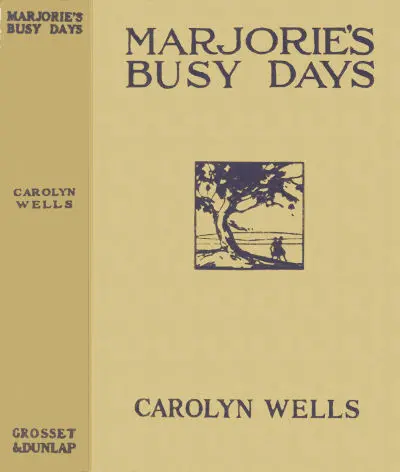
"Marjorie's Busy Days" by Carolyn Wells is a children's novel written in the early 20th century. The book centers around the lively adventures of Marjorie Maynard and her siblings, who engage in imaginative play, exploring their backyard and transforming it into a world full of creativity and fun. Through their antics and games, the story focuses on themes of friendship, family, and childhood joy. The opening of the book introduces us to Marjorie and her three siblings as they excitedly decide on their morning play. The children gather on the porch on a crisp September day, and after some playful banter, they settle on a shipwreck game, using their surroundings as the backdrop for an imaginative adventure. As they create their own rules and roles, the Maynard children embark on a series of playful misadventures, complete with make-believe emergencies and whimsical dialogue. This vibrant beginning sets the tone for a light-hearted, fun narrative that encapsulates the joys of childhood exploration and the bond of sibling companionship.
Introduction adapted from the source catalogue; source summaries may be automatically generated.
Free to read · English · 52,870 words · No account needed
MAKE TIME FOR A GOOD BOOK
On by default. Untick to stop anonymous reading totals. Each page counts after 10 seconds in view. How this works.
Anonymous counting is on unless you have switched it off.
"And I've got one that my boy says is in Dick Fulton's writin'!"
declared another angry citizen.
"Here comes Dick's father now," said Mr. Maynard, as he advanced a step to meet Mr. Fulton. "They tell me our sons have been writing miscellaneous letters," he said to Mr. Fulton, and, though there was a twinkle in his eye, Mr. Fulton saw at once that there was some serious matter in hand.
"Not only your sons, but your girls, too," growled another man. "My kid says this is your Marjorie's fist."
"Well, well, what are the letters all about?" asked Mr. Fulton, who did not like the attitude of the complainants.
"Read 'em, and see!" was the quick response, and half a dozen letters were thrust toward the two gentlemen.
Mr. Fulton adjusted his glasses, and both he and Mr. Maynard quickly
scanned the notes that were only too surely the work of their own
children.
"The signature is misleading," said Mr. Fulton, who was inwardly shaking with laughter at the absurd epistles, but who preserved a serious countenance; "but I feel sure it means 'The Village Improvement Society.' I have often thought such a society would be a good thing for our town, but I didn't know one had been started."
"But who is the society? A lot of youngsters?" demanded John Kellogg.
"Ahem! These documents would lead one to think so, wouldn't they?" said
Mr. Fulton, suavely.
But the offended men were not to be so easily placated.
"See here," said one of them, assuming a threatening tone, "these 'ere letters is insults; that's what I call 'em!"
"And I!" "Me, too!" said several others.
"And as they is insults," went on the first speaker, "we wants satisfaction; that's what we wants!"
"Yes, yes!" "We do!" chorused the crowd.
Mr. Fulton and Mr. Maynard were decidedly nonplussed. It was difficult to take the matter seriously, and yet, as these men were so incensed, it might make an unpleasant publicity for the two families, unless they placated the angry recipients of those foolish letters.
Mr. Maynard was a quick thinker, and a man of more even disposition and affable demeanor than Mr. Fulton. So Mr. Maynard, with a nod at his friend, jumped up on a chair and began to address the crowd, as if he were on a public platform.
Your reading position is saved on this browser. Take it to another device with a library code. Reading pages adapt to text, rather than matching a printed edition.
Carolyn Wells

Carolyn Wells & Harry Persons Taber

Carolyn Wells

Carolyn Wells
BEHIND THE BOOK
This eBook is for the use of anyone anywhere in the United States and most other parts of the world at no cost and with almost no restrictions whatsoever. You may copy it, give it away or re-use it under the terms of the Project Gutenberg License included with this eBook or online at www.gutenberg.org. If you are not located in the United States, you will have to check the laws of the country where you are located before using this eBook. Read the source licence.
The original source file, including credits and licence, is retained by this library. Request an original-format copy at no charge. Please include the book title and Project Gutenberg identifier #23531.
KEEP YOUR CURIOSITY GOING
Coulson Kernahan

Maurice Baring
Frances Wright
Cécile Tormay

Frederic Jesup Stimson

W. H. P. (William Henry Pope) Jarvis