
The story of Betty
Carolyn Wells
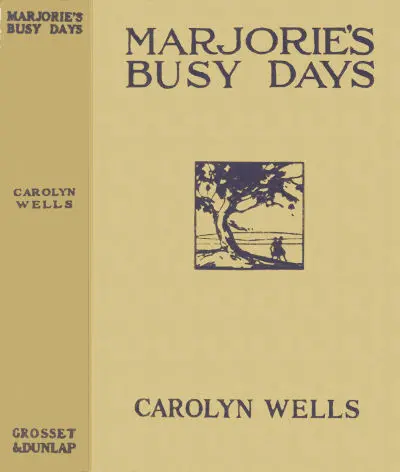
THE CLASSIC COLLECTION · 1906
"Marjorie's Busy Days" by Carolyn Wells is a children's novel written in the early 20th century. The book centers around the lively adventures of Marjorie Maynard and her siblings, who engage in imaginative play, exploring their backyard and transforming it into a world full of creativity and fun. Through their antics and games, the story focuses on themes of friendship, family, and childhood joy. The opening of the book introduces us to Marjorie and her three siblings as they excitedly decide on their morning play. The children gather on the porch on a crisp September day, and after some playful banter, they settle on a shipwreck game, using their surroundings as the backdrop for an imaginative adventure. As they create their own rules and roles, the Maynard children embark on a series of playful misadventures, complete with make-believe emergencies and whimsical dialogue. This vibrant beginning sets the tone for a light-hearted, fun narrative that encapsulates the joys of childhood exploration and the bond of sibling companionship.
Introduction adapted from the source catalogue; source summaries may be automatically generated.
Free to read · English · 52,870 words · No account needed
MAKE TIME FOR A GOOD BOOK
On by default. Untick to stop anonymous reading totals. Each page counts after 10 seconds in view. How this works.
Anonymous counting is on unless you have switched it off.
When it was time for the spelling-match, Marjorie put away her books, and sat waiting, with folded arms and a smiling face.
Miss Lawrence was surprised, for the child usually was worried and
anxious in spelling class.
Two captains were chosen, and these two selected the pupils, one by one,
to be their aids.
Marjorie was never chosen until toward the last, for though everybody loved her, yet her inability to spell was known by all, and she was not a desirable assistant in a match.
But at last her name was called, and she demurely took her place near the foot of the line on one side.
Gladys was on the other side, near the head. She was a good speller, and
rarely made a mistake.
Miss Lawrence began to give out the words, and the children spelled away blithely. Now and then one would miss and another would go above.
To everybody's surprise, Marjorie began to work her way up toward the head of her line. She spelled correctly words that the others missed, and with a happy smile went along up the line.
At last the "spelling down" began. This meant that whoever missed a word must go to his seat, leaving only those standing who did not miss any word.
One by one the crestfallen unsuccessful ones went to their seats, and, to the amazement of all, Marjorie remained standing. At last, there were but six left in the match.
"Macaroni," said Miss Lawrence.
"M-a-c-c-a-r-o-n-i," said Jack Norton, and regretfully Miss Lawrence
told him he must sit down.
Three more spelled the word wrongly, and then it was Marjorie's turn:
"M-a-c-a-r-o-n-i," said she, triumphantly, remembering her father's remark that there were no double letters in it.
Miss Lawrence looked astounded. Now there were left only Marjorie and Gladys, one on either side of the room. It was an unfortunate situation, for so fond were the girls of each other that each would almost rather fail herself than to have her friend fail.
On they went, spelling the words as fast as Miss Lawrence could
pronounce them.
Finally she gave Gladys the word "weird."
It was a hard word, and one often misspelled by people much older and
wiser than these children.
"W-i-e-r-d," said Gladys, in a confident tone.
"Next," said Miss Lawrence, with a sympathetic look at Gladys.
"W-e-i-r-d," said Marjorie, slowly. Her father had drilled her carefully on this word, bidding her remember that it began with two pronouns: that is, we followed by I. Often by such verbal tricks as this he fastened the letters in Marjorie's mind.
The match was over, and Marjorie had won, for the first time in her
life.
Your reading position is saved on this browser. Take it to another device with a library code. Reading pages adapt to text, rather than matching a printed edition.
Carolyn Wells

Carolyn Wells & Harry Persons Taber

Carolyn Wells

Carolyn Wells
BEHIND THE BOOK
This eBook is for the use of anyone anywhere in the United States and most other parts of the world at no cost and with almost no restrictions whatsoever. You may copy it, give it away or re-use it under the terms of the Project Gutenberg License included with this eBook or online at www.gutenberg.org. If you are not located in the United States, you will have to check the laws of the country where you are located before using this eBook. Read the source licence.
The original source file, including credits and licence, is retained by this library. Request an original-format copy at no charge. Please include the book title and Project Gutenberg identifier #23531.
KEEP YOUR CURIOSITY GOING
Coulson Kernahan

Maurice Baring
Frances Wright
Cécile Tormay

Frederic Jesup Stimson

W. H. P. (William Henry Pope) Jarvis