THE CLASSIC COLLECTION✦The Hansa TownsCLASSIC FREE BOOKS
The Hansa Towns
Helen Zimmern
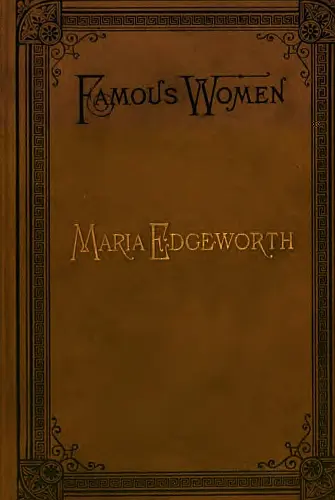
THE CLASSIC COLLECTION · 1883
"Maria Edgeworth" by Helen Zimmern is a biographical account written in the late 19th century. The work explores the life and contributions of Maria Edgeworth, a significant figure in the world of literature known for her children's literature and social commentary. It delves into her lineage, family influences, and early life experiences, setting the stage for her future literary achievements. The opening of this biography introduces Maria Edgeworth's heritage and the impact of her father, Richard Lovell Edgeworth, on her upbringing. It discusses her family's Irish roots and her father's progressive educational ideals, which shaped Maria’s intellect and creativity. Through anecdotes and letters, the narrative highlights her childhood environment, her mischievous nature, and the solid moral foundations set by her family. This foundation not only fueled her literary ambitions but also inspired a lifelong engagement with themes of education and social responsibility, as evidenced by her later works.
Introduction adapted from the source catalogue; source summaries may be automatically generated.
Free to read · English · 78,302 words · No account needed
MAKE TIME FOR A GOOD BOOK
On by default. Untick to stop anonymous reading totals. Each page counts after 10 seconds in view. How this works.
Anonymous counting is on unless you have switched it off.
The first series of Tales from Fashionable Life met with so much favor that the publisher clamored for more. Some were lying ready, others had to be written, but in 1812 Miss Edgeworth was able to issue a second series, containing three stories, of which one, The Absentee, ranks worthily beside Castle Rackrent as a masterpiece. The evils this story sought to expose came daily under Miss Edgeworth's observation; she beheld the Irish landed gentry forsake their homes and their duties in order to go to London and cut a figure in fashionable society, spending beyond their means, oblivious of the state of home affairs, and merely regarding their properties as good milch kine. How their unfortunate tenants were ground down in order to meet these claims they neither knew nor cared. Lord and Lady Clonbrony, the absentees, are drawn with vivid touches: she is devoured by ambition to shine in a society for which she is not fitted, and voluntarily submits to any humiliations and rebuffs, any sacrifices, to attain this end; he, uprooted from his wonted surroundings, cannot acclimatize himself to new ones, and, merely to pass his time, sinks into the vices of gaming and betting. Lady Clonbrony affects a contempt for her native land and pretends she is not Irish. As, however, she cannot rid herself of an Irish pronunciation and Irish phrases, she is constantly placed in the dilemma of holding her tongue and appearing yet more foolish than she is; or, by mistaking reverse of wrong for right, so caricaturing the English pronunciation that thus alone she betrayed herself not to be English. In vain, too, this lady struggles to school her free, good-natured Irish manner into the cold, sober, stiff deportment she deems English. The results to which all this gives rise are delineated with consummate skill and good-humored satire. The scenes that occur in London society are highly diverting, but the story gains in deeper interest when it shifts to Ireland, whither Lady Clonbrony drives her only son, Lord Colambre, whom she has sought to marry against his will to an English heiress. Unknown to his tenants, from whom he has so long been absent, and further purposely disguised in order to elicit the truth concerning certain unfavorable rumors that have reached his ears, Lord Colambre is a witness of the oppressions under which his tenants labor from an unscrupulous and rapacious agent, who feels secure in his master's absence, and in that master's indifference to all but the money result of his estate. Charmingly is the Irish character here described; we see it in its best phases, with all its kindliness, wit, generosity. There are elements of simple pathos scattered about this story. With delicate and playful humor we are shown the heroic and imaginative side of the Irish peasantry. We quite love the kindly old woman who kills her last fowl to furnish supper to the stranger, whom she does not know to be her landlord. On the other hand we are amused beyond measure with Mrs. Rafferty, the Dublin grocer's wife and parvenue, who, in the absence of those who should have upheld Irish society, is able to make that dash that Lady Clonbrony vainly seeks to make in London. Her mixture of taste and incongruity, finery and vulgarity, affectation and ignorance, is delightful. The dinner-party scene at her house would make the reputation of many a modern novelist. It was a dinner of profusion and pretension, during which Mrs. Rafferty toiled in vain to conceal the blunders of her two untrained servants, who were expected to do the work of five accomplished waiters, talking high art meanwhile to her lordly guest, and occasionally venting her ill humor at the servants' blunders upon her unfortunate husband, calling out so loud that all the table could hear, "Corny Rafferty, Corny Rafferty, you're no more gud at the fut of my table than a stick of celery!" As for the scene in which Lord Colambre discovers himself to his tenantry and to their oppressor, Macaulay has ventured to pronounce it the best thing written of its kind since the opening of the twenty-second book of the Odyssey. No mean authority and no mean praise! As a story it is certainly one of the best contrived, and the end is particularly happy. Instead of a tedious moral there is a racy letter from the post-boy who drove Lord Colambre, and who paints, with true Hibernian vivacity and some delicious malaprops, the ultimate return of the Clonbrony family to their estate, which, to the optimistic Irish mind, represents the end of all their troubles and the inauguration of a new era of prosperity and justice. For one thing, it is so much more in keeping that an uncultured peasant, rather than a thoughtful and philosophical mind, should believe in so simple a solution to evils of long standing; that what we should have felt an error in Miss Edgeworth becomes right and natural in Larry. The suggestion for this conclusion came from Mr. Edgeworth, and he wrote a letter for the purpose. Miss Edgeworth, however, wrote one too, and her father so much preferred hers that it was chosen to form the admirable finale to the Absentee.
Your reading position is saved on this browser. Take it to another device with a library code. Reading pages adapt to text, rather than matching a printed edition.
BEHIND THE BOOK
This eBook is for the use of anyone anywhere in the United States and most other parts of the world at no cost and with almost no restrictions whatsoever. You may copy it, give it away or re-use it under the terms of the Project Gutenberg License included with this eBook or online at www.gutenberg.org. If you are not located in the United States, you will have to check the laws of the country where you are located before using this eBook. Read the source licence.
The original source file, including credits and licence, is retained by this library. Request an original-format copy at no charge. Please include the book title and Project Gutenberg identifier #33268.
KEEP YOUR CURIOSITY GOING
John L. Ransom

Herman W. Mudgett

Harriet Monroe
Daniel Dulany Addison
Charles Lanman

Harold Rosher