THE CLASSIC COLLECTION✦The Hansa TownsCLASSIC FREE BOOKS
The Hansa Towns
Helen Zimmern
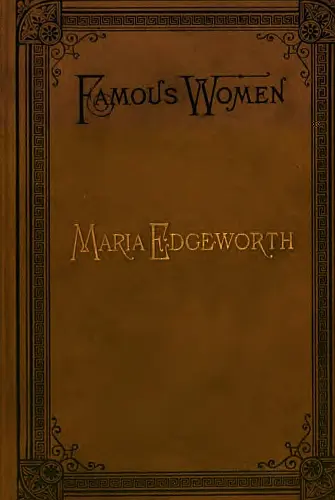
THE CLASSIC COLLECTION · 1883
"Maria Edgeworth" by Helen Zimmern is a biographical account written in the late 19th century. The work explores the life and contributions of Maria Edgeworth, a significant figure in the world of literature known for her children's literature and social commentary. It delves into her lineage, family influences, and early life experiences, setting the stage for her future literary achievements. The opening of this biography introduces Maria Edgeworth's heritage and the impact of her father, Richard Lovell Edgeworth, on her upbringing. It discusses her family's Irish roots and her father's progressive educational ideals, which shaped Maria’s intellect and creativity. Through anecdotes and letters, the narrative highlights her childhood environment, her mischievous nature, and the solid moral foundations set by her family. This foundation not only fueled her literary ambitions but also inspired a lifelong engagement with themes of education and social responsibility, as evidenced by her later works.
Introduction adapted from the source catalogue; source summaries may be automatically generated.
Free to read · English · 78,302 words · No account needed
MAKE TIME FOR A GOOD BOOK
On by default. Untick to stop anonymous reading totals. Each page counts after 10 seconds in view. How this works.
Anonymous counting is on unless you have switched it off.
The Dun is a short tale in Miss Edgeworth's most didactic and least happy style, dealing with a theme that should be more often emphasized and brought into view; namely, the unfeeling thoughtlessness of the rich, that withholds from the poor the result of their earnings, one of the most frequent and serious injuries perpetrated by the wealthy upon their indigent brethren.
Manoeuvring is a detailed account of the machinations of a certain Mrs. Beaumont, a country lady, who expends a great deal of Machiavelism, left-handed wisdom and intrigue upon the projects of her children's marriages, and also upon securing to her family the fortune of an old gentleman who never had a thought of disposing of it otherwise. The mortification and defeats to which her circuitous policy constantly exposes her constitute the plot and the moral of the tale, which is not ill-conceived, and yet for some cause fails to interest us long.
In Almeria, Miss Edgeworth's admirable story-telling powers, her grace and shrewdness, are once more seen at their very best. It is the history of a woman who has sacrificed all the happiness of life, all the better instincts of her nature, for the empty ambition of being admitted into the charmed circle of fashionable society; and who, though she finds out in time that it is Dead Sea apples she has sought, has become so immeshed that she cannot break away, but leads an existence of pleasure-hunting, ever seeking, never finding that commodity, a warning example of
How the world its veterans rewards--
A youth of folly, an old age of cards.
The moral is not insisted on, but is allowed to speak for itself, and is on that account far more eloquent.
Except when dealing with Irish scenes, Miss Edgeworth is never happier than when painting the perverse or intriguing fine ladies of society, who, having no real troubles or anxieties to occupy them, shielded from the physical evils of existence, make to themselves others, and find occupation for their empty heads and hours, with results put before us so simply, and devoid of euphemism, by Dr. Watts. Well indeed has the proverb said, "An empty mind is the devil's house." In her kindly way Miss Edgeworth can be scathing, and she exercises this power upon women of mere fashion. The ladies of the period were less occupied with public and philanthropic schemes than they are now, and hence had more time to expend on follies and frivolities. The whole pitiful system of unreal existence led by these women is exposed with an almost remorseless hand, for Miss Edgeworth had no tenderness for foolish failings. Inimitably, too, we are made to see how then, as now, there was tolerated in fashionable society a degree of vulgarity which would neither be suffered nor attempted in lower life. It was just because Miss Edgeworth's lines were cast among the rich and idle that she was able to understand all the misery and heartlessness of the lives of a large section of this community. We see how their petty cravings, their preposterous pursuits, bring positive misery on themselves if not on others; how their dispositions are sophisticated, their tempers warped, their time and talents wasted, in their restless chase after social distinction, after the craze of being in the fashion. "The scourges of the prosperous;" thus happily have these giant curses of mere fashionable life been defined. Miss Edgeworth certainly understood fully the nature of the disorder of her patients, the ennui, the stagnation of life and feeling that devoured them and sunk many of them at last to a depth at which they no longer merited the name of rational human beings. At the same time (and this is a point which must be insisted upon) there is no sourness about Miss Edgeworth's pictures of good society; her pen, in speaking of it, is not dipped in vinegar and wormwood, as was the pen of Thackeray, and sometimes even that of George Eliot. Without snobbishness, without envy, she writes quite simply, and absolutely objectively, of that which surged around her whenever she left the quiet of Edgeworthstown and visited in some of the many noble houses of Ireland, Scotland and England, in which she was a familiar friend. That her pictures of contemporary society were correct has never been disputed. She reproduced faithfully not only its coarser and silly side, but also the more brilliant conversational features, that make it contrast so favorably with that of our own day, in which the art of talking has been lost. Lord Jeffrey, an authority, and one not given to flattery, says that Miss Edgeworth need not be afraid of being excelled in "that faithful but flattering representation of the spoken language of persons of wit and politeness--in that light and graceful tone of raillery and argument, and in that gift of sportive but cutting medisance which is sure of success in those circles where success is supposed to be most difficult and desirable." In support of his statement he points to the conversation of Lady Delacour (Belinda), Lady Dashfort (Absentee) and Lady Geraldine (Ennui).
Your reading position is saved on this browser. Take it to another device with a library code. Reading pages adapt to text, rather than matching a printed edition.
BEHIND THE BOOK
This eBook is for the use of anyone anywhere in the United States and most other parts of the world at no cost and with almost no restrictions whatsoever. You may copy it, give it away or re-use it under the terms of the Project Gutenberg License included with this eBook or online at www.gutenberg.org. If you are not located in the United States, you will have to check the laws of the country where you are located before using this eBook. Read the source licence.
The original source file, including credits and licence, is retained by this library. Request an original-format copy at no charge. Please include the book title and Project Gutenberg identifier #33268.
KEEP YOUR CURIOSITY GOING
John L. Ransom

Herman W. Mudgett

Harriet Monroe
Daniel Dulany Addison
Charles Lanman

Harold Rosher