
Last letters from the living dead man
David Patterson (Spirit) Hatch
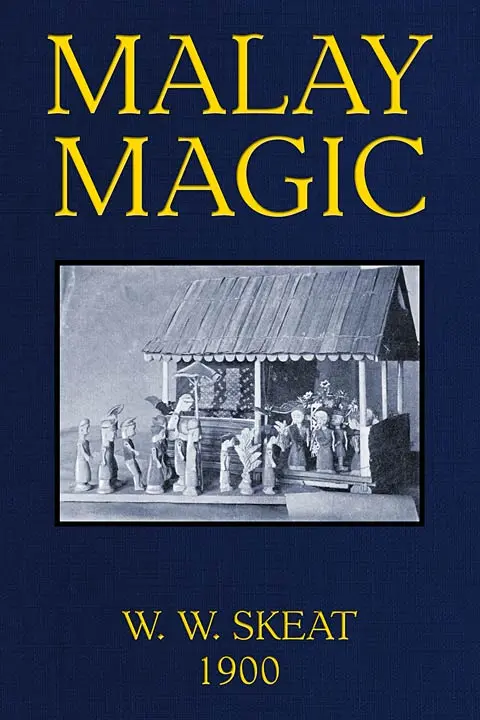
THE CLASSIC COLLECTION · 1900
"Malay Magic" by Walter William Skeat is an introductory work on folklore and popular religion written in the late 19th century. It explores the rich tapestry of beliefs, customs, and magical practices of the Malays in the Malay Peninsula, drawing upon a variety of sources, including personal observations, native manuscripts, and published works. The book aims to document and analyze the traditional beliefs and practices that are integral to Malay culture, highlighting the complexity of their folklore intertwined with influences from Indian, Arab, and indigenous sources. The opening of the book sets the stage for a comprehensive exploration of Malay folklore, establishing the author's intent to create a representative account of Malay beliefs and magical practices. Skeat introduces the key themes such as creation myths, the understanding of nature, and the relationships between humans and the supernatural world. He reflects on the significance of various folkloric beliefs, such as the creation of the world and the role of magic in everyday life, and emphasizes the importance of these elements in understanding the Malay identity and culture. As he begins to unfold these narratives, the reader is invited into the intricate world of Malay magic, laying the foundation for the detailed studies that follow.
Introduction adapted from the source catalogue; source summaries may be automatically generated.
Free to read · English · 226,518 words · No account needed
MAKE TIME FOR A GOOD BOOK
On by default. Untick to stop anonymous reading totals. Each page counts after 10 seconds in view. How this works.
Anonymous counting is on unless you have switched it off.
3. When raised for the third and last time they say, "I ask the Lord God to give us both long life, and that all our handiwork may prosper" (Sahya minta' kapada Tuhan Allah bersama-sama panjang `umor, samua kerja dengan salamat).
[626] It used to be considered an insult to omit offering one of these eggs to a guest, so much so, that I was assured that in former days a woman whose husband had been thus slighted would have a right to sue for a divorce.
[627] The Kathi is an official having superintendence over several mosques and jurisdiction in matters connected with marriage, divorce, and ecclesiastical affairs generally. The Imam is the chief elder of one mosque.
[628] There is a difference between b'lanja and mas kahwin, the former usually meaning the wedding expenses, the latter the dower; at least this is the Malacca terminology, which probably also obtains elsewhere.
[629] The descendant of one of the four great Chiefs (Orang Besar
ber-ampat) of Selangor.
[630] Ex-Prime Minister of Perak.
[631] Sireh or sirih, the betel leaf.
[632] The Bilal is an elder of the mosque; in western Muhammadan
countries he is styled Muezzin.
[633] Selangor Journal, vol. i. No. 2, p. 23.
[634] Probably this should be 4th.
[635] He was of Arab extraction. But wearing clothes in the Arab fashion is not unusual even in the case of purely Malay bridegrooms.
[636] Selangor Journal, vol. iv. No. 2, pp. 23-5. The list of presents sent by friends on this occasion included buffaloes, a bullock, goats, spices, plate, and jewellery.
[637] Sir William Maxwell in N. and Q., No. 4, sec. 91, issued with
No. 17 of the J.R.A.S., S.B.
[638] "At their funerals the corpse is carried to the place of interment on a broad plank, which is kept for the public service of the dusun, and lasts for generations. It is constantly rubbed with lime, either to preserve it from decay or to keep it pure. No coffin is made use of, the body being simply wrapped in white cloth, particularly of the sort called hummums. In forming the grave (kubur), after digging to a convenient depth they make a cavity in the side, at bottom, of sufficient dimensions to contain the body, which is there deposited on its right side. By this mode the earth literally lies light upon it; and the cavity, after strewing flowers in it, they stop up by two boards fastened angularly to each other, so that the one is on the top of the corpse, whilst the other defends it on the open side, the edge resting on the bottom of the grave. The outer excavation is then filled up with earth; and little white flags, or streamers, are stuck in order around. They likewise plant a shrub, bearing a white flower, called kumbangkamboja (Plumeria obtusa), and in some places wild marjoram. The women who attend the funeral make a hideous noise, not much unlike the Irish howl. On the third and seventh day the relations perform a ceremony at the grave, and at the end of twelve months that of tegga batu, or setting up a few long elliptical stones, at the head and foot, which, being scarce in some parts of the country, bear a considerable price. On this occasion they kill and feast on a buffalo, and leave the head to decay on the spot, as a token of the honour they have done to the deceased in eating to his memory. The ancient burying-places are called krammat, and are supposed to have been those of the holy men by whom their ancestors were converted to the faith. They are held in extraordinary reverence, and the least disturbance or violation of the ground, though all traces of the graves be obliterated, is regarded as an unpardonable sacrilege,"--Marsden, Hist. of Sumatra (ed. 1811), pp. 287, 288.
Your reading position is saved on this browser. Take it to another device with a library code. Reading pages adapt to text, rather than matching a printed edition.
BEHIND THE BOOK
This eBook is for the use of anyone anywhere in the United States and most other parts of the world at no cost and with almost no restrictions whatsoever. You may copy it, give it away or re-use it under the terms of the Project Gutenberg License included with this eBook or online at www.gutenberg.org. If you are not located in the United States, you will have to check the laws of the country where you are located before using this eBook. Read the source licence.
The original source file, including credits and licence, is retained by this library. Request an original-format copy at no charge. Please include the book title and Project Gutenberg identifier #47873.
KEEP YOUR CURIOSITY GOING
David Patterson (Spirit) Hatch

David Patterson (Spirit) Hatch

David Patterson (Spirit) Hatch

Maurice Baring
Francis Greenleaf Allinson & Anne C. E. (Anne Crosby Emery) Allinson

Edwin Abbott Abbott