
Last letters from the living dead man
David Patterson (Spirit) Hatch
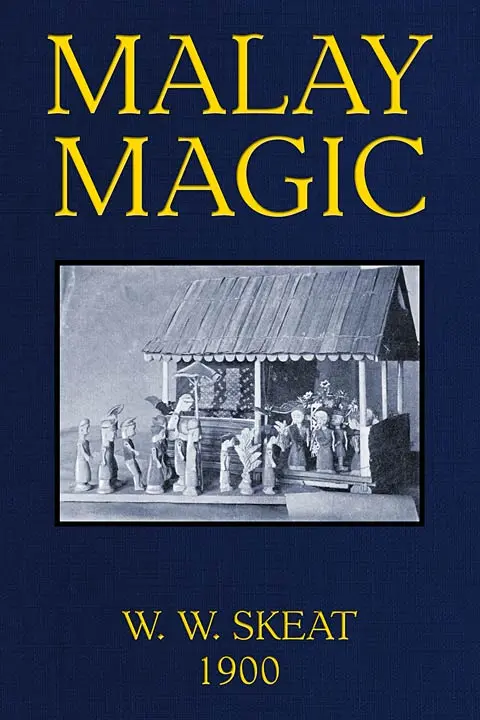
THE CLASSIC COLLECTION · 1900
"Malay Magic" by Walter William Skeat is an introductory work on folklore and popular religion written in the late 19th century. It explores the rich tapestry of beliefs, customs, and magical practices of the Malays in the Malay Peninsula, drawing upon a variety of sources, including personal observations, native manuscripts, and published works. The book aims to document and analyze the traditional beliefs and practices that are integral to Malay culture, highlighting the complexity of their folklore intertwined with influences from Indian, Arab, and indigenous sources. The opening of the book sets the stage for a comprehensive exploration of Malay folklore, establishing the author's intent to create a representative account of Malay beliefs and magical practices. Skeat introduces the key themes such as creation myths, the understanding of nature, and the relationships between humans and the supernatural world. He reflects on the significance of various folkloric beliefs, such as the creation of the world and the role of magic in everyday life, and emphasizes the importance of these elements in understanding the Malay identity and culture. As he begins to unfold these narratives, the reader is invited into the intricate world of Malay magic, laying the foundation for the detailed studies that follow.
Introduction adapted from the source catalogue; source summaries may be automatically generated.
Free to read · English · 226,518 words · No account needed
MAKE TIME FOR A GOOD BOOK
On by default. Untick to stop anonymous reading totals. Each page counts after 10 seconds in view. How this works.
Anonymous counting is on unless you have switched it off.
[449] A small tray or platform for offerings, supported by a central "leg," vide Mr. Hale's description, s.v. Kapala nasi (infra).
[450] Gantang is a measure approximately equivalent to a gallon.
[451] In Selangor anchak is the form used. It means a sacrificial tray (for offerings to the spirits), vide infra, pp. 260, 310-313, 414-423.
[452] Lit. the "Magician's wear."
[453] Ra`iyat is used here to denote a man of the common people,
as opposed to a Chief or Raja. It is sometimes used by Malays in
other senses.
[454] Seperti sungkei be-rendam, "like a soaked sungkei stick." When the sungkei stick has been soaked for a long time, say three months, the peel comes clean away; proverbial expression used of a person "cleaned out."
[455] Beam or rafter of the shed.
[456] Palm-leaf thatch.
[457] Forbes mentions a "palm-leaf fringe" used in certain rites by the Kalangs of Java.--A Naturalist's Wanderings, p. 101.
[458] "It is quite a common thing in Java to encounter by the wayside near a village, or in a rice-field, or below the shade of a great dark tree, a little platform with an offering of rice and prepared fruits to keep disease and blight at a distance and propitiate the spirits."--A Naturalist's Wanderings, Forbes, p. 103.
[459] In Selangor this custom is now
obsolete.--Sel. Jour. vol. iii. No. 18, p. 294.
[460] The derivation of the name of this primitive Malay censer from the Sanskrit çankha (conch shell) has been pointed out (Maxwell, Malay Manual, p. 32). Forbes notes having seen in a sacred grove in Java "the remnants of small torches of sweet gums which had been offered."--A Naturalist's Wanderings, p. 97.
[461] J.R.A.S., S.B., No. 16, pp. 310-320.
[462] Cliff. and Swett., Malay Dict., s.v. Amang: "tourmaline, wolfram, and titaniferous iron-ore are all called by this name. They are all considered impurities, and tourmaline is the one most commonly met with."
[463] The Malay was saperti ulat hidup, which would rather mean
"like live maggots."--W.S.
[464] Sel. Journ. vol. iii. No. 18, pp. 293, 294.
[465] Sel. Journ. vol. iv. No. 2, p. 26.
[466] i.e. tin-bearing stratum and stone overlying the ore.
[467] i.e. his "connections."
[468] Sel. Journ. vol. iv. No. 8, p. 139.
[469] "This my tank" is an allusion to the mine, the system on which mines are worked in the Malay States being that of the removal of the overburden, which, of course, forms immense pits, such as are here likened to an (empty) tank or reservoir.
[470] A plant, possibly Solanum aculeatissimum, Jacq., which has very thorny orange-coloured fruits.
[471] Sega is a species of rattan (Calamus viminalis or Calamus ornatus, Griff.); but probably the better reading here is segar, which means a long black spike of the kabong-palm (Arenga saccharifera, L.)
Your reading position is saved on this browser. Take it to another device with a library code. Reading pages adapt to text, rather than matching a printed edition.
BEHIND THE BOOK
This eBook is for the use of anyone anywhere in the United States and most other parts of the world at no cost and with almost no restrictions whatsoever. You may copy it, give it away or re-use it under the terms of the Project Gutenberg License included with this eBook or online at www.gutenberg.org. If you are not located in the United States, you will have to check the laws of the country where you are located before using this eBook. Read the source licence.
The original source file, including credits and licence, is retained by this library. Request an original-format copy at no charge. Please include the book title and Project Gutenberg identifier #47873.
KEEP YOUR CURIOSITY GOING
David Patterson (Spirit) Hatch

David Patterson (Spirit) Hatch

David Patterson (Spirit) Hatch

Maurice Baring
Francis Greenleaf Allinson & Anne C. E. (Anne Crosby Emery) Allinson

Edwin Abbott Abbott