
Last letters from the living dead man
David Patterson (Spirit) Hatch
THE CLASSIC COLLECTION · 1900
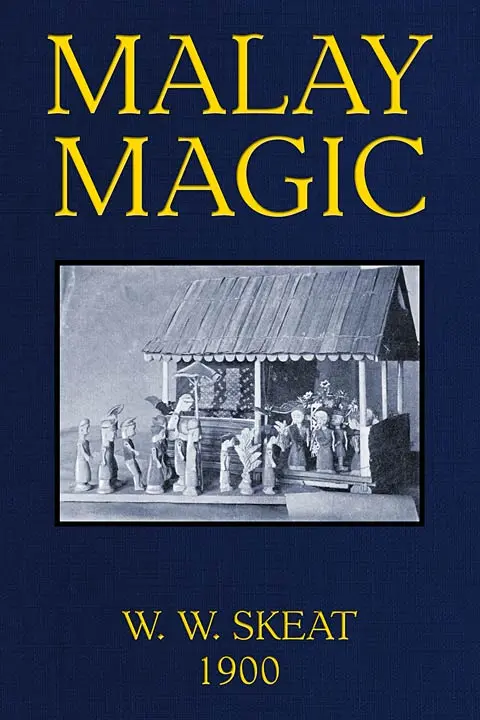
"Malay Magic" by Walter William Skeat is an introductory work on folklore and popular religion written in the late 19th century. It explores the rich tapestry of beliefs, customs, and magical practices of the Malays in the Malay Peninsula, drawing upon a variety of sources, including personal observations, native manuscripts, and published works. The book aims to document and analyze the traditional beliefs and practices that are integral to Malay culture, highlighting the complexity of their folklore intertwined with influences from Indian, Arab, and indigenous sources. The opening of the book sets the stage for a comprehensive exploration of Malay folklore, establishing the author's intent to create a representative account of Malay beliefs and magical practices. Skeat introduces the key themes such as creation myths, the understanding of nature, and the relationships between humans and the supernatural world. He reflects on the significance of various folkloric beliefs, such as the creation of the world and the role of magic in everyday life, and emphasizes the importance of these elements in understanding the Malay identity and culture. As he begins to unfold these narratives, the reader is invited into the intricate world of Malay magic, laying the foundation for the detailed studies that follow.
Introduction adapted from the source catalogue; source summaries may be automatically generated.
Free to read · English · 226,518 words · No account needed
MAKE TIME FOR A GOOD BOOK
On by default. Untick to stop anonymous reading totals. Each page counts after 10 seconds in view. How this works.
Anonymous counting is on unless you have switched it off.
"'It is the largest Hornbill which is found in Pêrak, bigger, I should say, than the Rhinoceros Hornbill, but I have never seen it except flying, or on very high trees. The legend about it is very common, but I do not know the scientific name of that particular Hornbill; but it is not that you refer to, viz. Berenicornis comatus, Raffles; nor is it the Rhinoceros.'"
[238] Vol. i. No. 23, pp. 360-363.
[239] If Sir W. E. Maxwell is right this must be another name for the night-jar (vide p. 110n. supra). But the identification is at least doubtful.
[240] Vide supra, p. 109, note.
[241] Cp. Swett., Mal. Sketches, p. 160.
[242] Swett., Mal. Sketches, pp. 159, 160.
[243] In Selangor I have heard a similar story; but in this case it was a red-crested hornbill which supplied the buttons, which latter were said to turn green on the approach of poison. The only solid-crested hornbill is, I believe, the Rhinoplax.
[244] The amount of luck which goes with any particular bird of this species depends on the number of scales on its feet, for counting which certain verbal categories (like our own "tinker, tailor, soldier" formula) are used. Forty-four is the luckiest number of scales for one of these birds to possess. An example is: "Manuk (3), Manumah (5), Sangkesa (6), Desa (1), Dewa (4), Raja (2)," which has to be repeated as the scales are counted (beginning with the lowest scale). The numbers after the words indicate the order of the luck which the birds are supposed to bring; a ground-dove of the first order bringing luck worth a ship's cargo (tuah merbok tuak sa-kapal). I have kept these birds myself.
[245] Cp. the Malay pantun:--
"Tekukur di gulei lemak
Sulasi di-bawah batang
Lagi lumpor jalan semak
Sebab kasih maka-nya datang."
[246] In Sel. Journ. vol. iii. No. 6, pp. 94, 95.
[247] Dissemurus platurus, Vieill.
[248] Haliætus leucogaster, Gm.
[249] An old Malay (in Selangor) once told me that the hornbill was the king of the birds until dispossessed by the eagle (Rajawali). If, as seems probable, the hornbill was taken as a substitute for the frigate-bird in places where the latter did not exist, this may be important.
[250] Argus giganteus, Temm.
[251] Corvus enca, Horsf., the Malay crow.
[252] I believe that a similar story exists in Siam, the Siamese, however, making turpentine play the part of the ink in the Malay story.
Your reading position is saved on this browser. Take it to another device with a library code. Reading pages adapt to text, rather than matching a printed edition.
BEHIND THE BOOK
This eBook is for the use of anyone anywhere in the United States and most other parts of the world at no cost and with almost no restrictions whatsoever. You may copy it, give it away or re-use it under the terms of the Project Gutenberg License included with this eBook or online at www.gutenberg.org. If you are not located in the United States, you will have to check the laws of the country where you are located before using this eBook. Read the source licence.
The original source file, including credits and licence, is retained by this library. Request an original-format copy at no charge. Please include the book title and Project Gutenberg identifier #47873.
KEEP YOUR CURIOSITY GOING
David Patterson (Spirit) Hatch

David Patterson (Spirit) Hatch

David Patterson (Spirit) Hatch

Maurice Baring
Francis Greenleaf Allinson & Anne C. E. (Anne Crosby Emery) Allinson

Edwin Abbott Abbott