
Last letters from the living dead man
David Patterson (Spirit) Hatch
THE CLASSIC COLLECTION · 1900
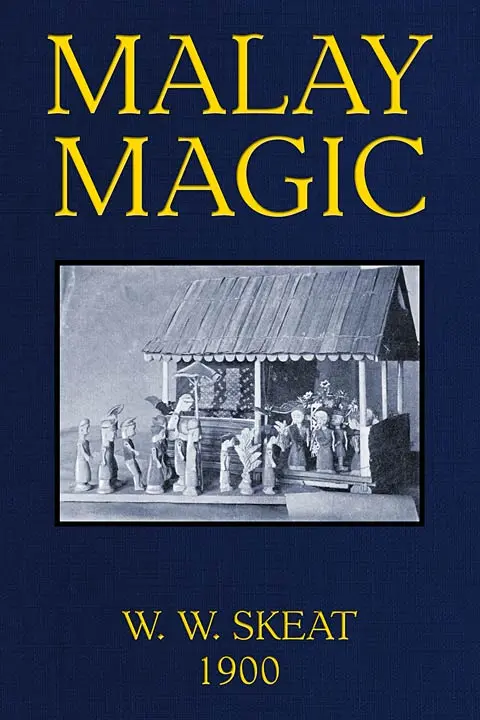
"Malay Magic" by Walter William Skeat is an introductory work on folklore and popular religion written in the late 19th century. It explores the rich tapestry of beliefs, customs, and magical practices of the Malays in the Malay Peninsula, drawing upon a variety of sources, including personal observations, native manuscripts, and published works. The book aims to document and analyze the traditional beliefs and practices that are integral to Malay culture, highlighting the complexity of their folklore intertwined with influences from Indian, Arab, and indigenous sources. The opening of the book sets the stage for a comprehensive exploration of Malay folklore, establishing the author's intent to create a representative account of Malay beliefs and magical practices. Skeat introduces the key themes such as creation myths, the understanding of nature, and the relationships between humans and the supernatural world. He reflects on the significance of various folkloric beliefs, such as the creation of the world and the role of magic in everyday life, and emphasizes the importance of these elements in understanding the Malay identity and culture. As he begins to unfold these narratives, the reader is invited into the intricate world of Malay magic, laying the foundation for the detailed studies that follow.
Introduction adapted from the source catalogue; source summaries may be automatically generated.
Free to read · English · 226,518 words · No account needed
MAKE TIME FOR A GOOD BOOK
On by default. Untick to stop anonymous reading totals. Each page counts after 10 seconds in view. How this works.
Anonymous counting is on unless you have switched it off.
[148] Vide Birth, Marriage, Funerals, Medicine.
[149] It was on Jugra Hill, according to tradition, that the Princess of Malacca fasted to obtain eternal youth.
[150] Frazer, Golden Bough, vol. i. pp. 9-12.
[151] Journal of the Indian Archipelago, vol. iv. p. 573.
[152] J.R.A.S., S.B., No. 7, pp. 11, 12.
[153] Swettenham, Malay Sketches, p. 192.
[154] Mr. R. J. Wilkinson in J.R.A.S., S.B., No. 30, p. 308.
[155] The following are the deities most usually inscribed in the "magic square" of five: 1. Kala (black), which is an epithet of Shiva; 2. Maheswara, which means Great Lord, an epithet of Shiva; 3. Vishnu; 4. Brahma; 5. S'ri (the wife of Vishnu); or else the names are mentioned in this order: 1. Brahma; 2. Vishnu; 3. Maheswara (Shiva); 4. S'ri; 5. Kala. Kali, Durga, or Gauri, is the wife of Shiva; Sarasvati is the wife of Brahma. See inf. p. 545, seqq. In the magic word Aum (OM): A = Vishnu, U = Shiva, M = Brahma.
[156] J.R.A.S., S.B., No. 30, p. 309. This is the water of life called Amrita, to obtain which, by churning the ocean, Vishnu assumed one of his avatars--that of the tortoise.
[157] Cp. Crawfurd, Hist. of the Ind. Archipelago, vol. ii. p. 219. "From some of the usual epithets bestowed upon Siwa by the pagan Javanese, and still familiar to their posterity, the pre-eminence of this deity is clearly demonstrated.... He is the same personage who acts so distinguished a part in the machinery of Malayan and Javanese romances, under the appellation of Guru, or the instructor, prefixing to it the word Batara, a corruption of Avatara, both in sense and orthography, for with the Indian islanders that word is not used as with the genuine Hindus, to express the incarnation of a god, but as an appellation expressing any deity; nay, as if conferring an apotheosis upon their princes, it has been sometimes prefixed to the names of some of the most celebrated of their ancient kings. When Siwa appears in this character, in the romances of the Indian islanders, he is painted as a powerful, mischievous, and malignant tyrant--a description sufficiently consonant to his character of Destroyer in the Hindu triad"; and, again, "ywang is a Javanese word used in the same sense as batara.... Usually the obsolete relative pronoun sang, which has the sense, in this case, of a definite article, is placed before it. Thus sangywang guru is the same as batara guru.... It is probably the same word also which forms the last part of a word in extensive use, sâmbahayang, 'worship or adoration.'"--Crawfurd, Mal. Grammar, p. cxcviii. To this I may add that the form ywang, when used by the Peninsular Malays, becomes "yang," sangyang being also found.
Your reading position is saved on this browser. Take it to another device with a library code. Reading pages adapt to text, rather than matching a printed edition.
BEHIND THE BOOK
This eBook is for the use of anyone anywhere in the United States and most other parts of the world at no cost and with almost no restrictions whatsoever. You may copy it, give it away or re-use it under the terms of the Project Gutenberg License included with this eBook or online at www.gutenberg.org. If you are not located in the United States, you will have to check the laws of the country where you are located before using this eBook. Read the source licence.
The original source file, including credits and licence, is retained by this library. Request an original-format copy at no charge. Please include the book title and Project Gutenberg identifier #47873.
KEEP YOUR CURIOSITY GOING
David Patterson (Spirit) Hatch

David Patterson (Spirit) Hatch

David Patterson (Spirit) Hatch

Maurice Baring
Francis Greenleaf Allinson & Anne C. E. (Anne Crosby Emery) Allinson

Edwin Abbott Abbott