
Last letters from the living dead man
David Patterson (Spirit) Hatch
THE CLASSIC COLLECTION · 1900
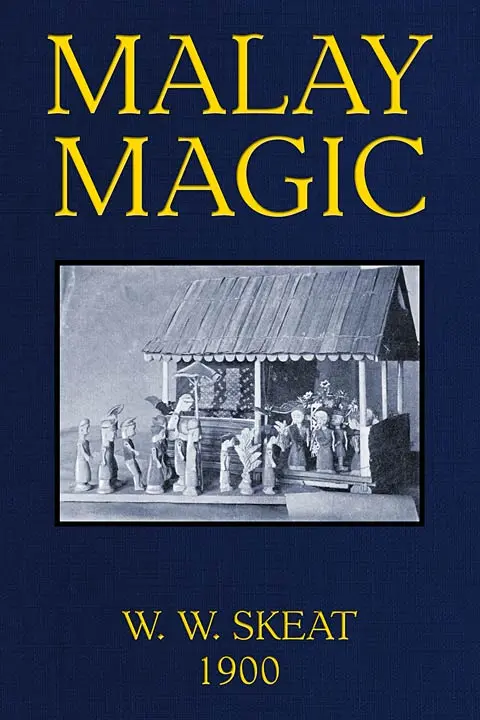
"Malay Magic" by Walter William Skeat is an introductory work on folklore and popular religion written in the late 19th century. It explores the rich tapestry of beliefs, customs, and magical practices of the Malays in the Malay Peninsula, drawing upon a variety of sources, including personal observations, native manuscripts, and published works. The book aims to document and analyze the traditional beliefs and practices that are integral to Malay culture, highlighting the complexity of their folklore intertwined with influences from Indian, Arab, and indigenous sources. The opening of the book sets the stage for a comprehensive exploration of Malay folklore, establishing the author's intent to create a representative account of Malay beliefs and magical practices. Skeat introduces the key themes such as creation myths, the understanding of nature, and the relationships between humans and the supernatural world. He reflects on the significance of various folkloric beliefs, such as the creation of the world and the role of magic in everyday life, and emphasizes the importance of these elements in understanding the Malay identity and culture. As he begins to unfold these narratives, the reader is invited into the intricate world of Malay magic, laying the foundation for the detailed studies that follow.
Introduction adapted from the source catalogue; source summaries may be automatically generated.
Free to read · English · 226,518 words · No account needed
MAKE TIME FOR A GOOD BOOK
On by default. Untick to stop anonymous reading totals. Each page counts after 10 seconds in view. How this works.
Anonymous counting is on unless you have switched it off.
The ketupats are called--(1) S'ri neg'ri (seven-cornered), or the "luck of the country"; (2) Buah k'ras (six-cornered), or the "candle-nut"; (3) Bawang puteh (six-cornered), or "garlic"; (4) Ulu pengayoh (four-cornered), or the "paddle-handle"; (5) Pasar (five-cornered), or the "market"; (6) Bawang merah (six-cornered), or the "onion"; (7) Pasar Pahang (six-cornered), or the "Pahang market"; (8) Telor, or the "hen's egg."
The lepats are called--(1) Lepat daun niyor (5-6 inches long and made of cocoa-nut leaves); (2) Lepat tilam (of plantain leaves); (3) Lepat daun palas (of palas leaves, three-sided).
Diminutive models of various objects (also made of cocoa-nut leaves) are often added, e.g. burong ponggok, the owl; ker'bau, the buffalo; rusa, the stag; tekukur, the ground-dove; ketam, the crab; and (but very rarely) kuda, the horse.
The things deposited in the tray are intended for the spirits (Hantus)
themselves; the refuse on the ground beneath it for their slaves
(hamba).
Of the food in the tray, the cooked food is for the king of the spirits (Raja Hantu), who is sometimes said to be the Wild Huntsman (Hantu Pemburu) and sometimes Batara Guru, and the uncooked for his following. But of the two eggs, the uncooked one is alleged to be for the Land-spirit (i.e. the Wild Huntsman), and the cooked for the Sea-spirit; this assertion, however, requires some further investigation before it can be unreservedly accepted.
The Wave-Offering
On one occasion, during my residence in the Kuala Langat district of Selangor, I had the good fortune to be present at the "waving" of a sacrificial tray (anchak) containing offerings to the spirits. The account of this ceremony, which I shall now give, is made up from notes taken during the actual performance. To commence:--The Pawang sat down with his back to the patient, facing a multitude of dishes which contained the various portions of cooked and uncooked food. The tray itself was suspended at a height of about three feet from the ground in the centre of the room, just in front of the Pawang's head. Lighting a wax taper and removing the yam-leaf covering from the mouth of the jar containing "holy" water, the Pawang now "inspected" the water in the jar by gazing intently into its depths, and re-extinguished the taper. Then he fumigated his hands in the smoke of the censer, extended them for a brief interval over the "holy" water, took the censer in both hands, described three circles round the jar with it, set it down again, and stirred the water thrice with a small knife or dagger (k'ris), the blade of which he kept in the water while he muttered a charm to himself. Then he charmed the betel-stand and the first dish of cooked food, pushing the latter aside and covering it with a small dish-cover as he finished the charm. Next, at the hands of one of the company, he accepted, in two pieces, five cubits of yellow cloth (yellow being the royal colour), and a small vessel of "oil of Celebes," with which, it may be added, he anointed the palms of both hands before he touched the cloth itself. Next, he fumigated the latter in the smoke of the censer, one end of the cloth being grasped firmly in the right hand, and the remainder of it being passed round the right wrist, and over and under the right arm, while the loose end trailed across his lap. Next, after repeating the usual charm, he breathed on one end of the cloth, passed the whole of the cloth through his fingers, fumigated it, and laid it aside; took an egg which was presented to him upon a tray, and deposited it exactly in the centre of a large dish of parched rice. Next, he pushed aside the jar of holy water, lowered the tray by means of the cord attached to it (which passed over a beam), and proceeded to supervise the preparation of the tray, which was being decorated with the "centipede" fringe by one of the company acting as an assistant. The fringe having been fitted by the latter to the edges of the tray, and the latter lined with three thicknesses of banana leaf, the Pawang described a circle round it thrice with the censer, and then deposited the censer upon the floor, exactly under the centre of the tray. Then anointing his hands again he passed them over both tray and fringe. A brief pause followed, and then the Pawang took the larger piece of yellow cloth and wrapped it like a royal robe around the shoulders of the patient as he sat up inside his mosquito curtain. Another brief pause, and the Pawang betook himself once more to the filling of the tray. Taking a large bowl of parched rice, he scooped up the rice in his hands, and let it run through his fingers into the tray, until there was a layer of parched rice in the latter of at least an inch in depth, and then deposited the egg, already alluded to, in the very centre of the parched rice. Next he took a comb of bananas (presented by one of the company), and cutting them off one by one deposited them in a dish, from which they were presently transferred to the tray. The Pawang now returned to the patient, and kneeling down in front of him, fumigated his hands in the smoke of the censer, and then, muttering a charm, wrapped the smaller piece of yellow cloth turban-wise round his own head, and slowly and carefully pushed the yellow-robed patient (who was still in a sitting posture) forward until he reached a spot which was exactly under the centre of the tray, and which faced, I was told, the "place of the Rising Sun."
Your reading position is saved on this browser. Take it to another device with a library code. Reading pages adapt to text, rather than matching a printed edition.
BEHIND THE BOOK
This eBook is for the use of anyone anywhere in the United States and most other parts of the world at no cost and with almost no restrictions whatsoever. You may copy it, give it away or re-use it under the terms of the Project Gutenberg License included with this eBook or online at www.gutenberg.org. If you are not located in the United States, you will have to check the laws of the country where you are located before using this eBook. Read the source licence.
The original source file, including credits and licence, is retained by this library. Request an original-format copy at no charge. Please include the book title and Project Gutenberg identifier #47873.
KEEP YOUR CURIOSITY GOING
David Patterson (Spirit) Hatch

David Patterson (Spirit) Hatch

David Patterson (Spirit) Hatch

Maurice Baring
Francis Greenleaf Allinson & Anne C. E. (Anne Crosby Emery) Allinson

Edwin Abbott Abbott