
Last letters from the living dead man
David Patterson (Spirit) Hatch
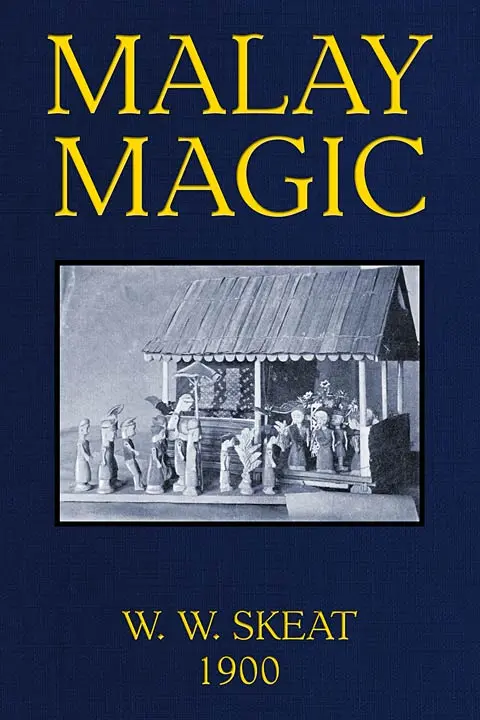
THE CLASSIC COLLECTION · 1900
"Malay Magic" by Walter William Skeat is an introductory work on folklore and popular religion written in the late 19th century. It explores the rich tapestry of beliefs, customs, and magical practices of the Malays in the Malay Peninsula, drawing upon a variety of sources, including personal observations, native manuscripts, and published works. The book aims to document and analyze the traditional beliefs and practices that are integral to Malay culture, highlighting the complexity of their folklore intertwined with influences from Indian, Arab, and indigenous sources. The opening of the book sets the stage for a comprehensive exploration of Malay folklore, establishing the author's intent to create a representative account of Malay beliefs and magical practices. Skeat introduces the key themes such as creation myths, the understanding of nature, and the relationships between humans and the supernatural world. He reflects on the significance of various folkloric beliefs, such as the creation of the world and the role of magic in everyday life, and emphasizes the importance of these elements in understanding the Malay identity and culture. As he begins to unfold these narratives, the reader is invited into the intricate world of Malay magic, laying the foundation for the detailed studies that follow.
Introduction adapted from the source catalogue; source summaries may be automatically generated.
Free to read · English · 226,518 words · No account needed
MAKE TIME FOR A GOOD BOOK
On by default. Untick to stop anonymous reading totals. Each page counts after 10 seconds in view. How this works.
Anonymous counting is on unless you have switched it off.
"If you are at one with me, rise towards me, O smoke; If you are not at one with me, rise athwart me, O smoke, Either to right or left." [655]
As you say this, "catch" the first puff of smoke and inhale it (tangkap-lah puchok asap, chium), as it rises towards you. If the smell is pleasant (sedap) it is a good sign; if it has a scorched smell (hangit) it is bad; but if it smells offensive (busok) no medicine can save the patient.
Next, before you look into the jars, take handfuls of "parched," "washed," and "saffron" rice, and after fumigating them over the incense, strew them all round the row of jars, saying as you do so:--
"Cluck, cluck! souls of So-and-so, all seven of you! [656] Come, and let all of us here together See (about the) medicine for (you) O souls of So-and-so."
Here strew (tabor) the rice first to the right, then to the left,
and then to the right again.
Before removing the calladium-leaves from the jar-mouths, repeat
the following:--
"Peace be with you, Prophet 'Tap, in whose charge is the earth, Suawam, in whose charge are the heavens, Prophet Noah, in whose charge are the Trees, Prophet Elias, Planter of Trees, And Prophet Khailir (Khizr), in whose charge is the water, I crave permission to see the remedies for So-and-so."
Here remove the calladium-leaves from the jar-mouths, and taking one of the wax tapers, wave it in the smoke of the censer seven times towards the right, and say:--
"Peace be with you, O Tanju, I adopt you to be a guardian for
my brother,
You who are sprung from the original elements,
From the former time unto the present,
You who sprang from the gum of the eyes of Muhammad,
I ask to see the disease of So-and-so."
Here plant the taper firmly upon the edge of the jar, and "gaze" into the water "to see the signs" (`alamat-nya).
Thus if there is an oily scum on the water (ayer berk'rak lemak) it is a bad sign; and to this may be added that if the calladium-leaf covering has acquired a faded look (layu) in the interim, it is a sign of severe sickness.
Fumigate the outside of the jars with the smoke of the incense (the medicine-man does this by "washing" his hands in the smoke and then rubbing over the outside of the jars as if he were "shampooing" them); and anoint them with "oil of Celebes" (minyak Bugis). Then take a "closed fistful" (sa-genggam) of parched rice, and holding it over the smoke of the censer (ganggang di asap kem'nyan), repeat this charm:--
Your reading position is saved on this browser. Take it to another device with a library code. Reading pages adapt to text, rather than matching a printed edition.
BEHIND THE BOOK
This eBook is for the use of anyone anywhere in the United States and most other parts of the world at no cost and with almost no restrictions whatsoever. You may copy it, give it away or re-use it under the terms of the Project Gutenberg License included with this eBook or online at www.gutenberg.org. If you are not located in the United States, you will have to check the laws of the country where you are located before using this eBook. Read the source licence.
The original source file, including credits and licence, is retained by this library. Request an original-format copy at no charge. Please include the book title and Project Gutenberg identifier #47873.
KEEP YOUR CURIOSITY GOING
David Patterson (Spirit) Hatch

David Patterson (Spirit) Hatch

David Patterson (Spirit) Hatch

Maurice Baring
Francis Greenleaf Allinson & Anne C. E. (Anne Crosby Emery) Allinson

Edwin Abbott Abbott