
Last letters from the living dead man
David Patterson (Spirit) Hatch
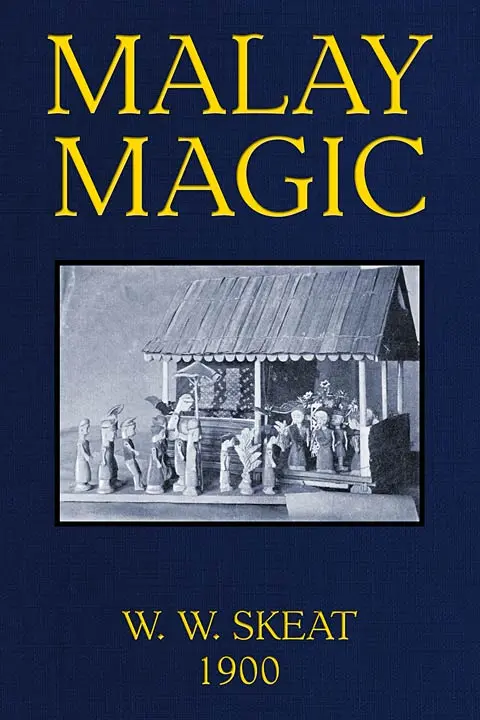
THE CLASSIC COLLECTION · 1900
"Malay Magic" by Walter William Skeat is an introductory work on folklore and popular religion written in the late 19th century. It explores the rich tapestry of beliefs, customs, and magical practices of the Malays in the Malay Peninsula, drawing upon a variety of sources, including personal observations, native manuscripts, and published works. The book aims to document and analyze the traditional beliefs and practices that are integral to Malay culture, highlighting the complexity of their folklore intertwined with influences from Indian, Arab, and indigenous sources. The opening of the book sets the stage for a comprehensive exploration of Malay folklore, establishing the author's intent to create a representative account of Malay beliefs and magical practices. Skeat introduces the key themes such as creation myths, the understanding of nature, and the relationships between humans and the supernatural world. He reflects on the significance of various folkloric beliefs, such as the creation of the world and the role of magic in everyday life, and emphasizes the importance of these elements in understanding the Malay identity and culture. As he begins to unfold these narratives, the reader is invited into the intricate world of Malay magic, laying the foundation for the detailed studies that follow.
Introduction adapted from the source catalogue; source summaries may be automatically generated.
Free to read · English · 226,518 words · No account needed
MAKE TIME FOR A GOOD BOOK
On by default. Untick to stop anonymous reading totals. Each page counts after 10 seconds in view. How this works.
Anonymous counting is on unless you have switched it off.
"In agricultural operations the animistic ideas of the Malays are clearly apparent: thus, before the rice is cut a sort of ritual is performed which is known as puji padi, and which is regarded, apparently, as a kind of propitiatory service, a sort of apology to the padi (rice) for reaping it. The padi is usually sprinkled with tepong tawar (flour mixed with water) before the reaping is commenced, and the first lot cut is set apart for a ceremonial feast.
"At planting there are also ceremonies: as a rule the beginning of the planting season is ushered in by a visit of the whole body of villagers to the most highly revered kramat in the neighbourhood, where the usual offerings are made and prayers are said. Sometimes, however, there is a special service known as bapua, [415] consisting of a sort of mock combat, in which the evil spirits are believed to be expelled from the rice-fields by the villagers: this is not done every year, but once in three or four years.
"Another occasional service of a peculiar character, which is not of very frequent occurrence, is the ceremony which would perhaps be best described as the propitiation of the earth-spirit. Some years ago I happened, by chance, to be present at a function of this kind, and as its details may be of some interest as illustrating the wide dispersion of certain points of ritual, I will end these notes by giving a full description of it as noted down at the time. It was in the month of October, and I happened to be out shooting snipe in the padi-fields of the village of Sebatu on a Sunday morning, when I was met by the Penghulu, the headman of the village, who asked me to leave off shooting for an hour or so. As I was having fair sport, I naturally wanted to know the reason why, so he explained that the noise of gunshots would irritate the hantu, and render unavailing the propitiatory service which was then about to begin. Further inquiry elicited the statement that the hantu in question was the one who presided over rice-lands and agricultural operations, and as I was told that there would be no objection to my attending the ceremony, I went there and then to the spot to watch the proceedings. The place was a square patch of grass-lawn a few yards wide, which had evidently for years been left untouched by the plough, though surrounded by many acres of rice-fields. On this patch a small wooden altar had been built: it consisted simply of a small square platform of wood or bamboo raised about three or four feet above the ground, each corner being supported by a small sapling with the leaves and branches left on it and overshadowing the platform, the sides of which appeared to face accurately towards the four cardinal points. To the western side was attached a small bamboo ladder leading from the ground to the edge of the platform. At the four corners of the patch of grass were four larger saplings planted in the ground. On the branches of all these trees were hung a number of ketupats, which are small squarish bags plaited of strips of the leaves of the screw-pine (mengkuang) or some similar plant, like the material of which native bags and mats are made. A larger ketupat hung over the centre of the altar, and all of them were filled with a preparation of boiled rice. On the altar were piled up various cooked foods laid on plantain leaves, including the flesh of a goat cooked in the ordinary way, as well as rice and different kinds of condiments and sweetmeats. The Pawang was present as well as a number of the villagers, and soon after my arrival with the Penghulu the ceremony began by some of the villagers producing out of a bag the skin of a black male goat with the head and horns attached and containing the entrails (the flesh having been cooked and laid on the altar previously). A large iron nail four or five inches long, and thick in proportion, was placed vertically in a hole about two feet deep which had been dug under the altar, and the remains of the goat were also buried in it, with the head turned towards the east, the hole being then closed and the turf replaced. Some of the goat's blood, in two cocoa-nut shells (tempurong), was placed on the ground near the south side and south-west corner of the altar close to the ladder.
Your reading position is saved on this browser. Take it to another device with a library code. Reading pages adapt to text, rather than matching a printed edition.
BEHIND THE BOOK
This eBook is for the use of anyone anywhere in the United States and most other parts of the world at no cost and with almost no restrictions whatsoever. You may copy it, give it away or re-use it under the terms of the Project Gutenberg License included with this eBook or online at www.gutenberg.org. If you are not located in the United States, you will have to check the laws of the country where you are located before using this eBook. Read the source licence.
The original source file, including credits and licence, is retained by this library. Request an original-format copy at no charge. Please include the book title and Project Gutenberg identifier #47873.
KEEP YOUR CURIOSITY GOING
David Patterson (Spirit) Hatch

David Patterson (Spirit) Hatch

David Patterson (Spirit) Hatch

Maurice Baring
Francis Greenleaf Allinson & Anne C. E. (Anne Crosby Emery) Allinson

Edwin Abbott Abbott