
The Writing of News A Handbook with Chapters on Newspaper Correspondence and Copy Reading
Charles G. (Charles Griffith) Ross
THE CLASSIC COLLECTION · 1897
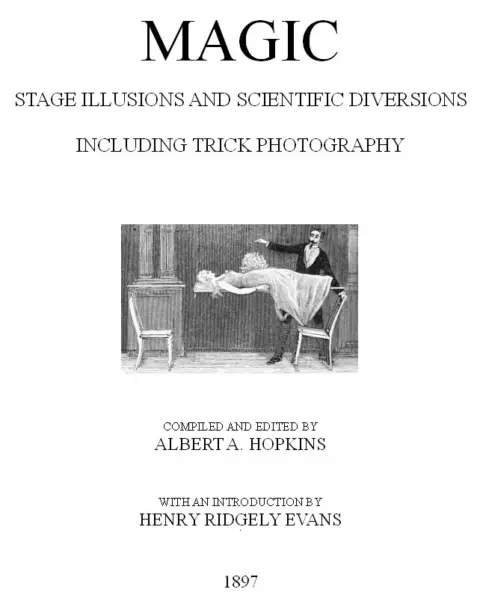
"Magic, Stage Illusions and Scientific Diversions, Including Trick Photography" compiled and edited by Albert A. Hopkins is a detailed exploration of magical arts and illusions written in the late 19th century. This comprehensive work delves into the integration of scientific principles such as optics, mechanics, and electricity into stage magic, presenting insights into some of the most renowned conjurers and their tricks, including elaborate descriptions and explanations of various illusions. The opening of this work sets the stage by outlining the unique niche it fills in the literature of magic, as it attempts to demystify stage illusions through scientific explanations. It highlights the significance of magic as an art form rooted in ancient practices and discusses notable figures in the field, explaining how their tricks are often based on ingenious mechanical and optical principles. Overall, the beginning serves as a promise of an entertaining and educational journey into the world of magic, including historical perspectives, specific techniques, and the harmonious blend of artistry and science in theatrical performances.
Introduction adapted from the source catalogue; source summaries may be automatically generated.
Free to read · English · 160,795 words · No account needed
MAKE TIME FOR A GOOD BOOK
On by default. Untick to stop anonymous reading totals. Each page counts after 10 seconds in view. How this works.
Anonymous counting is on unless you have switched it off.
Clever as was Robertson’s ghost illusion, performed by the aid of the phantasmagoric lantern, it had one great defect: the images were painted on glass and lacked the necessary vitality. It was reserved for the nineteenth century to produce the greatest of spectral exhibitions, that of Prof. Pepper, manager of the London Polytechnic Institution. In the year 1863, he invented a clever device for projecting the images of living persons in the air. The illusion is based on a simple optical effect. In the evening carry a lighted candle to the window and you will see reflected in the pane, not only the image of the candle but that of your hand and face as well. The same illusion may be seen while traveling in a lighted railway carriage at night; you gaze through the clear sheet of glass of the coach window and behold your “double” traveling along with you. The apparatus for producing the Pepper ghost has been used in dramatizations of Bulwer’s “Strange Story,” Dickens’ “Haunted Man” and “Christmas Carol,” and Dumas’ “Corsican Brothers.” In France the conjurers Robin and Lassaigne presented the illusion with many novel and startling effects.
One of the most famous of the eighteenth-century magicians was Torrini, a French nobleman, whose real name was the Comte de Grisi. His father, a devoted adherent of Louis XVI., lost his life at the storming of the Tuileries, on that fatal day in August, ever memorable in the annals of French history. Profiting by the disorders in the French capital, the young De Grisi was enabled to pass the barriers and reach the family chateau in Languedoc. He dug up a secret treasure his father had concealed for any emergency, and proceeded to Italy to study medicine. He established himself at Naples, where he soon became a physician of note. Here his noble birth and aristocratic manners gave him the entrée into the best society of the city. Like many enthusiastic amateurs he became interested in legerdemain, and performed for the amusement of his friends. A peculiar incident led him to adopt the profession of a magician. At the Carnival of 1796, the Chevalier Pinetti arrived in Naples to give a series of magical entertainments. Pinetti was the idol of the Italian public. The Comte de Grisi, having unraveled the secrets of most of Pinetti’s illusions, performed them for his friends. Pinetti, who was furious at having a rival, set about revenging himself on the audacious amateur. Without much difficulty he succeeded in ingratiating himself with De Grisi, and complimented him on his success as a prestidigitateur. One evening, he persuaded the young Count to take his place at the theater and give a performance for the benefit of the poor of the city. Intoxicated with flattery, to say nothing of numerous glasses of champagne, De Grisi consented. The greater number of Pinetti’s tricks were performed by the aid of confederates in the audience, who loaned various objects of which the magician had duplicates. A diabolical trap was laid for De Grisi. One of the accomplices declared that he had loaned the young magician a valuable diamond ring to use in a trick, and had had returned to him a pinchbeck substitute. Here was a dilemma, but De Grisi put the man off with an excuse until after the entertainment. Approaching the box where the king and his family were seated, De Grisi begged the monarch to draw a card from a pack. No sooner, however, had the king glanced at the card he had selected, than he threw it angrily on the stage, with marks of intense dissatisfaction. De Grisi, horror-struck, picked up the card and found written on it a coarse insult. The conjurer rushed off the stage, picked up his sword, and searched in vain for the author of the infamous act of treachery; but Pinetti had fled. De Grisi was so utterly ruined, socially and financially, by this fiasco, that he came near dying of brain fever, the result of overwrought emotions. On his recovery he vowed vengeance on Pinetti, a most unique vengeance. Says De Grisi: “To have challenged him would be doing him too much honor, so I vowed to fight him with his own weapons, and humiliate the shameful traitor in my turn. This was the plan I drew up: I determined to devote myself ardently to sleight-of-hand, to study thoroughly an art of which I as yet knew only the first principles. Then, when quite confident in myself--when I had added many new tricks to Pinetti’s repertoire--I would pursue my enemy, enter every town before him, and continually crush him by my superiority.”
Your reading position is saved on this browser. Take it to another device with a library code. Reading pages adapt to text, rather than matching a printed edition.
BEHIND THE BOOK
This eBook is for the use of anyone anywhere in the United States and most other parts of the world at no cost and with almost no restrictions whatsoever. You may copy it, give it away or re-use it under the terms of the Project Gutenberg License included with this eBook or online at www.gutenberg.org. If you are not located in the United States, you will have to check the laws of the country where you are located before using this eBook. Read the source licence.
The original source file, including credits and licence, is retained by this library. Request an original-format copy at no charge. Please include the book title and Project Gutenberg identifier #45235.
KEEP YOUR CURIOSITY GOING
Charles G. (Charles Griffith) Ross
Hannah Webster Foster

Emily Lawless
Edwin Hamlin Carr

Charles De Lano Hine
Andrew Ure