
The Writing of News A Handbook with Chapters on Newspaper Correspondence and Copy Reading
Charles G. (Charles Griffith) Ross
THE CLASSIC COLLECTION · 1897
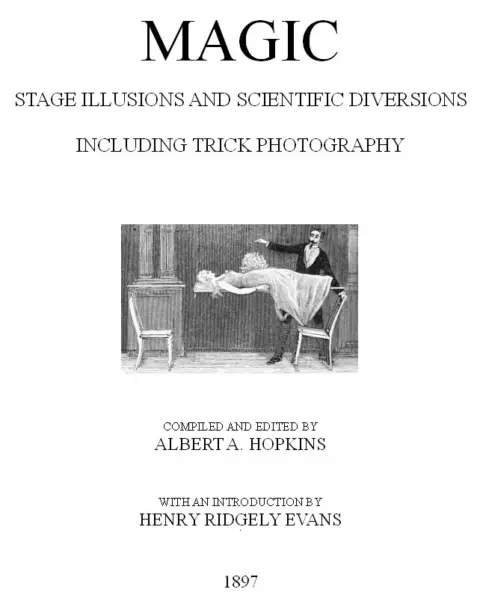
"Magic, Stage Illusions and Scientific Diversions, Including Trick Photography" compiled and edited by Albert A. Hopkins is a detailed exploration of magical arts and illusions written in the late 19th century. This comprehensive work delves into the integration of scientific principles such as optics, mechanics, and electricity into stage magic, presenting insights into some of the most renowned conjurers and their tricks, including elaborate descriptions and explanations of various illusions. The opening of this work sets the stage by outlining the unique niche it fills in the literature of magic, as it attempts to demystify stage illusions through scientific explanations. It highlights the significance of magic as an art form rooted in ancient practices and discusses notable figures in the field, explaining how their tricks are often based on ingenious mechanical and optical principles. Overall, the beginning serves as a promise of an entertaining and educational journey into the world of magic, including historical perspectives, specific techniques, and the harmonious blend of artistry and science in theatrical performances.
Introduction adapted from the source catalogue; source summaries may be automatically generated.
Free to read · English · 160,795 words · No account needed
MAKE TIME FOR A GOOD BOOK
On by default. Untick to stop anonymous reading totals. Each page counts after 10 seconds in view. How this works.
Anonymous counting is on unless you have switched it off.
The history of magic would be incomplete without a sketch of Cagliostro, the arch-necromancer of the eighteenth century, who filled all Europe with his fame. Novels and plays have been founded on his strange career, as witness Goethe’s “Grand Cophta” and Alexander Dumas’ “Memoirs of a Physician.” Thomas Carlyle has remorselessly dissected the character of Cagliostro in an immortal essay, “Count Cagliostro,” which makes fascinating reading. Cagliostro like Nostradamus, and others of that ilk, as the Scotch say, was a pretender to magic and sorcery. He manufactured elixirs of life, raised the shades of the illustrious dead, pretty much after the fashion of our modern spirit mediums; told fortunes, predicted lucky numbers in the lottery, transmuted metals, and founded occult lodges of Egyptian Masonry for the regeneration of mankind. Joseph Balsamo--for such was the Count’s real name--was born of poor parents at Palermo, Sicily, in the year 1743. He received the rudiments of an education, and a smattering of chemistry, at a neighboring monastery, and then started out to fleece mankind. He began by forging theater tickets, after that a will; then he robbed a goldsmith named Marano of a sum of money. Balsamo pretended that a secret treasure lay buried in a certain rocky chasm just outside the city of Palermo, and that he, for a consideration, was able to unearth the gold by means of certain magical incantations. Poor Marano like a susceptible gudgeon swallowed the bait, hook and all, paid the contingent fee, and accompanied by the amateur sorcerer (it was Balsamo’s first attempt in the necromantic line) paid a visit on a certain dark night to the lonely spot where the treasure lay hid from mortal gaze. Joseph drew a magic circle of phosphorus on the earth, pronounced some spells in a peculiar gibberish known only to himself, which he denominated Arabic, and bade the goldsmith dig away for dear life. Marano went vigorously to work with pick and spade. Suddenly terrific yells were heard, whereupon a legion of devils (Joseph’s boon companions with cork-blackened visages) rushed from behind the rocks, pounced upon the goldsmith, and nearly beat him to death with their pitchforks. The enchanter, in order to escape the vengeance of the furious Marano, was compelled to flee his native city. In company with a Greek, Althotas, he visited various places--Greece, Egypt, Arabia, Persia, Rhodes, Malta, Naples, Venice and Rome. According to his own account, he studied alchemy at Malta in the laboratory of Pinto, Grand Master of the Knights of Malta and St. John. At Rome he married a beautiful girl, Lorenza Feliciani, daughter of a girdle maker, who proved of great assistance to him in his impostures. They travelled over Europe in a coach-and-four with a retinue of servants garbed in gorgeous liveries. Balsamo changed his name to the high-sounding title of the Comte de Cagliostro, and scattered money right and left. “At Strasbourg,” says one of his biographers, “he reaped an abundant harvest by professing the art of making old people young; in which pretension he was seconded by his wife, Lorenza Feliciani, who, though only twenty years of age, declared that she was sixty and that she had a son a veteran in the Dutch service.” Cagliostro also pretended to be of a great age, and solemnly declared that he had hobnobbed with Alexander and Julius Cæsar; that he was present at the burning of Rome under Nero and was an eye-witness of the crucifixion of Christ. Cardinal de Rohan, of France, who became a firm believer in the pretensions of the charlatan, entertained him in Paris, introducing him to that gay world of the Old Régime which went out forever with the French Revolution. This was in 1785. All Paris went wild over the enchanter, and thronged to his magical soirées at his residence in the Rue St. Claude. Cagliostro coined money in the French capital with his spurious Egyptian Rite of Freemasonry, which promised to its votaries the length of life of the Noachites, and superhuman power over nature and her laws. Imbert Saint-Amand, the interesting author of “Marie Antoinette and the End of the Old Régime,” says (Scribner Edition): “The mania for the supernatural, the rage for the marvelous, prevailed in the last years of the eighteenth century, which had wantonly derided every sacred thing. Never were the Rosicrucians, the adepts, sorcerers, and prophets so numerous and so respected. Serious and educated men, magistrates, courtiers, declared themselves eye-witnesses of alleged miracles.... When Cagliostro came to France, he found the ground prepared for his magical operations. A society eager for distractions and emotions, indulged to every form of extravagance, necessarily welcomed such a man and hailed him as its guide. Whence did he come? What was his country, his age, his origin? Where did he get those extraordinary diamonds which adorned his dress, the gold which he squandered so freely? It was all a mystery.... So far as was known, Cagliostro had no resources, no letter of credit, and yet he lived in luxury. He treated and cured the poor without pay, and not satisfied with restoring them to health, he made them large presents of money. His generosity to the poor, his scorn for the great, aroused universal enthusiasm. The Germans, who lived on legends, imagined that he was the Wandering Jew.... Speaking a strange gibberish, which was neither French nor Italian, with which he mingled a jargon which he did not translate, but called Arabic, he used to recite with solemn emphasis the most absurd fables. When he repeated his conversation with the angel of light and the angel of darkness, when he spoke of the great secret of Memphis, of the Hierophant, of the giants, the enormous animals, of a city in the interior of Africa ten times as large as Paris, where his correspondents lived, he found a number of people ready to listen and believe him.”
Your reading position is saved on this browser. Take it to another device with a library code. Reading pages adapt to text, rather than matching a printed edition.
BEHIND THE BOOK
This eBook is for the use of anyone anywhere in the United States and most other parts of the world at no cost and with almost no restrictions whatsoever. You may copy it, give it away or re-use it under the terms of the Project Gutenberg License included with this eBook or online at www.gutenberg.org. If you are not located in the United States, you will have to check the laws of the country where you are located before using this eBook. Read the source licence.
The original source file, including credits and licence, is retained by this library. Request an original-format copy at no charge. Please include the book title and Project Gutenberg identifier #45235.
KEEP YOUR CURIOSITY GOING
Charles G. (Charles Griffith) Ross
Hannah Webster Foster

Emily Lawless
Edwin Hamlin Carr

Charles De Lano Hine
Andrew Ure