
The Writing of News A Handbook with Chapters on Newspaper Correspondence and Copy Reading
Charles G. (Charles Griffith) Ross
THE CLASSIC COLLECTION · 1897
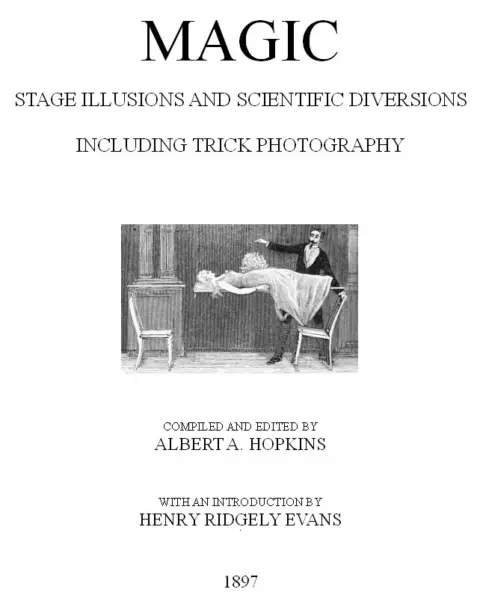
"Magic, Stage Illusions and Scientific Diversions, Including Trick Photography" compiled and edited by Albert A. Hopkins is a detailed exploration of magical arts and illusions written in the late 19th century. This comprehensive work delves into the integration of scientific principles such as optics, mechanics, and electricity into stage magic, presenting insights into some of the most renowned conjurers and their tricks, including elaborate descriptions and explanations of various illusions. The opening of this work sets the stage by outlining the unique niche it fills in the literature of magic, as it attempts to demystify stage illusions through scientific explanations. It highlights the significance of magic as an art form rooted in ancient practices and discusses notable figures in the field, explaining how their tricks are often based on ingenious mechanical and optical principles. Overall, the beginning serves as a promise of an entertaining and educational journey into the world of magic, including historical perspectives, specific techniques, and the harmonious blend of artistry and science in theatrical performances.
Introduction adapted from the source catalogue; source summaries may be automatically generated.
Free to read · English · 160,795 words · No account needed
MAKE TIME FOR A GOOD BOOK
On by default. Untick to stop anonymous reading totals. Each page counts after 10 seconds in view. How this works.
Anonymous counting is on unless you have switched it off.
Professor Jastrow, at his psychological laboratory, subjected the conjurers Herrmann and Kellar to a series of careful tests to ascertain their tactile sensibility, sensitiveness to textures, accuracy of visual perception, quickness of movement, mental processes, etc. In “Science” he details the results obtained by him in his experiments, the first of the kind ever made with magicians as subjects. Read in conjunction with the highly interesting series of articles on the “Psychology of Deception,” Robert-Houdin’s memoirs and magical revelations, and Max Dessoir’s fine papers, these studies of Herrmann and Kellar are of great interest to all students of experimental psychology. There are no finer illustrations of mental and visual deception than the tricks of prestidigitateurs.
---- Psychology of Deception. Popular Science Monthly, vol. xxxiv. pp.
145-157; 721-732.
KELLAR, HARRY. High Caste Indian Magic. North American Review, vol.
clvi. pp. 75-86.
In this entertaining paper, Kellar the conjurer describes some of the magical performances of the Hindu fakirs and Zulu wizards. They not only out-Herod Herod, but out-Haggard Rider Haggard, the prince of romancers, for weirdness and improbability. The article reads as if it had been “written up” for effect, being the product of an elastic and brilliant imagination, though Kellar claims to have been an eye-witness of all the marvels he describes. Some few of them, hypnotic in character, such as the feat of “imitation death,” are unquestionably true, as witness the evidence of Sir Claude M. Wade and other eminent Anglo-Indian investigators. The magician Herrmann, who traveled over India, had but a contemptuous opinion of Hindu fakir tricks. Modern theosophists have done much to exploit the so-called miracles of Tibetan and Indian necromancers. Madame Blavatsky’s works are full of absurd stories of Oriental magic. See her “Caves and Jungles of Hindustan,” “Isis Unveiled,” etc., for example. But also see Arthur Lillie’s work, “Madame Blavatsky and her Theosophy,” London, 1897, for amusing revelations of theosophical marvels.
---- Magic among the Red Men. North American Review, vol. clviii. pp.
591-600.
KUNARD, Prof. R. Book of Card Tricks for Drawing-Room and Stage.
London, 1888. 8vo.
---- Modern Magic; a Book of Conjuring for Amateurs. London, 1888. 8vo.
LE ROUX, HUGUES, and GARNIER, JULES. Acrobats and Mountebanks. Translated by A. P. Morton. London and New York, 1890. 4to.
A very entertaining work, tracing the history of the mountebank from his inception in the nomadic caravan to his apotheosis in the splendid modern circus and vaudeville theatre.
LEWIS, T. HANSON. The Great Wizard of the West [J. N. Maskelyne]. English Illustrated Magazine, vol. xii. p. 75.
LOCKHART, W. Advanced Prestidigitation. London, 1894.
LOGAN, OLIVE. The King of Conjurers [Robert-Houdin]. Harper’s Magazine,
vol. lv. pp. 817-831.
MACAIRE, SID. Mind-Reading, or Muscle-Reading? London, 1889.
Your reading position is saved on this browser. Take it to another device with a library code. Reading pages adapt to text, rather than matching a printed edition.
BEHIND THE BOOK
This eBook is for the use of anyone anywhere in the United States and most other parts of the world at no cost and with almost no restrictions whatsoever. You may copy it, give it away or re-use it under the terms of the Project Gutenberg License included with this eBook or online at www.gutenberg.org. If you are not located in the United States, you will have to check the laws of the country where you are located before using this eBook. Read the source licence.
The original source file, including credits and licence, is retained by this library. Request an original-format copy at no charge. Please include the book title and Project Gutenberg identifier #45235.
KEEP YOUR CURIOSITY GOING
Charles G. (Charles Griffith) Ross
Hannah Webster Foster

Emily Lawless
Edwin Hamlin Carr

Charles De Lano Hine
Andrew Ure