
The Writing of News A Handbook with Chapters on Newspaper Correspondence and Copy Reading
Charles G. (Charles Griffith) Ross
THE CLASSIC COLLECTION · 1897
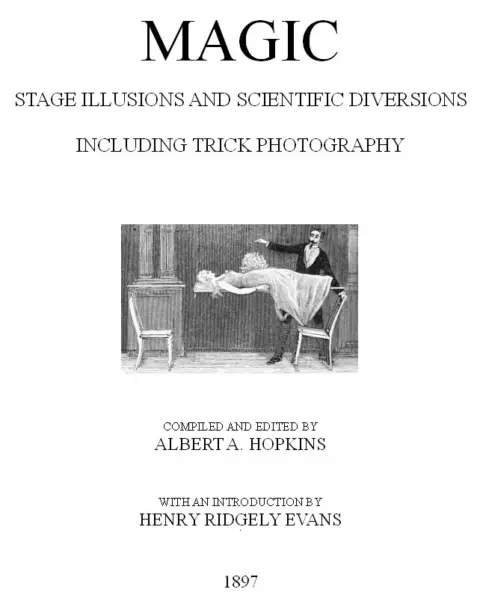
"Magic, Stage Illusions and Scientific Diversions, Including Trick Photography" compiled and edited by Albert A. Hopkins is a detailed exploration of magical arts and illusions written in the late 19th century. This comprehensive work delves into the integration of scientific principles such as optics, mechanics, and electricity into stage magic, presenting insights into some of the most renowned conjurers and their tricks, including elaborate descriptions and explanations of various illusions. The opening of this work sets the stage by outlining the unique niche it fills in the literature of magic, as it attempts to demystify stage illusions through scientific explanations. It highlights the significance of magic as an art form rooted in ancient practices and discusses notable figures in the field, explaining how their tricks are often based on ingenious mechanical and optical principles. Overall, the beginning serves as a promise of an entertaining and educational journey into the world of magic, including historical perspectives, specific techniques, and the harmonious blend of artistry and science in theatrical performances.
Introduction adapted from the source catalogue; source summaries may be automatically generated.
Free to read · English · 160,795 words · No account needed
MAKE TIME FOR A GOOD BOOK
On by default. Untick to stop anonymous reading totals. Each page counts after 10 seconds in view. How this works.
Anonymous counting is on unless you have switched it off.
1 is Say or Speak.
2 is Be, Look, or Let.
3 is Can or Can’t.
4 is Do or Don’t.
5 is Will or Won’t.
6 is What.
7 is Please or Pray.
8 is Are or Ain’t.
9 is Now.
10 is Tell.
0 is Hurry or Come.
“‘Well’ is to repeat the last figure.
“Example: The number 1,234 is required; attention must only be paid to the first word of a sentence, thus:
“‘Say the number. Look at it. Can you see it? Do you know?’
“Or say the number is 100:
“‘Tell me the number. Hurry!’
“A rather difficult number would be 1,111. The question would be put in
this wise:
“‘Say the number. Well? Speak out. Say what it is.’
“On a watch or greenback there are sometimes eight or nine numbers, which can be followed as easily as the above.
“The table of colors is as follows:
1 is White.
2 is Black.
3 is Blue.
4 is Brown.
5 is Red.
6 is Green.
7 is Yellow.
8 is Gray.
“The solution of the numbers, as I have explained, will furnish the key. For example, the article presented is green; the question will be:
“‘What is the color?’ green being the sixth color in the list.
“Blue is wanted, and, as it stands third in the list, the word would be:
“‘Can you tell the color?’
“White is wanted, and, as it stands first in the list, the question is:
“‘Say the color.’
“Understand that the words explaining the numbers, as given in the list, are applied to the articles enumerated in each of the subjoined tables.
1. Gold.
2. Silver.
3. Brass.
4. Copper.
5. Lead.
6. Iron.
7. Tin.
8. Platina.
9. Steel.
1. Diamond.
2. Ruby.
3. Pearl.
4. Amethyst.
5. Onyx.
6. Garnet.
7. Emerald.
8. Turquoise.
9. Carbuncle.
10. Topaz.
The stone--opal.
“Take the metals, for instance. The metal presented is copper, which is fourth in the list. The question would be:
“‘Do you know the metal?’
“If steel, which is ninth in the list:
“‘Now, what is the metal?’
“Sex, countries, materials, fabrics, watches, are as follows:
[This set to describe the sex, etc., of the pictures.]
1. Lady.
2. Gentleman.
3. Boy.
4. Girl.
5. Child.
6. Group.
7. Animal.
8. Drawing.
9. Sketch.
1. America.
2. England.
3. France.
4. Germany.
5. Russia.
6. Italy.
7. Spain.
8. Canada.
9. Foreign.
10. Mexico.
1. Wood.
2. Stone.
3. Marble.
4. Bronze.
5. Lava.
6. Rubber.
7. Glass.
8. Bone.
9. Ivory.
10. China.
1. Silk.
2. Wool.
3. Cotton.
4. Linen.
5. Leather.
6. Kid.
7. Buckskin.
8. Lace.
The maker’s name?
Of what company’s make?
[This is to tell the maker’s name of watches.]
1. American Watch Co.
2. Waltham Watch Co.
3. Elgin Watch Co.
4. Dueber Watch Co.
5. Tobias.
6. Johnson.
7. Swiss.
8.
9.
10.
“Miscellaneous articles are divided into nineteen sets, thus:
What article is this?
1. Handkerchief.
2. Neckerchief.
3. Bag.
4. Glove.
5. Purse.
6. Basket.
7. Beet.
8. Comforter.
9. Headdress.
10. Fan.
What is this?
Your reading position is saved on this browser. Take it to another device with a library code. Reading pages adapt to text, rather than matching a printed edition.
BEHIND THE BOOK
This eBook is for the use of anyone anywhere in the United States and most other parts of the world at no cost and with almost no restrictions whatsoever. You may copy it, give it away or re-use it under the terms of the Project Gutenberg License included with this eBook or online at www.gutenberg.org. If you are not located in the United States, you will have to check the laws of the country where you are located before using this eBook. Read the source licence.
The original source file, including credits and licence, is retained by this library. Request an original-format copy at no charge. Please include the book title and Project Gutenberg identifier #45235.
KEEP YOUR CURIOSITY GOING
Charles G. (Charles Griffith) Ross
Hannah Webster Foster

Emily Lawless
Edwin Hamlin Carr

Charles De Lano Hine
Andrew Ure