THE CLASSIC COLLECTION✦An outlaw’s diary: the CommuneCLASSIC FREE BOOKS
An outlaw’s diary: the Commune
Cécile Tormay
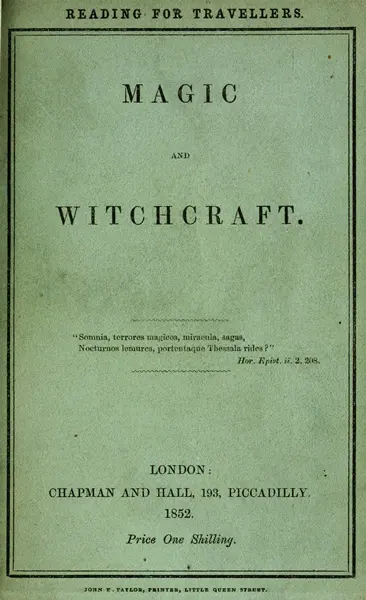
THE CLASSIC COLLECTION · 1852
"Magic and Witchcraft" by George Moir is a historical account written in the mid-19th century. The work delves into the history of magic and witchcraft, exploring their evolution and impact on human thought and society. Through a blend of scholarly insight and historical narratives, the text aims to uncover the origins and consequences of these beliefs, tracing their evolution across various cultures and epochs. The opening of the book presents a preface outlining the author's intention to compile a thorough investigation into the subjects of magic and witchcraft. It expresses the need for a comprehensive history that reflects human belief systems, particularly focusing on the darker aspects of superstition and the societal delusions it spurred. Moir argues that magic often emerges from profound truths twisted into falsehoods and gets interwoven with humanity’s enduring quest for power over nature and the divine. The tone is reflective and analytical, setting the stage for a discussion on the universality of these beliefs and their consequences throughout history, laying the groundwork for specific examples and cases that would be explored later in the text.
Introduction adapted from the source catalogue; source summaries may be automatically generated.
Free to read · English · 26,919 words · No account needed
MAKE TIME FOR A GOOD BOOK
On by default. Untick to stop anonymous reading totals. Each page counts after 10 seconds in view. How this works.
Anonymous counting is on unless you have switched it off.
[31] Peter died in prison just in time to escape the flames. He was burned in effigy however after his death.
[32] Lindon, cited by Wyttenbach, 'Versuch einer Geschichte von Trier,'
vol. iii. p. 110.
[33] Beyträge zur Beförderung einer nähern Einsicht in das gesammte Geisterreich, vol. i. p. 284.
[34] The Abbé Fiard, one of the latest believers on record, has printed the Requête at full length in his 'Lettres sur la Magie,' p. 117 et seq.
[35] Even now a complaint of 'being bewitched' is occasionally made to Justices of the Peace by the very ignorant or the very malignant.
[36] Trials and other Proceedings in Matters Criminal before the High Court of Justiciary in Scotland, selected from the Records of that Court. By Robert Pitcairn. Edinburgh.
[37] Holingshed, vol. i. pp. 50, 317.
[38] At the second marriage of Alexander III., Fordun, vol. ii. p. 128.
Boece, p. 294, ed. 1574.
[39] Boece, p. 149.
[40] In the case of Cameron, Bishop of Glasgow, 1466.--Buchanan.
Pitscottie.
"Quell' altro, che nei fianchi è così poco,
Michele Scotto fu, che veramente
Delle magiche frode seppe il giuoco."--Canto xx.
[42] As in the case of the witches at Forres, who attempted to destroy King Duffus by the favourite pagan charm of roasting his image in wax, and those burnt at Edinburgh for a similar attempt against James III., in 1479.
[43] Scot of Scotstarvet, Home of Godscroft, passim.
[44] Nov. 8, 1576. Pitcairn, vol. i. p. 48.
[45] Ibid. p. 51.
[46] Rec. of Just. May 27, 1601.
[47] News from Scotland, declaring the damnable life of Dr.
Fian.--Pitcairn, vol. i. p. 213.
[48] We need hardly remind our readers of the torture of Macbriar by the Boots, before the Privy Council, in the 'Tales of my Landlord.'
[49] Old French, Turquois, a smith's pincers, from torquere.
[50] Sir James Melville, p. 294.
[51] Pitcairn, vol. i. p. 211.
[52] Crook--the hook from which pots are hung over a Scottish kitchen
fire.
[53] Just. Records, 1590-1610.
[54] Most of the cases here cited are found in the Justiciary Records,
from about 1605 to 1640.
[55] Feb. 4, 1629.
[56] Just. Records, Jan. 1630.
[57] Just. Rec., Dec. 1643.
[58] The paper is marked on the back, "Edinburgh, July 10th, 1662: considered and found relevant by the Justice Depute." The part of Janet Braidhead's deposition, which appears to have borne a similar marking by the Justice Depute, is torn off.
[59] Her fellow-witch, Braidhead, was baptized by the very inappropriate
name of Christian.
[60] This seems to have been a common practice in the Infernal ritual. Law gives the nicknames of the Renfrewshire witches, in the Bangarran Case. (Memorials, p. 122.)
[61] Taking the form of foul and ominous birds was a favourite practice of witches in all ages. Apuleius, in his character of Lucius, thus describes the metamorphosis of his hostess at Larissa:--
Your reading position is saved on this browser. Take it to another device with a library code. Reading pages adapt to text, rather than matching a printed edition.
BEHIND THE BOOK
This eBook is for the use of anyone anywhere in the United States and most other parts of the world at no cost and with almost no restrictions whatsoever. You may copy it, give it away or re-use it under the terms of the Project Gutenberg License included with this eBook or online at www.gutenberg.org. If you are not located in the United States, you will have to check the laws of the country where you are located before using this eBook. Read the source licence.
The original source file, including credits and licence, is retained by this library. Request an original-format copy at no charge. Please include the book title and Project Gutenberg identifier #42550.
KEEP YOUR CURIOSITY GOING
Cécile Tormay

Moritz Busch
John L. Ransom
Frances Wright
Cécile Tormay

Mabel Potter Daggett