THE CLASSIC COLLECTION✦An outlaw’s diary: the CommuneCLASSIC FREE BOOKS
An outlaw’s diary: the Commune
Cécile Tormay
THE CLASSIC COLLECTION · 1852
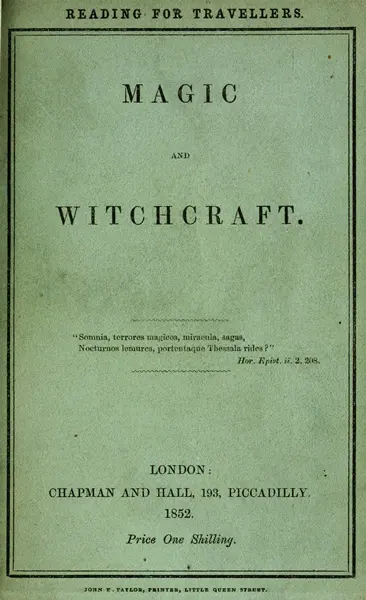
"Magic and Witchcraft" by George Moir is a historical account written in the mid-19th century. The work delves into the history of magic and witchcraft, exploring their evolution and impact on human thought and society. Through a blend of scholarly insight and historical narratives, the text aims to uncover the origins and consequences of these beliefs, tracing their evolution across various cultures and epochs. The opening of the book presents a preface outlining the author's intention to compile a thorough investigation into the subjects of magic and witchcraft. It expresses the need for a comprehensive history that reflects human belief systems, particularly focusing on the darker aspects of superstition and the societal delusions it spurred. Moir argues that magic often emerges from profound truths twisted into falsehoods and gets interwoven with humanity’s enduring quest for power over nature and the divine. The tone is reflective and analytical, setting the stage for a discussion on the universality of these beliefs and their consequences throughout history, laying the groundwork for specific examples and cases that would be explored later in the text.
Introduction adapted from the source catalogue; source summaries may be automatically generated.
Free to read · English · 26,919 words · No account needed
MAKE TIME FOR A GOOD BOOK
On by default. Untick to stop anonymous reading totals. Each page counts after 10 seconds in view. How this works.
Anonymous counting is on unless you have switched it off.
[18] Records of Justiciary. Trial of the Master of Orkney.
[19] Calef's Journal.
[20] Cobbett's State Trials.
[21] Trial of Bartie Paterson. Records of Scottish Justiciary. Dec. 18,
1607.
[22] In Wenham's case, Mr. Chauncy deposed that a cat belonging to Jane Wenham had come and knocked at his door at night, and that he had killed it. This was founded on evidence at the trial.
[23] Rec. of Just. 1613, Dec. 1.
[24] See the 'Neue Necrologie der Deutschen, 1823,' for an account of these remarkable appearances.
[25] Divina et Vera Metaphysica.
[26] Wordsworth's 'Dion.'
[27] The prefixed characters which Ashmole interprets to mean Responsum Raphaelis seem remarkably to resemble that cabalistic-looking initial which in medical prescriptions is commonly interpreted "Recipe."
[28] Dapper (Beschreibung von Amsterdam, p. 150) describes her as a melancholy or hypochondriac girl. She was burned however as usual. These rhyming or alliterative charms are of very remote antiquity. Cato, in his treatise on Husbandry, recommends the following formulary for a sprain or fracture: "Huat Hanat, Huat Ista, Pista Sista, Domiabo Damnaustra," or "Motas Væta, Daries Dardaries, Astataries Dissunapiter."
[29] This, indeed, is an almost invariable feature in the witch trials, and, if the subject could justify the discussion, might lead to some singular medical conclusions.
[30] The trade of a pricker, as it was called, i. e. a person who put pins into the flesh of a witch, was a regular one in Scotland and England, as well as on the Continent. Sir George Mackenzie mentions the case of one of them who confessed the imposture (p. 48); and a similar instance is mentioned by Spottiswood (p. 448). Sir Walter Scott gives the following account of this trade:--"One celebrated mode of detecting witches, and torturing them at the same time, to draw forth confession, was, by running pins into their body, on pretence of discovering the devil's stigma, or mark, which was said to be inflicted by him upon all his vassals, and to be insensible to pain. This species of search, the practice of the infamous Hopkins, was in Scotland reduced to a trade; and the young witch-finder was allowed to torture the accused party, as if in exercise of a lawful calling, although Sir George Mackenzie stigmatizes it as a horrid imposture. I observe in the Collections of Mr. Pitcairn, that, at the trial of Janet Peaston of Dalkeith, the magistrates and ministers of that market-town caused John Kincaid of Tranent, the common pricker, to exercise his craft upon her, 'who found two marks of what he called the devil's making, and which appeared indeed to be so, for she could not feel the pin when it was put into either of the said marks, nor did they (the marks) bleed when they were taken out again; and when she was asked where she thought the pins were put in, she pointed to a part of her body distant from the real place. They were pins of three inches in length.' Besides the fact, that the persons of old people especially sometimes contain spots void of sensibility, there is also room to believe that the professed prickers used a pin, the point or lower part of which was, on being pressed down, sheathed in the upper, which was hollow for the purpose, and that which appeared to enter the body did not pierce it at all."--Demonology and Witchcraft, p. 297.
Your reading position is saved on this browser. Take it to another device with a library code. Reading pages adapt to text, rather than matching a printed edition.
BEHIND THE BOOK
This eBook is for the use of anyone anywhere in the United States and most other parts of the world at no cost and with almost no restrictions whatsoever. You may copy it, give it away or re-use it under the terms of the Project Gutenberg License included with this eBook or online at www.gutenberg.org. If you are not located in the United States, you will have to check the laws of the country where you are located before using this eBook. Read the source licence.
The original source file, including credits and licence, is retained by this library. Request an original-format copy at no charge. Please include the book title and Project Gutenberg identifier #42550.
KEEP YOUR CURIOSITY GOING
Cécile Tormay

Moritz Busch
John L. Ransom
Frances Wright
Cécile Tormay

Mabel Potter Daggett