THE CLASSIC COLLECTION✦Goldsmith English Men of Letters SeriesCLASSIC FREE BOOKS
Goldsmith English Men of Letters Series
William Black
THE CLASSIC COLLECTION · 1879
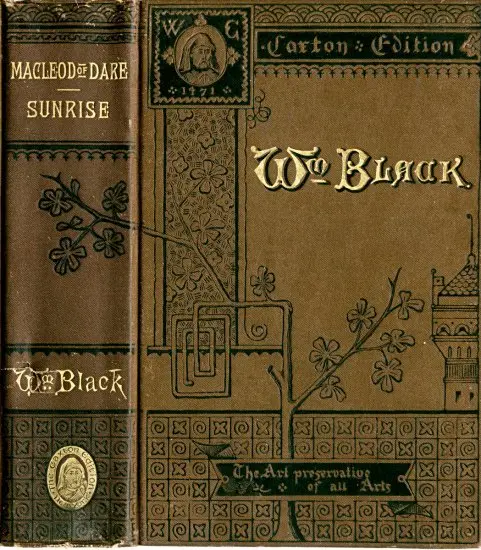
"Macleod of Dare" by William Black is a novel written in the late 19th century. The story centralizes around Sir Keith Macleod, the last surviving son of Lady Macleod, as he prepares to leave his home at Castle Dare for London. The narrative explores themes of family, duty, and the contrast between the wildness of the Scottish Highlands and the sophistication of urban society. The opening of the novel introduces us to Castle Dare, illuminating the emotional weight that Lady Macleod carries as she bids farewell to her only remaining son, Keith. Surrounded by memories of her other sons who have fallen in battle, she is proud yet sorrowful as Keith embraces his youthful spirit, ready for adventure. The poignant moment is heightened by their cousin Janet's efforts to maintain a sense of cheerfulness despite the family's grief. As the scene progresses, Keith’s spirited nature becomes evident through his dialogue and interactions with the people around him, including the piper and his dear cousin Janet, who worry about his departure. The contrasting emotions set the stage for his journey away from the familiar rugged beauty of Mull into the bustling life of London, suggesting the intertwining of their fates as they navigate matters of heart and heritage.
Introduction adapted from the source catalogue; source summaries may be automatically generated.
Free to read · English · 165,752 words · No account needed
MAKE TIME FOR A GOOD BOOK
On by default. Untick to stop anonymous reading totals. Each page counts after 10 seconds in view. How this works.
Anonymous counting is on unless you have switched it off.
"Come along, then, Hamish," said she, quickly. "Oh, but he cannot be so ill as that. And the long sea-voyage will pull him round, don't you think?"
"Ay, ay, mem," said Hamish; but he was paying little heed. He called up the cab, and Miss White stepped inside, and he and Colin Laing got on the box.
"Tell him to go quickly," she said to Hamish, "for I must have something instead of luncheon if we have a minute at the station."
And Miss White, as the cab rolled away, felt pleased with herself. It
was a brave act.
"It is the least I can do for the sake of my bonny Glenogie," she was saying to herself, quite cheerfully. "And if Mr. Lemuel were to hear of it? Well, he must know that I mean to be mistress of my own conduct. And so the poor Glenogie is really ill. I can do no harm in parting good friends with him. Some men would have made a fuss."
At the station they had ten minutes to wait; and Miss White was able to get the slight refreshment she desired. And although Hamish would fain have kept out of her way--for it was not becoming in a rude sailor to be seen speaking to so fine a lady--she would not allow that.
"And where are you going, Hamish, when you leave the Thames?" she asked, smoothing the fingers of the glove she had just put on again.
"I do not know that, mem," said he.
"I hope Sir Keith won't go to Torquay or any of those languid places. You will go to the Mediterranean, I suppose?"
"Maybe that will be the place, mem," said Hamish.
"Or the Isle of Wight, perhaps," said she, carelessly.
"Ay, ay, mem--the Isle of Wight--that will be a ferry good place, now. There wass a man I wass seeing once in Tobbermorry, and he wass telling me about the castle that the Queen herself will hef on that island. And Mr. Ross, the Queen's piper, he will be living there too."
But, of course, they had to part company when the train came up; and Hamish and Colin Laing got into a third-class carriage together. The cousin from Greenock had been hanging rather in the background; but he had kept his ears open.
"Now, Hamish," said he, in the tongue in which they could both speak freely enough, "I will tell you something; and do not think I am an ignorant man, for I know what is going on. Oh yes. And it is a great danger you are running into."
Your reading position is saved on this browser. Take it to another device with a library code. Reading pages adapt to text, rather than matching a printed edition.
William Black
William Black
William Black

William Black
BEHIND THE BOOK
This eBook is for the use of anyone anywhere in the United States and most other parts of the world at no cost and with almost no restrictions whatsoever. You may copy it, give it away or re-use it under the terms of the Project Gutenberg License included with this eBook or online at www.gutenberg.org. If you are not located in the United States, you will have to check the laws of the country where you are located before using this eBook. Read the source licence.
The original source file, including credits and licence, is retained by this library. Request an original-format copy at no charge. Please include the book title and Project Gutenberg identifier #15587.
KEEP YOUR CURIOSITY GOING
Coulson Kernahan

Maurice Baring
Frances Wright
Cécile Tormay

Frederic Jesup Stimson

W. H. P. (William Henry Pope) Jarvis