THE CLASSIC COLLECTION✦Goldsmith English Men of Letters SeriesCLASSIC FREE BOOKS
Goldsmith English Men of Letters Series
William Black
THE CLASSIC COLLECTION · 1879
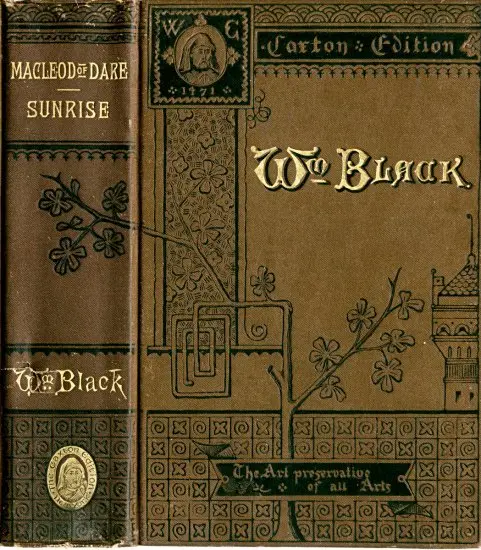
"Macleod of Dare" by William Black is a novel written in the late 19th century. The story centralizes around Sir Keith Macleod, the last surviving son of Lady Macleod, as he prepares to leave his home at Castle Dare for London. The narrative explores themes of family, duty, and the contrast between the wildness of the Scottish Highlands and the sophistication of urban society. The opening of the novel introduces us to Castle Dare, illuminating the emotional weight that Lady Macleod carries as she bids farewell to her only remaining son, Keith. Surrounded by memories of her other sons who have fallen in battle, she is proud yet sorrowful as Keith embraces his youthful spirit, ready for adventure. The poignant moment is heightened by their cousin Janet's efforts to maintain a sense of cheerfulness despite the family's grief. As the scene progresses, Keith’s spirited nature becomes evident through his dialogue and interactions with the people around him, including the piper and his dear cousin Janet, who worry about his departure. The contrasting emotions set the stage for his journey away from the familiar rugged beauty of Mull into the bustling life of London, suggesting the intertwining of their fates as they navigate matters of heart and heritage.
Introduction adapted from the source catalogue; source summaries may be automatically generated.
Free to read · English · 165,752 words · No account needed
MAKE TIME FOR A GOOD BOOK
On by default. Untick to stop anonymous reading totals. Each page counts after 10 seconds in view. How this works.
Anonymous counting is on unless you have switched it off.
"That is a lie, Colin!" said Hamish, with decision, "We have better Gaelic there than any other Gaelic that is spoken."
"Were you ever in Lochaber, Hamish?"
"No, I was never in Lochaber."
"Then do not pretend to give an opinion about the Gaelic--especially to a man who has travelled all over the world, though perhaps he cannot sail a yacht as well as you, Hamish."
The two cousins soon became friends again, however. And now, as they were approaching London, a strange thing became visible. The blue sky grew more and more obscured. The whole world seemed to be enveloped in a clear brown haze of smoke.
"Ay, ay," said Hamish, "that is a strange thing."
"What is a strange thing, Hamish?"
"I was reading about it in a book many a time--the great fire that was burning in London for years and years and years, and have they not quite got it out yet, Colin?"
"I do not know what you are talking about, Hamish," said the other, who had not much book-learning, "but I will tell you this, that you may prepare yourself now to open your eyes. Oh yes, London will make you open your eyes wide; though it is nothing to one who has been to Rio, and Shanghai, and Rotterdam, and other places like that."
Now these references to foreign parts only stung Hamish's pride, and when they did arrive at London Bridge he was determined to show no surprise whatever. He stepped into the four-wheeled cab that Colin Laing chartered, just as if four-wheeled cabs were as common as sea-gulls on the shores of Loch-na-Keal. And though his eyes were bewildered and his ears dinned with the wonderful sights and sounds of this great roaring city--that seemed to have the population of all the world pouring through its streets--he would say nothing at all. At last the cab stopped; the two men were opposite the Piccadilly Theatre.
Then Hamish got out and left his cousin with the cab, He ascended the wide steps; he entered the great vestibule; and he had a letter in his hand. The old man had not trembled so much since he was a schoolboy.
"What do you want, my man?" some one said, coming out of the box-office by chance. Hamish showed the letter.
"I wass to hef an answer, sir if you please, sir, and I will be opliged," said Hamish, who had been enjoined to be very courteous.
"Take it round to the stage entrance," said the man, carelessly.
"Yes, sir, if you please, sir," said Hamish; but he did not understand;
and he stood.
Your reading position is saved on this browser. Take it to another device with a library code. Reading pages adapt to text, rather than matching a printed edition.
William Black
William Black
William Black

William Black
BEHIND THE BOOK
This eBook is for the use of anyone anywhere in the United States and most other parts of the world at no cost and with almost no restrictions whatsoever. You may copy it, give it away or re-use it under the terms of the Project Gutenberg License included with this eBook or online at www.gutenberg.org. If you are not located in the United States, you will have to check the laws of the country where you are located before using this eBook. Read the source licence.
The original source file, including credits and licence, is retained by this library. Request an original-format copy at no charge. Please include the book title and Project Gutenberg identifier #15587.
KEEP YOUR CURIOSITY GOING
Coulson Kernahan

Maurice Baring
Frances Wright
Cécile Tormay

Frederic Jesup Stimson

W. H. P. (William Henry Pope) Jarvis