THE CLASSIC COLLECTION✦Goldsmith English Men of Letters SeriesCLASSIC FREE BOOKS
Goldsmith English Men of Letters Series
William Black
THE CLASSIC COLLECTION · 1879
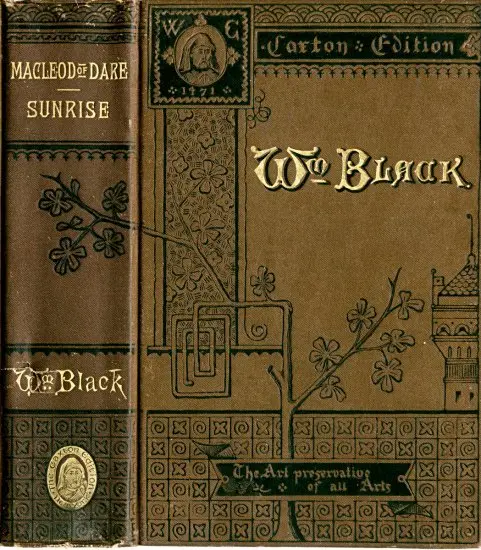
"Macleod of Dare" by William Black is a novel written in the late 19th century. The story centralizes around Sir Keith Macleod, the last surviving son of Lady Macleod, as he prepares to leave his home at Castle Dare for London. The narrative explores themes of family, duty, and the contrast between the wildness of the Scottish Highlands and the sophistication of urban society. The opening of the novel introduces us to Castle Dare, illuminating the emotional weight that Lady Macleod carries as she bids farewell to her only remaining son, Keith. Surrounded by memories of her other sons who have fallen in battle, she is proud yet sorrowful as Keith embraces his youthful spirit, ready for adventure. The poignant moment is heightened by their cousin Janet's efforts to maintain a sense of cheerfulness despite the family's grief. As the scene progresses, Keith’s spirited nature becomes evident through his dialogue and interactions with the people around him, including the piper and his dear cousin Janet, who worry about his departure. The contrasting emotions set the stage for his journey away from the familiar rugged beauty of Mull into the bustling life of London, suggesting the intertwining of their fates as they navigate matters of heart and heritage.
Introduction adapted from the source catalogue; source summaries may be automatically generated.
Free to read · English · 165,752 words · No account needed
MAKE TIME FOR A GOOD BOOK
On by default. Untick to stop anonymous reading totals. Each page counts after 10 seconds in view. How this works.
Anonymous counting is on unless you have switched it off.
"'Be true to yourself,' people say to you. But surely every one who is conscious of failings, and deceitfulness, and unworthy instincts, would rather try to be a little better than himself? Where else would there be any improvement, in an individual or in society? You have to fight against yourself, instead of blindly yielding to your wish of the moment. I know I, for one, should not like to trust myself. I wish to be better than I am--to be other than I am--and I naturally look around for help and guidance. Then, you find people recommending you absolutely diverse ways of life, and with all show of authority and reason, too; and in such an important matter ought not one to consider before making a final choice?"
Miss White's studies in mental and moral science, as will readily be perceived, had not been of a profound character. But he did not stay to detect the obvious fallacy of her argument. It was all a maze of words to him. The drowning man does not hear questions addressed to him. He only knows that the waters are closing over him, and there is no arm stretched out to save.
"I do not know myself for two minutes together," she wrote. "What is my present mood, for example? Why, one of absolute and ungovernable hatred--hatred of the woman who would take my place if I were to retire from the stage. I have been thinking of it all the morning--picturing myself as an unknown nonentity, vanished from the eyes of the public, in a social grave. And I have to listen to people praising the new actress; and I have to read columns about her in the papers; and I am unable to say, 'Why, all that and more was written and said about me!' What has an actress to show for herself if once she leaves the stage? People forget her the next day; no record is kept of her triumphs. A painter, now, who spends years of his life in earnest study--it does not matter to him whether the public applaud or not, whether they forget or not. He has always before him these evidences of his genius; and among his friends he can choose his fit audience. Even when he is an old man, and listening to the praise of all the young fellows who have caught the taste of the public, he can, at all events, show something of his work as testimony of what he was. But an actress, the moment she leaves the stage, is a snuffed-out candle. She has her stage-dresses to prove that she acted certain parts; and she may have a scrap-book with cuttings of criticisms from the provincial papers! You know, dear Keith, all this is very heart-sickening; and I am quite aware that it will trouble you, as it troubles me, and sometimes makes me ashamed of myself; but then it is true, and it is better for both of us that it should be known. I could not undertake to be a hypocrite all my life. I must confess to you, whatever be the consequences, that I distinctly made a mistake when I thought it was such an easy thing to adopt a whole new set of opinions and tastes and habits. The old Adam, as your Scotch ministers would say, keeps coming back, to jog my elbow as an old familiar friend. And you would not have me conceal the fact from you? I know how difficult it will be for you to understand or sympathize with me. You have never been brought up to a profession, every inch of your progress in which you have to contest against rivals; and you don't know how jealous one is of one's position when it is gained. I think I would rather be made an old woman or sixty to-morrow morning, than get up and go out and find my name printed in small letters in the theatre-bills. And if I try to imagine what my feelings would be if I were to retire from the stage, surely that is in your interest as well as mine. How would you like to be tied for life to a person who was continually looking back to her past career with regret, and who was continually looking around her for objects of jealous and envious anger? Really, I try to do my duty by everybody. All the time I was at Castle Dare I tried to picture myself living there, and taking an interest in the fishing, and the farms, and so on; and if I was haunted by the dread that, instead of thinking about the fishing and the farms, I should be thinking of the triumphs of the actress who had taken my place in the attention of the public, I had to recognize the fact. It is wretched and pitiable, no doubt; but look at my training. If you tell me to be true to myself--that is myself. And at all events I feel more contented that I have made a frank-confession."
Your reading position is saved on this browser. Take it to another device with a library code. Reading pages adapt to text, rather than matching a printed edition.
William Black
William Black
William Black

William Black
BEHIND THE BOOK
This eBook is for the use of anyone anywhere in the United States and most other parts of the world at no cost and with almost no restrictions whatsoever. You may copy it, give it away or re-use it under the terms of the Project Gutenberg License included with this eBook or online at www.gutenberg.org. If you are not located in the United States, you will have to check the laws of the country where you are located before using this eBook. Read the source licence.
The original source file, including credits and licence, is retained by this library. Request an original-format copy at no charge. Please include the book title and Project Gutenberg identifier #15587.
KEEP YOUR CURIOSITY GOING
Coulson Kernahan

Maurice Baring
Frances Wright
Cécile Tormay

Frederic Jesup Stimson

W. H. P. (William Henry Pope) Jarvis