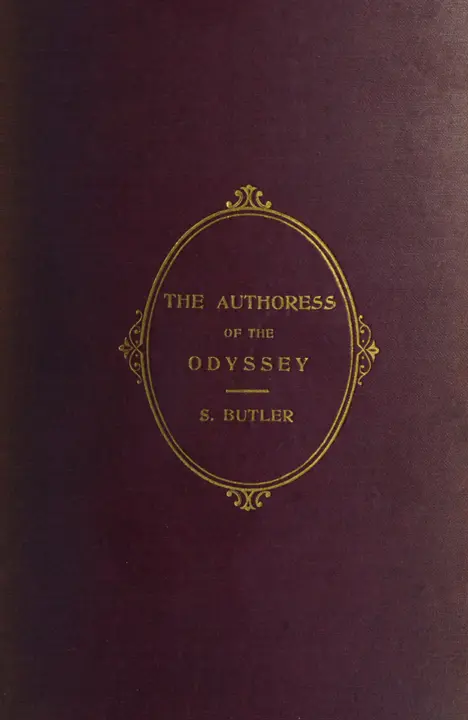
The Authoress of the Odyssey Where and when she wrote, who she was, the use she made of the Iliad, and how the poem grew under her hands
Samuel Butler
THE CLASSIC COLLECTION · 1887
"Luck, or Cunning, as the Main Means of Organic Modification" by Samuel Butler is a scientific publication written in the late 19th century. The book explores the complex relationship between heredity and memory while seeking to reintegrate the concept of design into the evolutionary narrative, challenging the dominant Darwinian view of natural selection. The beginning of the text establishes Butler's intent to delve into the nuances of organic development, arguing for the significant overlap between heredity and memory. Following an introduction that highlights his shift from an initial focus on the division of life forms to a deeper examination of Darwin's theories, Butler reflects on his interactions with influential contemporaries such as Alfred Tylor and Herbert Spencer. He articulates that understanding the intricacies of descent requires acknowledging design's role in evolution while arguing that instinct should be perceived as inherited memory—a concept he aims to substantiate throughout the work.
Introduction adapted from the source catalogue; source summaries may be automatically generated.
Free to read · English · 84,207 words · No account needed
MAKE TIME FOR A GOOD BOOK
On by default. Untick to stop anonymous reading totals. Each page counts after 10 seconds in view. How this works.
Anonymous counting is on unless you have switched it off.
{73a} Quoted by M. Vianna De Lima in his “Exposé Sommaire des Théories Transformistes de Lamarck, Darwin, et Hæckel.” Paris, 1886, p. 23.
{81a} “Origin of Species,” ed. i., p. 6; see also p. 43.
{83a} “I think it can be shown that there is such a power at work in ‘Natural Selection’ (the title of my book).”—“Proceedings of the Linnean Society for 1858,” vol. iii., p. 51.
{86a} “On Naval Timber and Arboriculture,” 1831, pp. 384, 385. See also “Evolution Old and New,” pp. 320, 321.
{87a} “Origin of Species,” p. 49, ed. vi.
{92a} “Origin of Species,” ed. i., pp. 188, 189.
{93a} Page 9.
{94a} Page 226.
{96a} “Journal of the Proceedings of the Linnean Society.” Williams and Norgate, 1858, p. 61.
{102a} “Zoonomia,” vol. i., p. 505.
{104a} See “Evolution Old and New.” p. 122.
{105a} “Phil. Zool.,” i., p. 80.
{105b} Ibid., i. 82.
{105c} Ibid. vol. i., p. 237.
{107a} See concluding chapter.
{122a} Report, 9, 26.
{135a} Ps. cii. 25–27, Bible version.
{136a} Ps. cxxxix., Prayer-book version.
{140a} Contemporary Review, August, 1885, p. 84.
{142a} London, David Bogue, 1881, p. 60.
{144a} August 12, 1886.
{150a} Paris, Delagrave, 1886.
{150b} Page 60.
{150c} “Œuvre complètes,” tom. ix. p. 422. Paris, Garnier frères, 1875.
{150d} “Hist. Nat.,” tom. i., p. 13, 1749, quoted “Evol. Old and New,”
p. 108.
{156a} “Origin of Species,” ed. vi., p. 107.
{156b} Ibid., ed. vi., p. 166.
{157a} “Origin of Species,” ed. vi., p. 233.
{157b} Ibid.
{157c} Ibid., ed. vi., p. 109.
{157d} Ibid., ed. vi., p. 401.
{158a} “Origin of Species,” ed. i., p. 490.
{161a} “Origin of Species,” ed. vi., 1876, p. 171.
{163a} “Charles Darwin,” p. 113.
{164a} “Animals and Plants under Domestication,” vol. ii., p. 367, ed.
1875.
{168a} Page 3.
{168b} Page 4.
{169a} It should be remembered this was the year in which the “Vestiges of Creation” appeared.
{173a} “Charles Darwin,” p. 67.
{173b} H. S. King & Co., 1876.
{174a} Page 17.
{195a} “Phil. Zool.,” tom. i., pp. 34, 35.
{202a} “Origin of Species,” p. 381, ed. i.
{203a} Page 454, ed. i.
{205a} “Principles of Geology,” vol. ii., chap. xxxiv., ed. 1872.
{206a} “Natürliche Schöpfungsgeschichte,” p. 3. Berlin, 1868.
{209a} See “Evolution Old and New,” pp. 8, 9.
{216a} “Vestiges,” &c., ed. 1860; Proofs, Illustrations, &c., p. xiv.
{216b} Examiner, May 17, 1879, review of “Evolution Old and New.”
{218a} Given in part in “Evolution Old and New.”
{219a} “Mind,” p. 498, Oct., 1883.
{224a} “Degeneration,” 1880, p. 10.
{227a} E.g. the Rev. George Henslow, in “Modern Thought,” vol. ii., No.
5, 1881.
{232a} “Nature,” Aug. 6, 1886.
{234a} See Mr. Darwin’s “Animals and Plants under Domestication,” vol. i., p. 466, &c., ed. 1875.
{235a} Paris, 1873, Introd., p. vi.
{235b} “Hist. Nat. Gen.,” ii. 404, 1859.
{239a} As these pages are on the point of going to press, I see that the writer of an article on Liszt in the “Athenæum” makes the same emendation on Shakespeare’s words that I have done.
{240a} “Voyages of the Adventure and Beagle,” vol. iii., p. 373.
London, 1839.
Your reading position is saved on this browser. Take it to another device with a library code. Reading pages adapt to text, rather than matching a printed edition.
Samuel Butler
Samuel Butler
Samuel Butler
Samuel Butler
BEHIND THE BOOK
This eBook is for the use of anyone anywhere in the United States and most other parts of the world at no cost and with almost no restrictions whatsoever. You may copy it, give it away or re-use it under the terms of the Project Gutenberg License included with this eBook or online at www.gutenberg.org. If you are not located in the United States, you will have to check the laws of the country where you are located before using this eBook. Read the source licence.
The original source file, including credits and licence, is retained by this library. Request an original-format copy at no charge. Please include the book title and Project Gutenberg identifier #4967.
KEEP YOUR CURIOSITY GOING

David Patterson (Spirit) Hatch
Coulson Kernahan

Ralph Waldo Emerson
Frances Wright

Edwin Abbott Abbott

Joseph Droz